Home renovation budget: how to set one, step by step
A home renovation budget is a spending limit, a scope and a list of every cost, with a contingency on top. Eight steps to set one, the lines people miss, and how to keep it honest once work starts.
Set the spending limit first, then fit the scope to it, not the other way round.
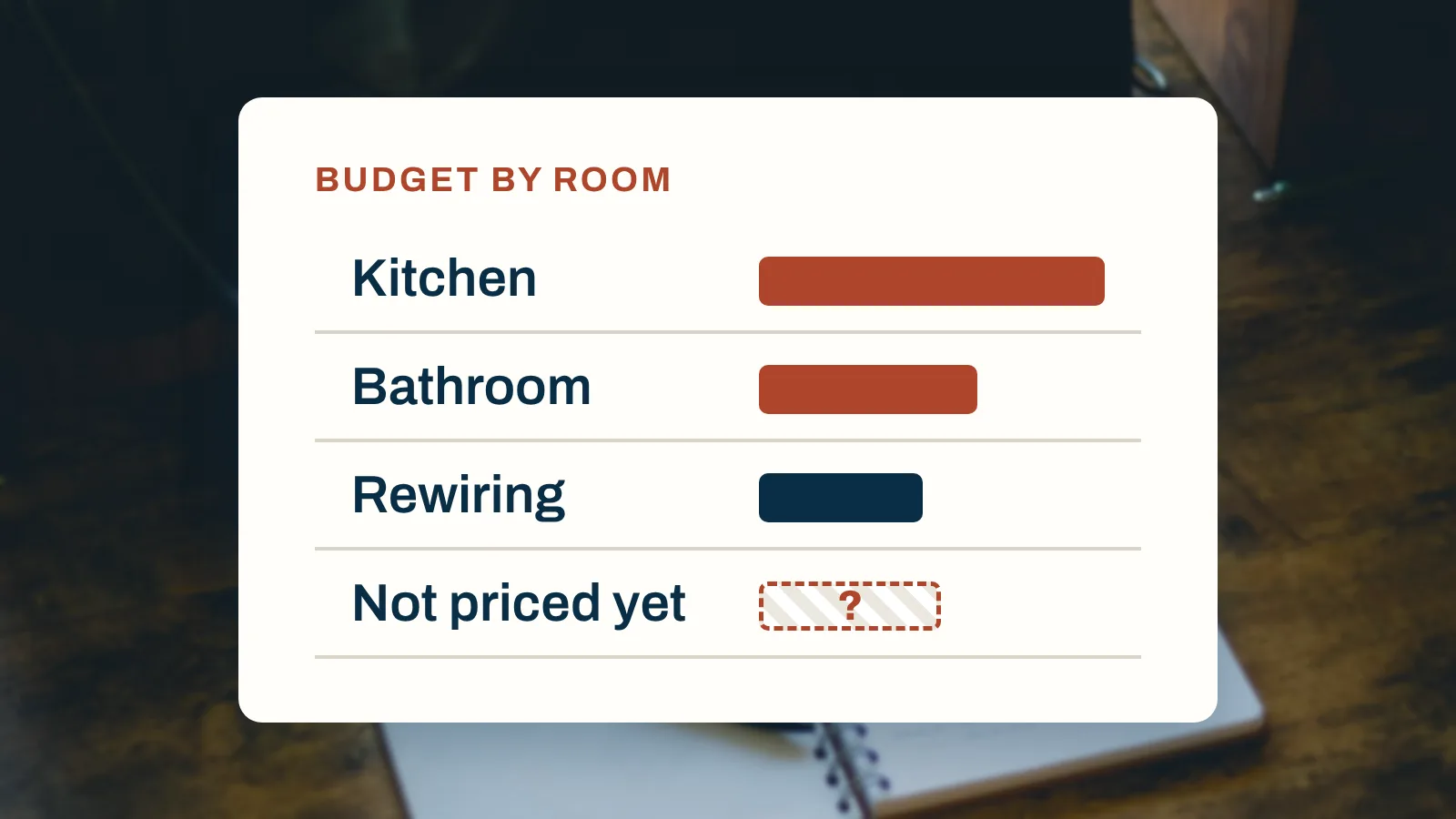
Price the work room by room and line by line, with labour, materials, permissions and fees, professional fees and living costs as separate lines.
Citizens Advice suggests getting written quotes from at least 3 traders, each with a fixed total price, a breakdown, VAT and how long the price is valid.
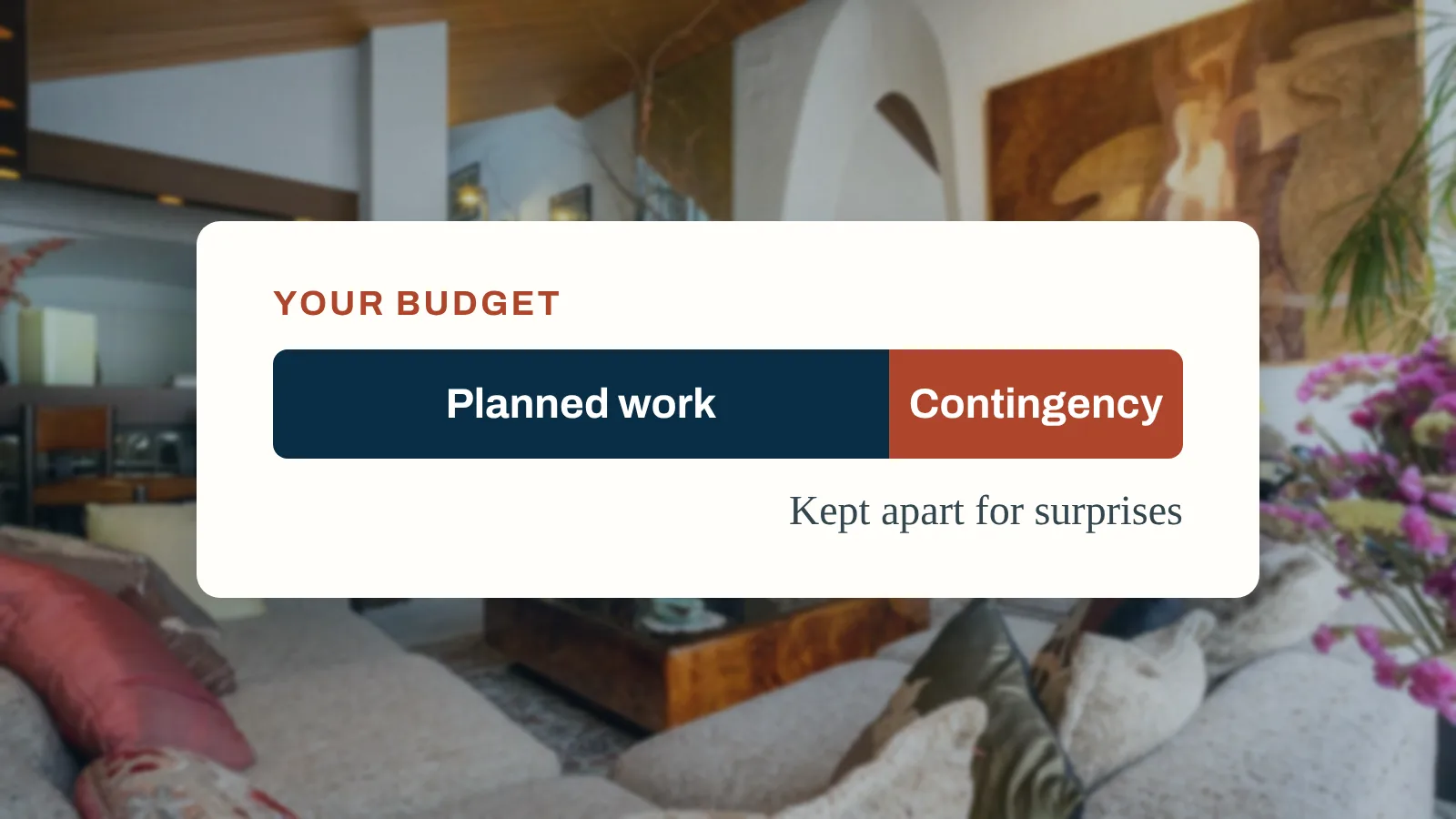
Hold a contingency sized to the risk: Mekozo's founder, Jonathan Smith, sets 10 to 15% as a backup fund on his villa renovation, and would hold back 20 to 25% on an abandoned property.
Track every line as estimate, quote, agreed price, final cost and paid, so the total never surprises you.
How do you set a home renovation budget?
Set a home renovation budget in eight steps: decide your spending limit, write the scope room by room, list every cost line, price each line from published figures, replace them with written quotes, add professional fees, permissions and living costs, hold a contingency, then compare the total with your limit and adjust the scope before work starts.
A budget is not one number. It is a limit, a scope and a list of lines, each with a figure and a status. This guide takes you through the steps, the lines people miss, and how to keep the budget honest once the builders arrive. It explains a budgeting method; it does not cover borrowing or tax.
The eight steps at a glance
Step
What you do
What you end up with
1. Set the limit
Decide the most you can spend
A ceiling for the whole project
2. Write the scope
Room by room, what changes
A scope of works
3. List every line
Labour, materials, fees, living costs
A complete cost list
4. Price from published figures
Named, dated sources
A first estimate
5. Get written quotes
Same scope to every trader
Real prices
6. Build the working budget
Status for every line, contingency
A budget you can track
7. Check it against the limit
Cut, phase or confirm
A budget that fits
8. Track it as work happens
Agreed price, final cost, paid
No surprises
Step 1: set your spending limit first
Start with the most you can spend on the whole project, including the contingency, from money you know you will have when each payment falls due. Then fit the scope to that figure. Working the other way, from a wish list to a total, is how budgets drift.
The total available for the project
When the money is available, if it arrives in stages
What you will not touch, so the limit is a real limit
Who else needs to agree the figure, such as a partner
Tip
Write the limit at the top of the budget and keep it there. Every decision later is easier when the ceiling is visible.
Step 2: write the scope room by room
List each room and area, and what will change in it. Put must-haves first and upgrades on a separate list. Jonathan, who films his villa renovation on Operation Sicily, puts structural repairs, plumbing and electrics first, and premium finishes and decorative upgrades on a separate list (Episode 14).
Give every cost its own line. A cost without a line is a cost that gets forgotten.
Line
What it covers
Often missed
Labour
Every trade, room by room
Return visits, making good
Materials
Everything the trades fit
Delivery, waste, accessories
Professional fees
Architect, engineer, surveyor, designer
Revisions and site visits
Permissions and fees
Planning, building control, party wall
Inspection fees after the work
Site costs
Scaffolding, skips, toilet, protection
Hire running longer than planned
Services
New connections, meter moves
Lead times from suppliers
Fixtures and appliances
Kitchen, bathroom, lighting
Installation and removal of old
Finishes
Flooring, tiling, decorating
Preparation and levelling
Living costs
Rent, storage, eating out, travel
Weeks longer than planned
VAT
Shown on every quote
Quotes that leave it out
Changes
Anything added after quotes
Every "while you are at it"
Contingency
The unknowns
Being used for upgrades
In the UK (England)
Citizens Advice says you usually need planning permission from your local council for something new, a major change such as an extension, or a change of use, and that you usually pay a fee when you apply. Building control bodies also usually charge a fee when you apply, and you might pay another when they inspect the work. GOV.UK explains when you need planning permission and when you need building regulations approval. Scotland, Wales and Northern Ireland have their own rules.
Step 4: price each line from published figures
Before you have quotes, use named, dated sources for a first figure, and mark it as an estimate. Our cost guides give published figures for common jobs:
Kitchen renovation budget: for example, Which? says labour makes up roughly 20% to 30% of the final cost of a kitchen if you do none of the installation yourself (BCIS data, April 2026).
Jonathan's own 2026 renovation cost breakdown gives typical ranges for western Sicily, from €25,000 to €45,000 for a light renovation of a property in reasonable structural condition to €60,000 to €120,000 or more for a full structural renovation of one in poor condition, with line items for roofs, rewiring, plumbing and finishes.
Step 5: replace estimates with written quotes
Send the same written scope to every trader. Citizens Advice suggests trying to get written quotes from at least 3 different traders, and says a quote should include:
A fixed total price, not a daily rate
A breakdown of all the work and materials
Separate costs for each material and part of the work
How long the price is valid for
Whether the price includes VAT
When the price can go up, for example only if you agree to extra work
Citizens Advice also explains that a quote is a fixed price while an estimate is a rough guess, so you might end up paying more on an estimate. Our guide to comparing builders' quotes on the same scope shows how to line them up.
Watch out
Citizens Advice warns to be cautious if one price is a lot lower than the others. It could mean the trader is not quoting for exactly the same work.
Step 6: turn it into a working budget
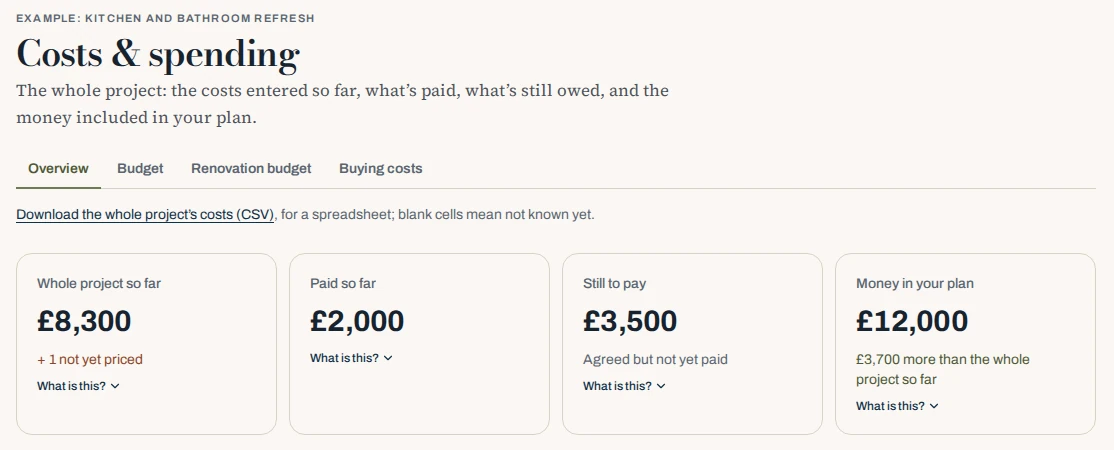
Mekozo's Costs & spending view shows the whole project so far, what is paid, what is agreed but still to pay, any line not yet priced, and how it compares with the money in your plan.
Final cost. What the line actually came to once the work is done. An invoice is the bill for agreed work; record it, then the payment against it.
Paid. Money that has gone.
Still to pay. The final cost, or the agreed price until that is known, less what you have paid.
Then add the contingency as its own line. Size it to the risk, not to a habit. Jonathan sets a backup fund of 10 to 15% on top of labour, materials, permits and fees, and says that on an abandoned property he would hold back 20 to 25% of the build cost. For roof work, the Federation of Master Builders suggests around 10% to 15% when the old covering is stripped and hidden defects may appear (FMB, September 2026). Our guide to how much renovation contingency to allow shows how to set yours from your own list of risks.
Step 7: check the total against your limit
Add up every line plus the contingency and compare it with your limit from step 1.
Under the limit: keep the difference unallocated. It is not spare money until the work is finished.
Over the limit: move upgrades off the list, phase work into a later year, or change the specification. Do not shrink the contingency to make the sum work.
Close to the limit: check that every line has a figure. A line marked unknown is not zero.
Record every order, invoice and payment the day it happens
Put every change on a separate list with its own price, agreed in writing before it is done
Pay in stages tied to finished work; Citizens Advice suggests paying in stages, avoiding deposits where you can, and not agreeing to more than 25% if a deposit cannot be avoided
Review agreed, paid and still to pay totals against the budget every week
Draw on the contingency only for genuine unknowns, and note why
Price and agree each variation or extra (change order) in writing before the work goes ahead, as our guide to variations and extras explains.
On the Operation Sicily villa
From the villa in Sicily. Before the work started at Jonathan's villa, bought for €21,500, he set out nine steps for budgeting a renovation: a structural survey first, must-haves before upgrades, labour, materials and permits and fees as separate lines, a backup fund of 10 to 15%, three to five quotes, timing, doing the preparation himself, negotiating, knowing which jobs to leave to professionals, and monitoring spending regularly so overspending shows early (Episode 14). The unknowns came anyway: undocumented drainage, electrical back boxes plastered over and forgotten, and roof sections that looked sound but were not, all needed unplanned spending, which is why he would now hold back 20 to 25% on an abandoned property. One test on the old cesspit decided whether a replacement costing upwards of €12,000 was needed; it passed (Episode 57). He keeps lines like these visible until they are settled, rather than hiding them inside one total.
This guide explains a budgeting method. It is not financial or tax advice; figures are published examples from the named sources, not quotes for your project.
Questions people ask
How do I set a budget for a home renovation?
Decide the most you can spend, write the scope room by room, list every cost line including fees, permissions and living costs, price each line from published figures and then written quotes, add a contingency, and compare the total with your limit. If it is over, cut or phase the scope rather than squeezing the contingency.
Where does the contingency go in a renovation budget?
On its own line, outside every job, so you can see what is left after each new commitment. Size it to the risk: Jonathan Smith of Operation Sicily sets a backup fund of 10 to 15% on top of labour, materials, permits and fees. Our guide to renovation contingency shows how to size yours from a list of risks.
What costs do people forget in a renovation budget?
The usual gaps are professional fees, planning and building control fees, scaffolding and skips, making good after the trades, moving services, temporary living costs, storage, and changes made after work starts. Give each its own line so it cannot be absorbed into the total.
How many quotes should I get for a renovation?
Citizens Advice suggests trying to get written quotes from at least 3 different traders before you decide. Jonathan Smith of Operation Sicily gets three to five quotes and prioritises quality and reliability over the cheapest price. Give every trader the same written scope so the quotes are comparable.
How do I stop a renovation going over budget?
Fix the scope and specification before quotes, keep changes on a separate list with their own prices, pay in stages tied to finished work, and record every order and payment as it happens. Review the budget against what has been agreed and paid at least weekly while work is on site.
Jonathan Smith is the founder of Mekozo and Operation Sicily. Jonathan bought an abandoned villa in Sicily and is rebuilding it on camera, every week. Mekozo is the app Jonathan built to keep that renovation's money in one picture.
There is no honest single figure for renovating a house. Here is how to build your own estimate from the size, the depth of work and the finish, using named, dated figures for each job.
A kitchen budget is far more than the units. Here is every line to allow for, the published UK figures behind them, and how to keep the budget honest once work starts.