
Planning a renovation
Scope of works: what to include, with an example
What a scope of works should include, what each section should say, and a worked example that builders can price like for like.


What a good builder's quote includes, what to ask every builder to send back, and how to compare quotes like for like rather than by the total.

A good builder's quote is a fixed price for a clearly described job. It splits work and materials into separate costs, says what is excluded, whether VAT is included, how long the price is valid and the payment stages. To compare quotes fairly, send every builder the same numbered scope, then compare item by item, not by the total.
The cheapest headline figure is often the one with the most unanswered questions. This guide shows what to ask every builder to send back, a checklist for what comes back, and a step by step comparison method.
The words matter. According to Citizens Advice's guidance before you get work done on your home, a quote is a fixed price, while an estimate is just a rough guess, so you might end up paying more.
Under a quote, Citizens Advice says the trader cannot charge you more than the quoted price unless:
Citizens Advice also notes that once you say yes to a quote, it is a binding agreement, whether it is written down or not, and recommends getting it in writing so you can prove what was agreed.
In the UK
The rules above are from Citizens Advice's guidance for England, with separate pages for Scotland, Wales and Northern Ireland. Consumer rights differ in other countries, so check the official consumer body where the work is being done.
Citizens Advice lists what a quote should contain: a fixed total price (not a daily rate), a breakdown of all the work and materials, separate costs for each material and part of the work, how long the price is valid for, whether it includes VAT, and when the price can go up. To make quotes truly comparable, add the rest of this checklist.
The price
The work
The terms
The paperwork at the end
Watch out
A daily rate is not a quote. If you are offered one, Citizens Advice suggests getting in writing how many days the work will take, how many hours count as a day and when the trader needs your go-ahead to work more days.
Ask every builder to price your scope of works in the same layout, so each one returns the same information. If you do not have a written scope yet, start with our guide to writing a scope of works.
| Scope item no. | Description | Labour | Materials | Item total | Included? Notes |
|---|---|---|---|---|---|
| 4.1 | |||||
| 4.2 | |||||
| 4.3 | |||||
| Provisional sums | |||||
| Exclusions | |||||
| Total (excluding VAT) | |||||
| VAT | |||||
| Total (including VAT) |
Then ask each builder to answer these in writing:
At least three written quotes, on the same scope, is the usual advice: RICS's guide to home extensions and improvements recommends at least three detailed quotes. Citizens Advice notes that some contractors charge for quotes, so ask about this first. Our guide to how to find a good builder covers who to ask and the checks to make before you invite them.
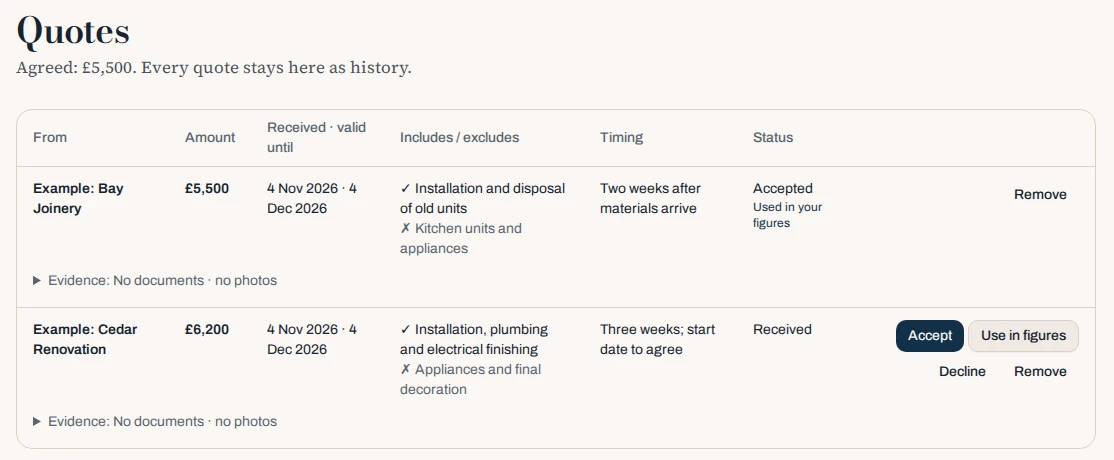
Mekozo lines builders' quotes up side by side, with what each includes and excludes and its timing, so you compare like for like and can see what each one leaves out.
Try it free for 30 days, no card neededHere is how a levelled comparison looks:
| Item | Builder A | Builder B | Builder C |
|---|---|---|---|
| 4.1 Strip out | £800 | £650 | £900 |
| 4.2 First fix | £2,400 | £2,100 | £2,600 |
| 4.3 Tiling | £1,900 | Excluded | £1,750 |
| Gap priced by you | +£1,800 (your estimate) | ||
| Waste removal | Included | £350 extra | Included |
| Adjusted total | £5,100 | £4,900 | £5,250 |
| Deposit asked | 10% | 30% | None |
| Start | 4 weeks | 2 weeks | 10 weeks |
Illustrative figures only.
Builder B's headline looked cheapest by far. Once the excluded tiling and the waste removal are added, the gap shrinks to a few hundred pounds, and the 30% deposit is above the 25% ceiling Citizens Advice suggests not exceeding. That is a very different decision from the one the totals suggested.
Tip
Keep a single list of questions per builder. When you ring them, you can work through it and note the answers against their quote, rather than relying on memory.
The quote is also where you set the rules for money. Citizens Advice suggests paying by card rather than cash, paying in stages, avoiding deposits where you can and, if one is unavoidable, not agreeing to more than 25%. RICS suggests agreeing a method for making changes before work begins, and holding back 5% to be released on satisfactory completion.
In the UK
Citizens Advice notes that if you pay for work costing between £100.01 and £30,000 by credit card, you may be able to make a section 75 claim against the card provider if something goes wrong, including on a deposit paid by credit card.
Once a quote is agreed, tie each payment to a stage you can check, as our guide to how to pay a contractor explains, and price any variation or extra (change order) before it goes ahead, as our guide to variations and extras shows.
On the Operation Sicily villa
From the villa in Sicily. For the new windows and doors at his villa, Mekozo's founder, Jonathan Smith, contacted window companies across Italy, Poland and Germany. Along the way he changed a lot of details, from colours and glass to handles and opening directions, and he says price mattered but was not the deal-breaker, as he explains in Episode 88 of Operation Sicily, where he films the renovation. Each change to the specification is a reason to make sure every supplier is quoting for the same thing. For plastering, he went further and marked the scope on the building itself, spraying green crosses on every wall and ceiling to be skimmed so the plasterers could see exactly what to price (Episode 29). His real-world breakdown of renovation costs in Sicily has a section on comparing labour quotes for the complete job.
Playing loads YouTube’s external player.
Watch directly on YouTube ↗For the wider planning stage, see our guide to how to plan a renovation, from scope to quotes and budget, our guide to how much contingency to allow, the line-by-line kitchen renovation budget as an example of a fully broken-down price, and Mekozo's own guide to comparing quotes. When you have agreed a price, the renovation budget tracker shows how to keep it apart from what you have paid.
This guide explains a method for comparing quotes. It is not legal advice; for a dispute or a contract question, contact Citizens Advice or a qualified adviser.
Citizens Advice says a quote should include a fixed total price rather than a daily rate, a breakdown of the work and materials, separate costs for each part, how long the price is valid, whether it includes VAT and when the price can go up. Add exclusions, payment stages, start and finish dates and the certificates you will receive.
A quote is a fixed price for the work described; an estimate is a rough guess, so you might end up paying more. Under a quote, Citizens Advice says the trader cannot charge more unless you ask for extra work, agree to pay for extra work they tell you about, or there was a genuine mistake in the price.
At least three written quotes, Citizens Advice and RICS both suggest. More quotes only help if each one prices the same written scope.
Send every builder the same numbered scope, ask them to price against your item numbers, and line the quotes up item by item. List each quote's exclusions and assumptions, add a price for anything missing, and compare the adjusted totals along with payment terms, programme and insurance.
Not automatically. Citizens Advice warns that a price much lower than the others might mean the trader is not quoting for exactly the same work, and RICS advises against automatically accepting the cheapest quote. Compare what each price includes before comparing the numbers.
Some do, Citizens Advice notes, so ask before anyone visits. A free quote is still worth having in writing, priced against your scope.

Jonathan Smith is the founder of Mekozo and Operation Sicily. Jonathan bought an abandoned villa in Sicily and is rebuilding it on camera, every week. Mekozo is the app Jonathan built to keep that renovation's money in one picture.
Real renovation experience and regional guidance from Operation Sicily.
What a scope of works should include, what each section should say, and a worked example that builders can price like for like.

Where to find builders worth calling, how to check they are who they say they are, and the questions to ask before you hire, with what a good answer sounds like.
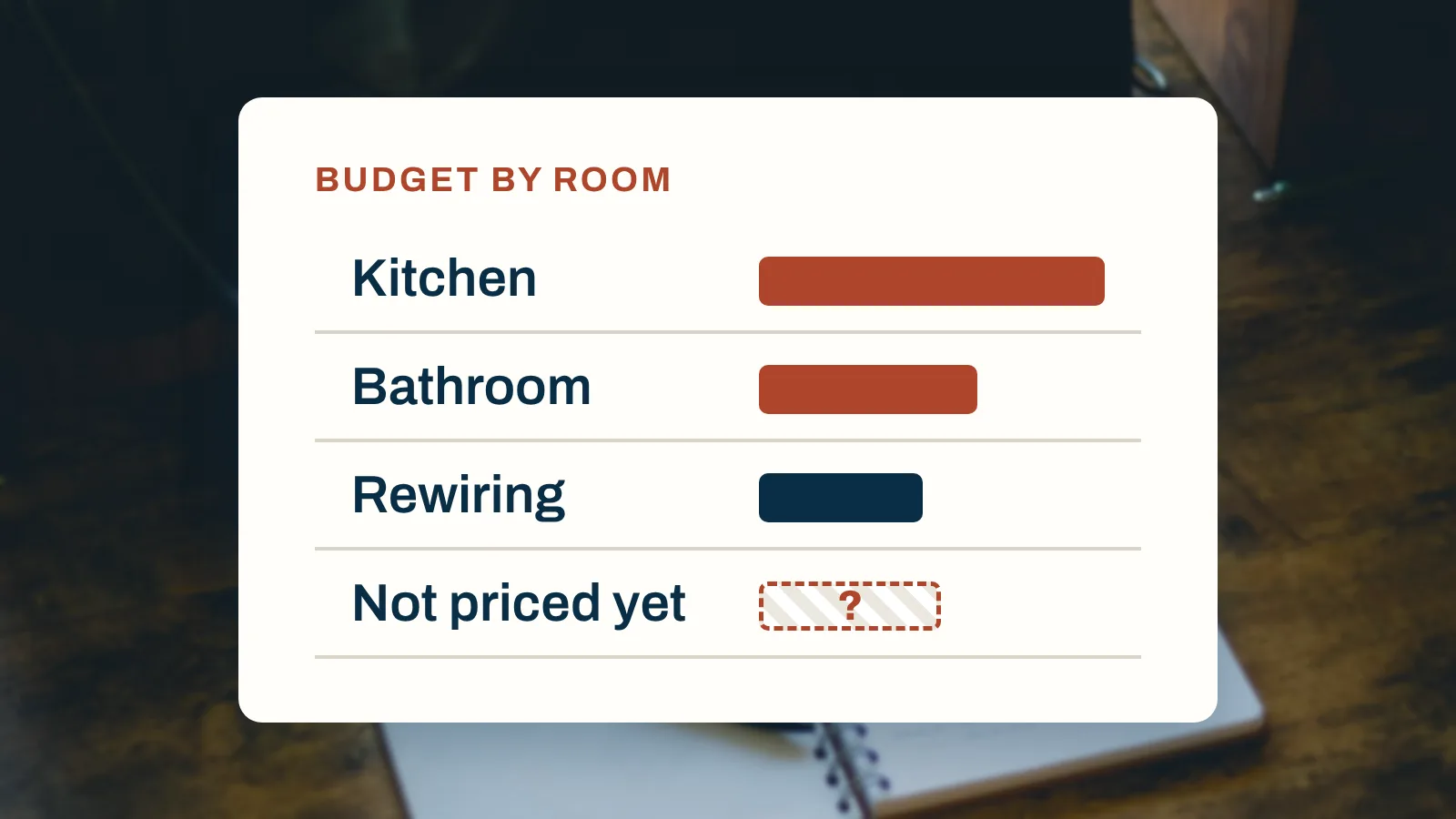
A home renovation budget is a spending limit, a scope and a list of every cost, with a contingency on top. Eight steps to set one, the lines people miss, and how to keep it honest once work starts.
Budgets, quotes, payments, documents and decisions in one place
30 days free. No card needed.
Monthly, with no annual plan. The Terms of membership set out the details.