How much does it cost to renovate a house? Estimate yours
There is no honest single figure for renovating a house. Here is how to build your own estimate from the size, the depth of work and the finish, using named, dated figures for each job.
The cost of renovating a house depends on three things: how big it is, how deep the work goes and the finish you choose.
Build an estimate job by job from named, dated figures, then add fees, living costs and a contingency, rather than trusting one headline number.
Published UK figures help with single jobs: Which? found 12-unit kitchens from about £1,500 to £9,000 (May 2025) and new boiler installations from about £1,400 to £7,000 (October 2026).
The older the house and the more you cannot see, the bigger the contingency should be: Mekozo's founder, Jonathan Smith, who films his villa renovation on Operation Sicily, holds back 20% to 25% on an abandoned property.
An estimate is your planning figure, a quote is a supplier's price and a budget is the total you commit to; keep them apart.
What it costs to renovate a house depends on three things: its size, how deep the work goes and the finish you choose. UK figures are published per job rather than per house: HomeOwners Alliance puts a single-storey extension at £1,800 to £3,000 per square metre (July 2026) and Which? a new boiler at around £1,400 to £7,000 (October 2026). Estimate yours by listing every job, pricing each one from a named, dated source or a quote, then adding fees, living costs during the work and a contingency.
This guide shows you the published UK figures that are useful for single jobs, what pushes renovation costs up, and a step by step method for turning your own house into an estimate you can test against quotes.
How much does it cost to renovate a house?
Two renovations of the same house can differ many times over in cost, which is why national averages mislead. The useful way to think about it is by depth of work:
Depth of renovation
Typically includes
What drives the cost
Cosmetic refresh
Decorating, flooring, new fittings, minor repairs
Area and finish
Partial renovation
One or two rooms, such as a kitchen or bathroom
The rooms chosen and the services moved
Full renovation
Every room, plus rewiring, plumbing and heating
Area, services and the state of what is hidden
Structural renovation
All of the above plus walls, roof, floors or foundations
Condition, design and professional input
Renovation and extension
All of the above plus new floor area
Size and type of the addition
Find the row that describes your house, then build the estimate line by line underneath it.
Published UK figures you can use for single jobs
Single-job figures from named sources are far more reliable than whole-house averages, because you can check what they include.
Job
Published figure
Source
Kitchen units (12 units, no worktops or appliances)
About £1,500 to £9,000, depending on retailer and range
A figure you cannot trace to a named source and a date is not a figure; it is a guess. Treat any "average renovation cost" without a source, a date and a description of what it includes with suspicion.
What makes renovation costs go up?
Age and condition. Old houses hide things: damp, failed lintels, old wiring, drains in unexpected places.
Structural work. Moving walls, new openings, roofs and floors need design, engineering and approvals as well as labour.
Services. Rewiring, replumbing and new heating touch every room and must happen before plastering and floors.
Moving things. Relocating a kitchen or bathroom moves pipes, waste, gas and circuits with it.
Specification. The same room costs very different amounts with standard or bespoke fittings.
Access and waste. Scaffolding, skips, narrow streets and upper floors all add cost.
Location. Labour and materials usually cost more in London and the South East.
Changing your mind. A change after ordering or after work starts costs more than the same decision made before. Price and agree each variation or extra (change order) in writing before the work goes ahead, as our guide to variations and extras explains.
Estimate, quote and budget: three different figures
Keeping these apart is what makes an estimate useful:
Estimate. Your own planning figure for a line, from a published source, past experience or a rough AI figure.
Quote. A written price for that line from a supplier or trade, for a defined scope.
Budget. The total you commit to: the agreed quotes, the remaining estimates and a contingency.
An estimate is meant to change. A budget should only change when the scope does.
How to estimate the cost of renovating your house
Step 1: find out what condition the house is in
Before you price anything, find out what the house needs. A survey or a structural assessment uncovers problems such as damp or failed structure before they become surprise costs. Jonathan's budgeting method for his villa starts here, in Episode 14. If you are still buying, our guide to the costs of buying a house lists everything to budget alongside the price.
Step 2: list every job, room by room and across the house
Go room by room, then add the jobs that cross rooms: roof, structure, rewiring, plumbing, heating, windows, damp and drainage. Our guide to writing a renovation scope shows how to describe each job so it can be priced, and our guide to the full house renovation shows how to plan it room by room.
Step 3: decide how far each job goes
For each line, write the depth: repair, replace like for like, or upgrade. "Kitchen: new units, same layout" prices very differently from "Kitchen: new layout, island, moved sink".
Step 4: price every line and mark how solid it is
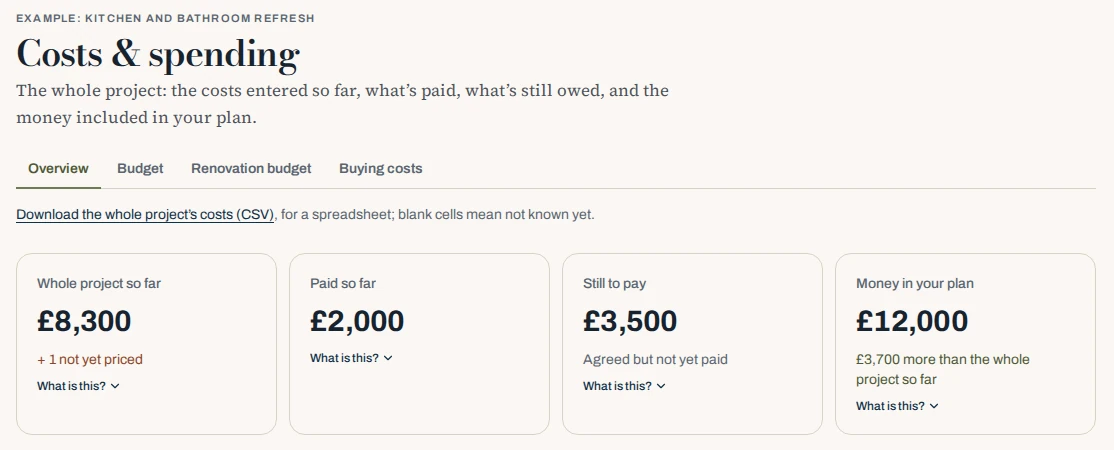
Mekozo's Costs & spending view adds every job to one total, shows what is paid and still to pay, and flags any line not yet priced; its AI can explain a figure or test a what-if as a rough planning figure.
A published figure with its source and date, for early estimates.
A quote from a supplier or trade, as soon as you have one.
"Unknown" where you have nothing yet, kept visible in the total so it does not look smaller than it is.
Step 5: add the costs that are not building work
Design, structural engineer, surveys and building control.
Planning applications or certificates if needed.
Skips, waste and scaffolding if not in the trades' prices.
Living costs during the work: rent, storage, eating out, travel.
VAT, if it is not already in each quote.
In the UK (England and Wales)
Many renovation jobs need building regulations approval. GOV.UK lists replacing fuse boxes and connected electrics, installing a bathroom that involves plumbing, replacing windows and doors, replacing roof coverings and installing or replacing a heating system among them. You do not need to get approval yourself if the work is done by someone registered with a competent person scheme, but budget for the approval or the registered installer either way. Scotland and Northern Ireland have their own building rules.
Outside the UK
Permits, professional roles and taxes differ by country. In Italy, for example, a geometra handles the technical and planning side of a renovation. Check the official authority where the property is and ask a qualified local professional.
Step 6: add a contingency from your own risks
Start from what is unknown: the roof you cannot see, the wiring behind the plaster, the drains under the floor. The more unknowns, the larger the contingency. Which? suggests around 10% to 15% for an extension and at least 10% for a loft conversion, more with structural work. Our guide to how much renovation contingency to allow shows how to size it from a list of risks.
Step 7: replace estimates with quotes
Ask for written quotes on the same scope from more than one trade for each major job, and compare them line by line. Our guide to comparing builders' quotes shows how. As each quote arrives, update the line, and watch the total move from estimate towards a budget you can commit to.
A worked renovation estimate
This shows the structure, not a recommended spend. Replace every figure with your own sources and quotes.
Line
Depth
Figure
Source or status
Survey and structural check
Before anything
Quote
Surveyor
Roof and structure
Repair or replace
Unknown until surveyed
Survey findings
Rewiring
Full or partial
Quote
Electrician
Plumbing and heating
Boiler, pipes, radiators
Estimate, then quote
Which? range, then heating engineer
Windows and doors
Replace or repair
Quote
Installer
Kitchen
Same layout or new
Estimate, then quote
Which? figures, then fitter
Bathroom
Suite, tiling, plumbing
Estimate, then quote
Which? figures, then trades
Plastering and making good
All rooms or some
Quote
Plasterer
Flooring and decorating
Room by room
Estimate
Your own pricing
Fees and approvals
Design, engineer, building control
Quote
Professionals
Living costs
Weeks times weekly cost
Estimate
Your own figures
Contingency
From your risks
Set aside
Risk list
On the Operation Sicily villa
From the villa in Sicily. Jonathan bought his villa for €21,500 after it had been abandoned for decades, and his real-world breakdown of renovation costs in Sicily is clear that the purchase price was the starting point, not the project budget. For an 80 to 120 square metre property in Sicily in 2026, it gives about €25,000 to €45,000 for a light renovation of a house in reasonable condition and €60,000 to €120,000 or more for a full structural renovation of one in poor condition, with a further €16,000 to €41,000 if off-grid water and solar are part of the plan. It puts labour at typically 40% to 60% of the total, and on an abandoned property recommends holding back 20% to 25% of the build cost. Unknowns are why: a single cesspit test decided whether the villa's could stay or cost upwards of €12,000 to replace. In Episode 14, Jonathan sets out his own budgeting steps: start with a structural survey, put structure, plumbing and electrics before finishes, split the budget into labour, materials, and permits and fees, then add a backup fund. Those are Sicilian figures for Sicilian houses; price your own from local sources.
This guide explains an estimating method. Figures are published prices and ranges, not quotes, and nothing here is financial or survey advice; get written prices for your own house.
Questions people ask
How much does it cost to renovate a house in the UK?
There is no reliable single figure, because a cosmetic refresh and a back-to-brick renovation of the same house can differ many times over. Estimate yours by listing each job, pricing it from a named, dated source or a quote, and adding fees, living costs and contingency. Published figures for single jobs, such as kitchens or boilers, are more useful than whole-house averages.
How do I estimate renovation costs?
Get the condition checked first, list every job room by room and across the house, decide how far each job goes, then price each line from a published figure or a quote. Add professional fees, approvals, living costs during the work and a contingency sized from your risks. Replace each estimate with a written quote as soon as you have one.
What is the most expensive part of renovating a house?
It depends on the house, but structural work, roofs, rewiring, heating, kitchens and anything that adds floor area are usually the largest lines. Jonathan Smith's own breakdown of a Sicilian renovation, on Operation Sicily, puts labour at typically 40% to 60% of total renovation costs, so the jobs that take the most trade time often cost the most.
Is it cheaper to renovate or to buy a house that is already done?
It depends on the price gap between the two houses, the real cost of the work and your time. Price the renovation properly, including contingency and living costs during the work, before comparing. A low purchase price does not guarantee a cheaper finished home.
Does a whole-house estimate need a bigger contingency than a single job?
Usually, because a whole house has more you cannot see: roofs, wiring, drains and floors. Which? suggests around 10% to 15% for an extension and at least 10% for a loft conversion, more with structural work. Size a whole-house figure from your own list of unknowns; our guide to renovation contingency shows how.
Can Mekozo tell me what my renovation will cost?
Mekozo's AI can give rough planning figures and explain a figure in your budget, but it can be wrong and it does not replace a builder's quote or a survey. Use it to test a what-if, then replace every estimate with a written quote.
Jonathan Smith is the founder of Mekozo and Operation Sicily. Jonathan bought an abandoned villa in Sicily and is rebuilding it on camera, every week. Mekozo is the app Jonathan built to keep that renovation's money in one picture.
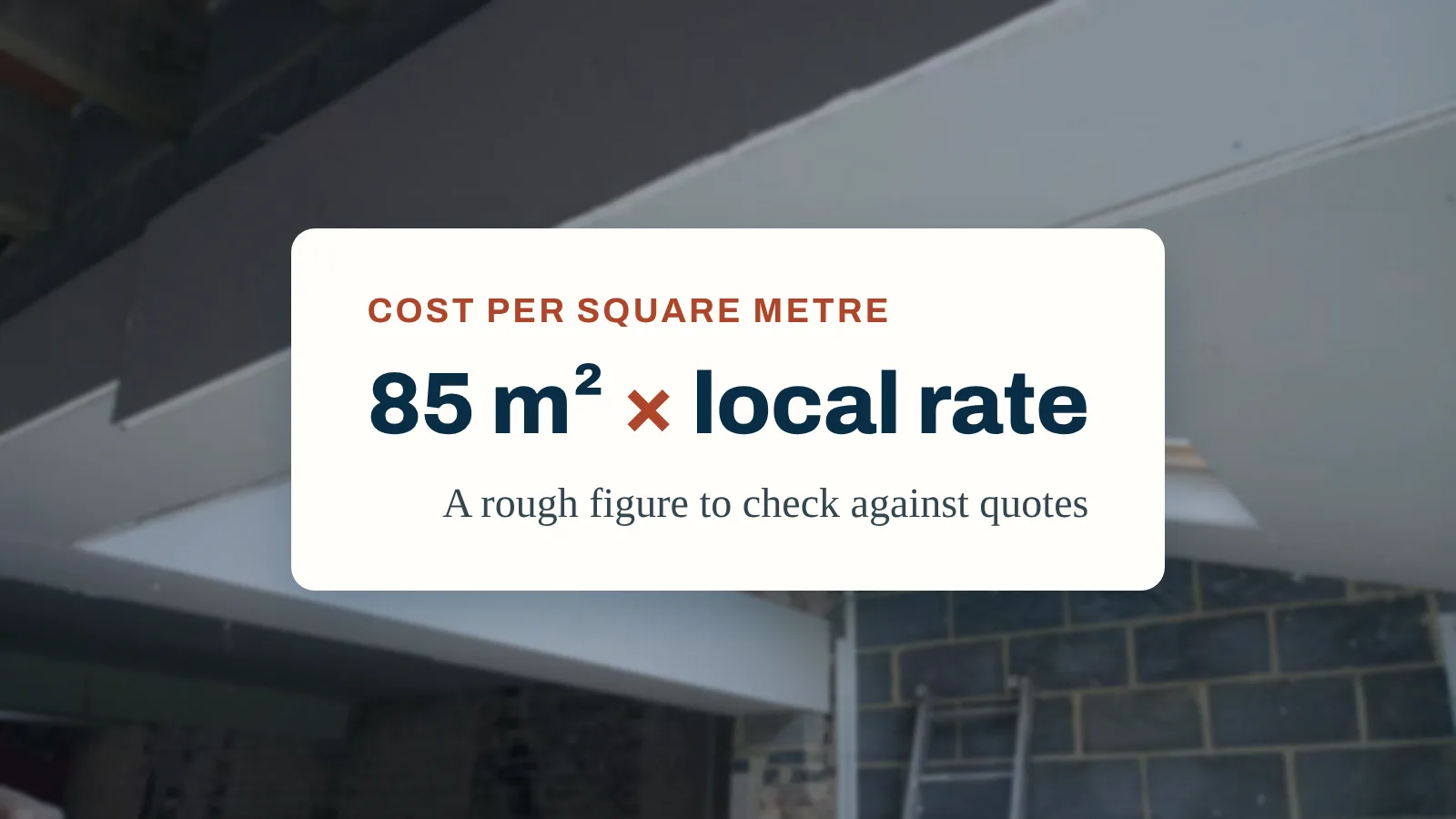
A cost per square metre is a quick first figure, not a budget. What published rates cover, how to measure the right area, the six ways a rate misleads, and how to turn it into a budget you can rely on.
A home renovation budget is a spending limit, a scope and a list of every cost, with a contingency on top. Eight steps to set one, the lines people miss, and how to keep it honest once work starts.
An old house rewards patience. Check the structure, roof, damp, services and paperwork before you plan finishes, do the work in the right order, use materials that suit how the house was built and give the unknowns their own budget.