Choosing a property
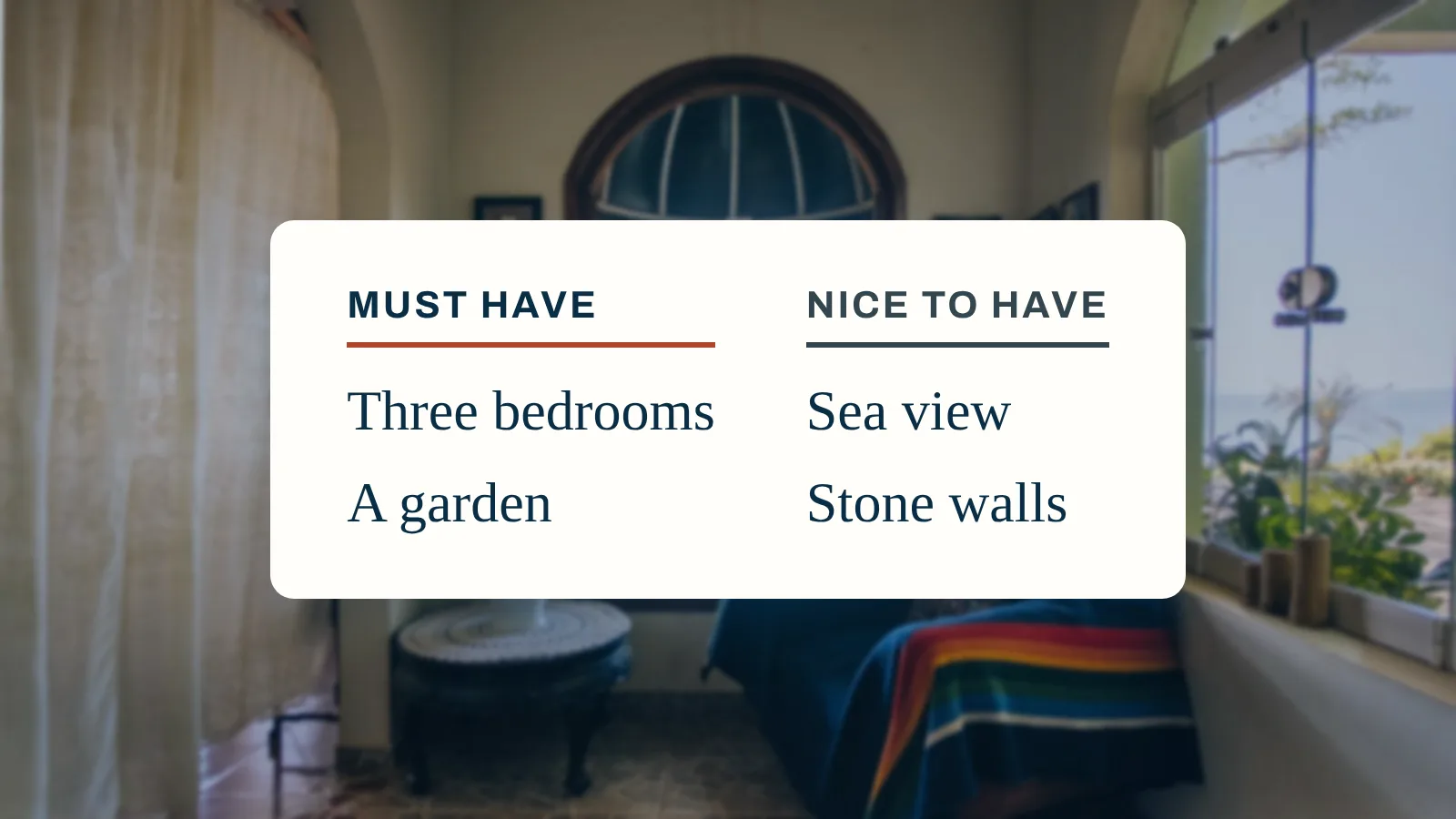
Your house wish list: must-haves and nice-to-haves
A step-by-step way to write a house wish list, with the four categories that keep it honest, a dream home checklist to start from and how to use it at every viewing.


Every step of a house hunt in order, from setting the whole-project budget and writing a wish list to viewings, comparisons and the checks to make before you offer, as one checklist you can work through.
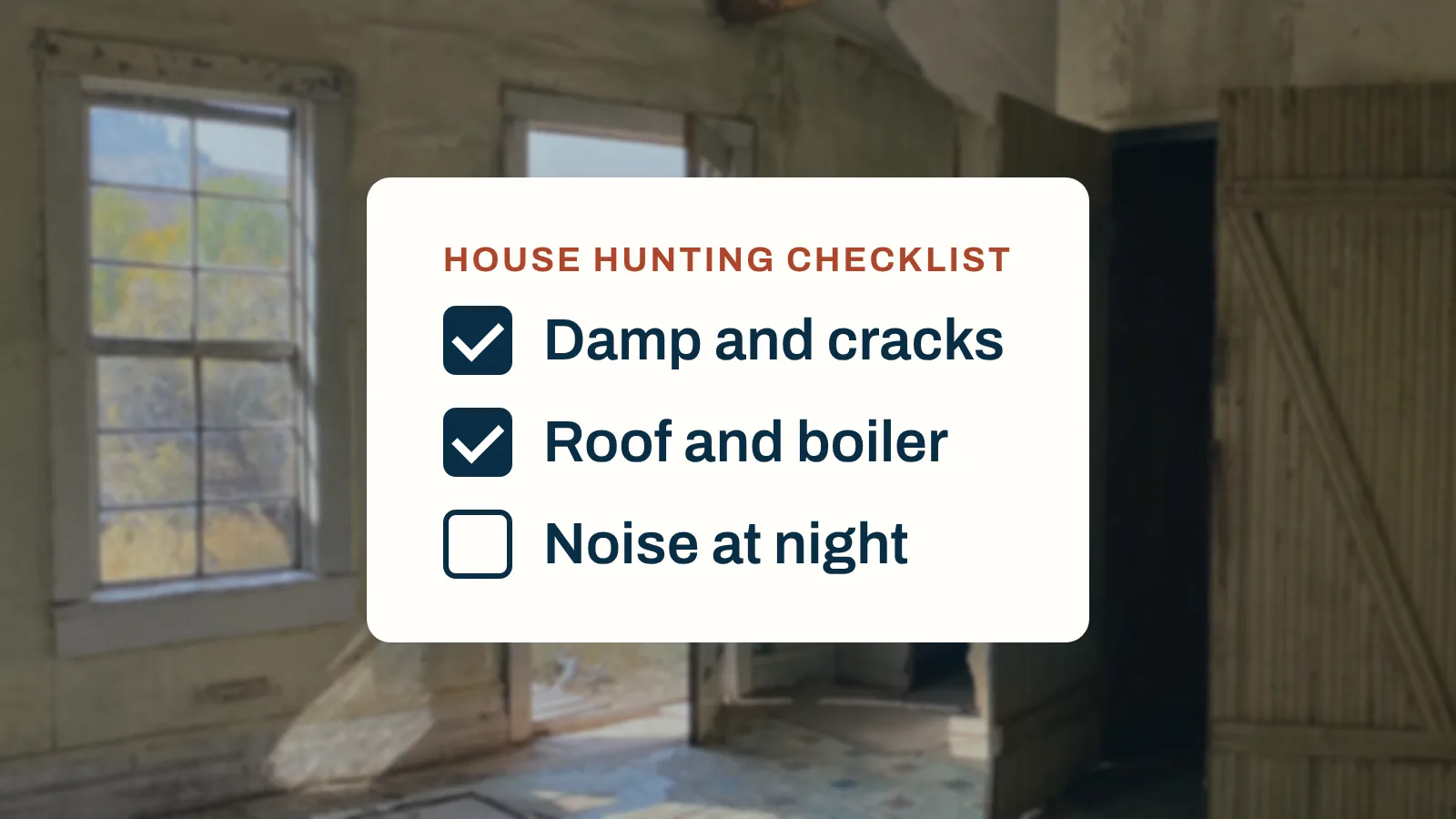
A house hunting checklist covers six stages in order: get ready (budget for the whole project and a wish list), set up the search, check each listing before you view, view with a plan, compare the homes side by side, then prepare your offer. Each stage has a few checks, and skipping one usually shows up as a cost or a regret later.
This guide gives you every step, from the first search to the moment you make an offer. When your offer is accepted, our buying a house checklist takes over and covers every step from offer to keys.
| Stage | What you do | What you have at the end |
|---|---|---|
| 1. Get ready | Set the whole-project budget, write the wish list, decide timing | A budget and a short list of must-haves |
| 2. Set up the search | Choose areas, set alerts, set up your notes | A search you can run consistently |
| 3. Check listings | Look up the facts before you book a viewing | A shortlist worth viewing |
| 4. View | Ask the same questions and record every house the same way | Comparable notes and photos |
| 5. Compare | Score each house against the wish list and the full cost | A clear favourite, or a reason to keep looking |
| 6. Prepare the offer | Clear the big unknowns, set your figure and walk-away point | An offer you can explain |
Most of the hard thinking happens before you look at a single listing.
Tip
Write one compromise down at this stage, the thing you are genuinely willing to give up for the right house. It is much easier to decide in your kitchen than in a lovely garden with an agent waiting.
Ten minutes on a listing can save an hour at a viewing.
In the UK
You can look up a property's energy rating with GOV.UK's Find an energy certificate service, check an area's long term flood risk in England, and check the council tax band in England and Wales. GOV.UK's guide to how to buy a home also suggests looking at sold property price data, which shows what the seller paid and whether the property has changed hands repeatedly. Agents must not leave out information that could affect your decision: National Trading Standards withdrew its detailed material information guidance in May 2025, when the Digital Markets, Competition and Consumers Act 2024 took over, but Propertymark explains that the duty remains. Ask the agent for anything the listing does not show.
Use the same checklist at every viewing. Our full guide to the questions to ask when viewing a house covers what to look for room by room.
Ask the agent
Look at
Before you leave
Second viewing
Watch out
A viewing is not a survey. You can spot warning signs, but structure, services and hidden defects need a professional. If the house is older, needs work or you plan big changes, read our guide to what to look for when buying an old house and plan for a thorough survey.
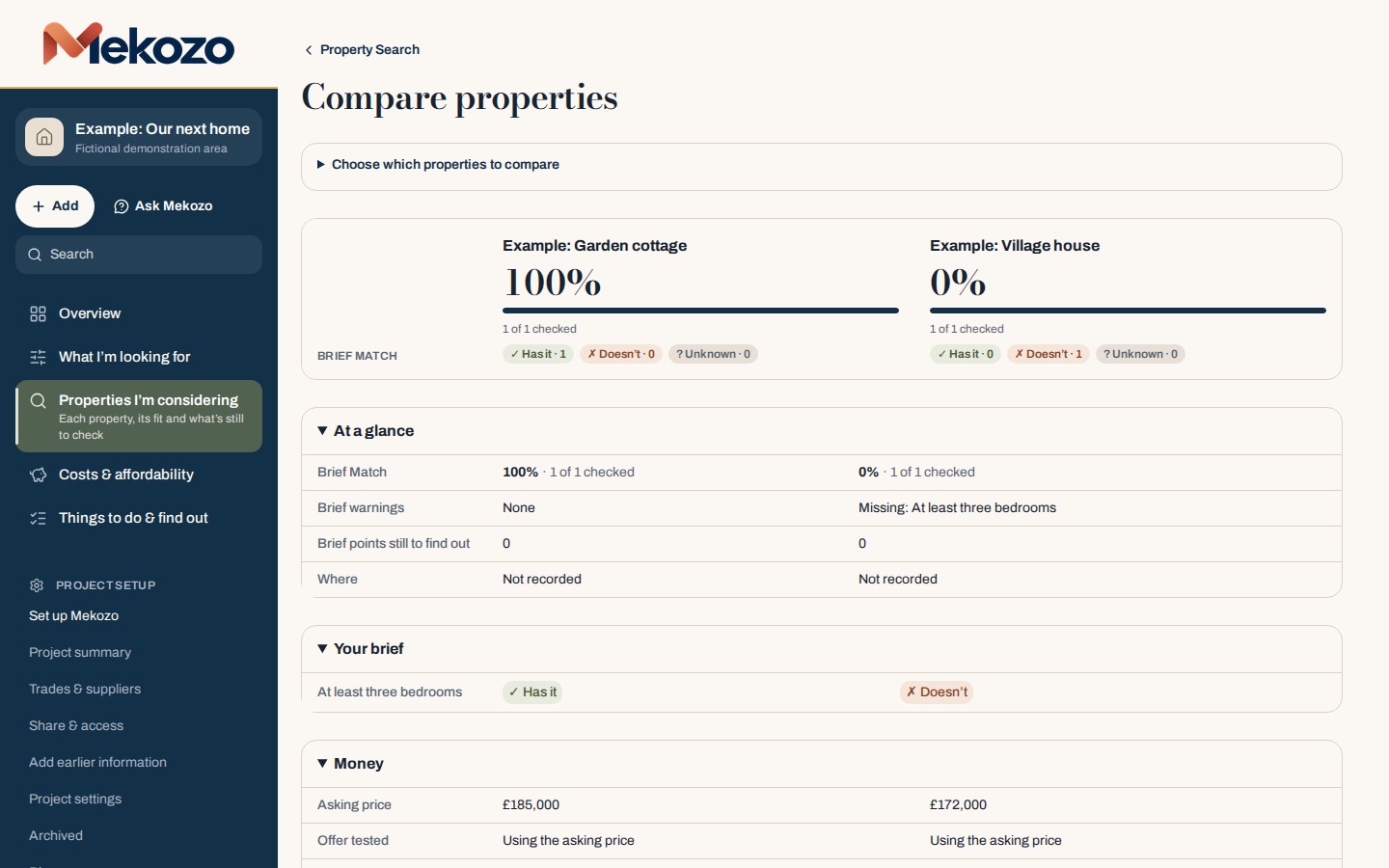
Mekozo lines up the homes in your search against the same Property Brief, showing which points each one meets, which it misses and which are still unknown.
Try it free for 30 days, no card neededBy the fourth or fifth viewing, memories blur. Comparing on paper keeps the decision fair.
Our guide on how to compare houses you have viewed goes through this in detail.
Before you put a figure on the table, make sure you know what you are offering for.
If the house needs work, price it before you offer. Our guides to buying a fixer-upper and how much to offer on a house show how.
In the UK
GOV.UK suggests asking whether the seller would enter a reservation agreement, which shows they are committed and may include compensation if they pull out. In England and Wales, GOV.UK says it is the exchange of contracts that makes the purchase a legal commitment.
The stages are the same in any country, but some steps move earlier. You will usually need a local tax number before you can sign anything, an independent lawyer, and translated documents. In several countries the first signed offer or preliminary contract is already binding, so the checks you would leave to the legal work in the UK need doing before you offer.
Plan viewing trips carefully, with a route, a shortlist checked in advance and time for second viewings. The guide to planning a property viewing trip by Mekozo's founder, Jonathan Smith, who films his villa renovation on Operation Sicily, covers where to stay, the route and what to check on the ground. For the steps in each country, see our guides to buying a house in Spain, buying a house in France, buying a house in Italy and buying a house in Portugal, and our guide to buying a property abroad.
On the Operation Sicily villa
From the villa in Sicily. Jonathan wrote down what he was looking for before he started: a detached house with a garden, at least two bedrooms, quiet and near the sea, under €100,000, on the market for a while and needing a full renovation. Then he spent three months travelling the coast and viewed about 50 properties before buying his villa, checking each one against that list (Episode 8). He walked away from two homes after problems missing from the documents came to light. The search was long, but it was the same search every time: the same list, the same questions and the same checks, which is what made the final choice clear.
Playing loads YouTube’s external player.
Watch directly on YouTube ↗For more on house hunting and comparing homes, see our starting point, and when your offer is accepted, move on to buying a property. Mekozo keeps your wish list, viewings and purchase costs in one search, and lets you compare homes side by side; see how to compare properties without losing your priorities.
This checklist explains a method for organising a house search. It is not survey, legal or financial advice; use a qualified surveyor and a solicitor or conveyancer once your offer is accepted.
Take your wish list, the floor plan, a tape measure and your phone for notes and photos, plus the three key questions you wrote down for that house. Before you leave, mark each must-have as met, not met or unknown.
Work out what you can spend on the whole purchase, including the costs of buying, and write a short wish list. If you need to borrow, speak to a qualified adviser early so you know your limits. Then decide on your areas and how you will keep notes, before the first viewing.
There is no right number. What matters is that you judge every house against the same written wish list and the same full cost. Some buyers know after five viewings; Jonathan Smith viewed around 50 over three months before buying the Operation Sicily villa.
Read the listing and floor plan against your wish list, look up the energy certificate, check the flood risk and the council tax band, and look at what similar homes nearby sold for. Write down the three questions that would change your mind about the house.
You are ready when the house meets your must-haves, you know its full cost including buying costs and any work, you have viewed it at least twice, and you have a list of the questions the legal work and survey still need to answer. Then decide your figure and your walk-away point.
The stages are the same, but you will usually need a local tax number, an independent lawyer and translated documents, and the first signature can be binding. Plan viewing trips carefully and check each country's official sources before you commit.

Jonathan Smith is the founder of Mekozo and Operation Sicily. Jonathan bought an abandoned villa in Sicily and is rebuilding it on camera, every week. Mekozo is the app Jonathan built to keep that renovation's money in one picture.
Real renovation experience and regional guidance from Operation Sicily.
A step-by-step way to write a house wish list, with the four categories that keep it honest, a dream home checklist to start from and how to use it at every viewing.
What to ask, what to look at and how to record every viewing the same way, so you can compare homes fairly afterwards.

A house survey tells you about a home's condition before you commit. Which RICS level to book, what it covers and leaves out, a checklist to use alongside it, and how to act on the report.
Budgets, quotes, payments, documents and decisions in one place
30 days free. No card needed.
Monthly, with no annual plan. The Terms of membership set out the details.