How do you buy a house in Portugal?
Buying a house in Portugal usually follows six steps: get a Portuguese tax number (NIF), open a bank account, instruct an independent lawyer, check the property's registration, licences and condition, sign a promissory contract with a deposit, then sign the deed and register the purchase. Budget for purchase taxes, deed, registration, legal fees and running costs on top of the price.
This guide sets out each step, the cost headings to plan for, and the official Portuguese and UK sources to check. It explains the method; it is not legal or tax advice, and the taxes that apply depend on the property and on you.
The steps of buying a house in Portugal at a glance
| Step | What happens | Who is involved |
|---|
| 1. NIF | You get your Portuguese tax number | The tax authority, directly or through a representative |
|---|
| 2. Bank account | A Portuguese account for payments and bills | A bank in Portugal |
|---|
| 3. Lawyer | An independent lawyer to act for you | A lawyer registered with the Ordem dos Advogados |
|---|
| 4. Checks | Registration, tax record, licences, energy certificate and condition | Your lawyer, a surveyor |
|---|
| 5. Promissory contract | A contract with a deposit, setting the price and date | You, the seller, your lawyer |
|---|
| 6. Taxes and deed | The purchase taxes are settled and the deed signed | Notary or Casa Pronta, you, the seller |
|---|
| 7. Registration | The purchase is entered in the land registry | Notary, Casa Pronta or your lawyer |
|---|
Step 1: get your NIF
Every buyer needs a Portuguese tax identification number, the NIF (Número de Identificação Fiscal). It is issued by the Autoridade Tributária e Aduaneira, whose Portal das Finanças is also where purchase taxes and the annual property tax are handled. Depending on where you live, you may need a tax representative in Portugal; ask your lawyer which applies to you. Apply early: the bank account, the contract and the taxes all wait for it.
Step 2: open a bank account
You will use it to pay the deposit, the balance and the taxes, and later the utilities and the annual property tax. Keep a record of every transfer with its reference.
Step 3: instruct an independent lawyer
GOV.UK's guidance for Portugal suggests getting advice from an English-speaking lawyer if you plan to buy property or land, and checking that they are registered with the Portuguese law society, the Ordem dos Advogados. GOV.UK also notes that some notaries, who are trained lawyers in Portugal, offer an independent property purchasing service called Casa Simples, Casa Segura.
Watch out
The agent works for the seller. Do not sign a contract or pay a deposit until your own lawyer has read the documents, and have anything you do not fully understand translated by an independent translator.
Step 4: check the property before you sign
Ask your lawyer to check, and to put the answers in writing:
- The land registry certificate. Who owns the property, how it is described and whether there are mortgages or other charges registered against it.
- The tax record of the property. That its description and area match the registry and what you have seen.
- The usage licence (licença de utilização). Decree-Law 10/2024, the planning Simplex, removed the requirement to show the usage licence and the ficha técnica at the deed from 1 January 2024, as the Ordem dos Advogados explains. Ask your lawyer to check the licence position anyway: a building used without the right licence can still bring problems later.
- The energy certificate. Casa Pronta asks for it to complete a purchase.
- The technical file of the building (ficha técnica), where one exists.
- Unpaid charges. Any property tax, utility bills or, for a flat, condominium charges still owing.
- The condition of the building. A survey, if you want one, arranged before you commit.
In Portugal (location rules)
GOV.UK flags two things to check. If you plan to buy a coastal, river or lakeside property, make sure it is not affected by the 2005 water resources law. If you buy rural property, you must comply with the law on preventing forest fires. Ask your lawyer to confirm both for the property you are buying.
Step 5: sign the promissory contract
The promissory contract (contrato de promessa de compra e venda) commits buyer and seller to the sale on stated terms: the price, the deposit, the date for the deed and any conditions. The deposit is usually paid at signing and counts towards the price.
In Portugal
The deposit is usually a sinal. Under article 442 of the Civil Code, if the buyer fails to complete, the seller keeps the sinal; if the seller fails to complete, the buyer can claim double. Ask your lawyer to explain the clause before you sign, and to include any conditions you need, such as a satisfactory survey.
Step 6: settle the taxes and sign the deed
Before the deed, the purchase taxes are settled with the tax authority. The deed itself is signed before a notary, or through the government's Casa Pronta service. The comparison of Sicily and Portugal by Jonathan Smith, Mekozo's founder, who documents his villa renovation on Operation Sicily, notes that both countries use a notary for the final deed, and that in his view Portugal's process is more streamlined for foreign buyers.
Step 7: register the purchase
Registration in the land registry protects your ownership. Make sure it is done, and keep the registry certificate showing you as owner with the deed and your purchase records. Then move the utilities and the annual property tax into your name.
Casa Pronta: purchase and registration in one place
Casa Pronta is a Ministry of Justice service that lets you handle several procedures of a purchase and its registration at one counter, in one appointment. According to the Ministry of Justice page (updated 28 July 2026):
| What you need | What it costs |
|---|
| Identity and tax documents for sellers, buyers and anyone else involved | One registration act, such as the purchase alone: €375 |
|---|
| The technical file of the building, if one exists | More than one registration act, such as a purchase with a bank loan: €700 |
|---|
| A deed referring to the usage licence or its exemption, where needed | Each additional property: €50 more |
|---|
| The energy certificate | |
|---|
Anyone can use the service, by appointment at a Casa Pronta counter. It does not replace your own lawyer's checks; it is a way of completing and registering the purchase once those checks are done.
The costs of buying a house in Portugal
Every purchase has the same cost headings. The rates and who pays them depend on the property, its price and use, and your own situation, so treat this as a list to price, not a set of figures.
| Cost heading | What it is | Where to check |
|---|
| Property transfer tax (IMT) | A tax on the purchase, set by price band and use | Portal das Finanças IMT information |
|---|
| Stamp duty (Imposto do Selo) | 0.8% of the value used for IMT | Portal das Finanças |
|---|
| Deed and registration | Notary and land registry fees, or the Casa Pronta charge | Notary's quote, Casa Pronta |
|---|
| Independent lawyer | Checks, contracts and completion | A written quote |
|---|
| NIF and tax representative | Any fees if someone acts for you | A written quote |
|---|
| Translation | Of contracts and documents | A written quote |
|---|
| Survey | Optional, but the only way to know the condition | A written quote |
|---|
| Lender fees, if borrowing | Charged by the lender | The lender |
|---|
| Currency transfer | Charges and the rate on the day you pay | Your bank or provider |
|---|
| Travel | Viewing trips, signing and handover | Your own estimate |
|---|
In Portugal (tax)
A purchase usually brings two taxes, the municipal property transfer tax (Imposto Municipal sobre as Transmissões Onerosas de Imóveis, IMT) and stamp duty (Imposto do Selo), which the Portal das Finanças sets at 0.8% of the same value used for IMT. How much IMT you pay depends on the price, on whether the home will be your permanent residence and on where it is, and owners then pay an annual municipal property tax (Imposto Municipal sobre Imóveis, IMI). The Portal das Finanças is the official source for the current IMT bands. Mekozo does not give tax advice: ask your lawyer to confirm the taxes in writing for your purchase and your circumstances.
Running costs after you buy
Budget for these from the first year:
- Annual property tax (IMI). Set by the municipality where the home is.
- Condominium charges. For a flat in a shared building, ask for the last accounts before you sign.
- Fire prevention work. For rural property, any work the fire prevention rules require.
- Insurance, utilities and maintenance. Including any pool, garden or private water system.
- Travel and stays. For a second home, every visit has a cost.
Put every cost in one list before you sign
Questions to ask before you commit
- Does the land registry certificate show the seller as owner, with no charges?
- Do the registry and the tax record describe the same property and area?
- Is there a usage licence, or proof that none is needed?
- Is there a valid energy certificate?
- Are any property taxes, utility bills or condominium charges unpaid?
- Is the property affected by the water resources or fire prevention rules?
- What happens to the deposit if either side withdraws?
- What does your lawyer estimate for the purchase taxes, in writing?
For more questions across the whole purchase, see our guide to questions to ask when buying a house, and for a structured look at the building, our house survey checklist.
Buying a house in Portugal checklist
- NIF applied for early
- Portuguese bank account opened
- Independent lawyer instructed and registration with the Ordem dos Advogados checked
- Independent translations of contracts and documents
- Registry certificate, tax record, usage licence and energy certificate checked
- Coastal, river, lakeside and rural rules checked for the location
- Survey arranged before signing, or a survey condition agreed
- Every cost heading priced from an official source or a written quote
- Promissory contract terms explained before signing
- Purchase taxes settled and the deed signed
- Purchase registered in your name
- First-year running costs, including the annual property tax, planned
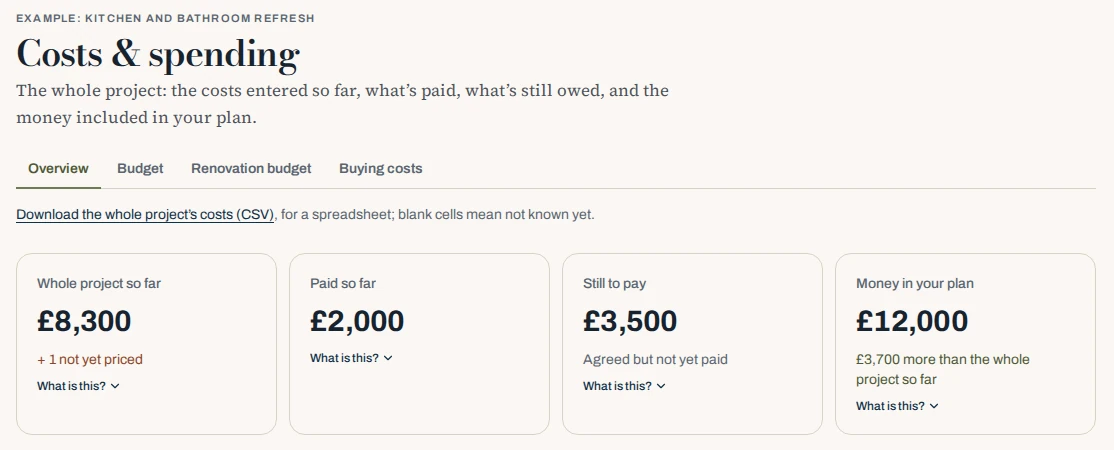
If you are comparing countries, see our guides to buying a house in Spain, buying a house in France and buying a house in Italy. For the earlier stages, see our guide to shortlisting and comparing homes and how long it takes to buy a house, stage by stage. To keep a Portuguese purchase and all its costs together, see how Mekozo keeps every buying cost in one list.
This guide explains the steps and cost headings of a purchase. It is not legal or tax advice; check the current rules with the official Portuguese sources and a qualified, independent adviser.