Managing a renovation from abroad or at a distance
Renovating a house you cannot visit every day takes a different kind of planning. The local team, written briefs, photo routines, payments and travel costs, with lessons from a villa renovated between the UK and Sicily.
To manage a renovation from abroad, you need one trusted local professional who can oversee the work and make or relay decisions while you are away.
Write specific briefs before you leave: what is to be done, in what order, to what standard, and what to do if something unexpected turns up.
Agree a regular photo and update routine, and pay only for stages you have seen finished, in person or in dated photos.
Budget for the costs of distance: travel, accommodation, translation and the longer timeline that distance usually brings.
Some jobs and decisions need you on site; plan your visits around them rather than the other way round.
How do you manage a renovation from abroad?
Manage a renovation from abroad by putting one trusted local professional in charge on site, writing specific briefs before you leave, agreeing a weekly routine of dated photos and updates, paying only for stages you have seen finished, and planning your visits around the decisions only you can make. Budget for travel, accommodation and a longer timeline.
Renovating at a distance, whether from another country or another city, changes the job. You cannot pop round to answer a question, check a socket position or stop a mistake before it is plastered over. Everything that is easy on site has to be planned, written down or photographed. This guide covers how to set that up, with lessons from the villa that Jonathan Smith, Mekozo's founder, is renovating between the UK and Sicily and filming for Operation Sicily.
What changes when you are not on site
On site, you can
At a distance, you need
Answer questions as they come up
A list of decisions made in advance, and someone who can make small ones
See work before it is covered
Dated photos at agreed points, before walls and floors close
Check a stage before paying
Photos, a report from someone you trust, or a visit
Meet trades and suppliers
Introductions through your local professional
Notice a problem early
A regular update routine that would reveal it
Fix small things yourself
Someone local who can, or a visit
None of this is impossible. It just has to be designed, rather than left to chance.
Step 1: build a local team you trust
Distance makes your local team more important, not less. You need one person who is your eyes and your point of contact.
Choose the lead. A main builder who coordinates every trade, or a local professional such as a surveyor, architect or, in Italy, a geometra, who oversees the work and the permits.
Agree what they can decide alone. For example, small fixes up to an agreed amount, or the exact position of a pipe within a set area.
Agree what must come to you. Anything that changes the price, the layout, the finish or the dates.
Get local recommendations. Ask the professionals you already trust who they would use; good trades tend to know each other.
Do the usual checks. Qualifications, insurance, references and a written quote, as you would at home. Our guide to finding a good builder covers the questions to ask.
Watch out
Rules on who must design, approve, install and sign off work vary by country. Being an owner who lives elsewhere does not change them. Check with a qualified local professional what applies to your job before work starts.
Step 2: write briefs that work without you
A brief that works on site, with you there to explain, often fails when you are a thousand miles away. Write each one so someone could follow it without calling you.
What is to be done, room by room, referring to the scope of works
The order of the jobs, and what must be finished first
Measurements, positions and heights, marked on a plan or on the wall
Photos of what you want, and of what you do not
The materials, with product names, colours and quantities
What to do if something unexpected turns up: stop and photograph, or carry on up to an agreed limit
Who to contact, and how quickly you will reply
Mark positions on the walls themselves before you leave: sockets, switches, lights, radiators and pipe runs. A spray-painted cross is harder to misread than a sketch. Our guide to writing a scope of works is a good starting point for the written part.
In the UK
If you are not in the country where the work is, the language barrier matters more. GOV.UK's guidance for buying property abroad advises getting contracts and relevant documents translated by an independent translator, and having an interpreter with you at meetings, and to be wary of using one recommended by the agent or lawyer. The same thinking applies to building contracts and permits.
Step 3: share one record, not a stream of messages
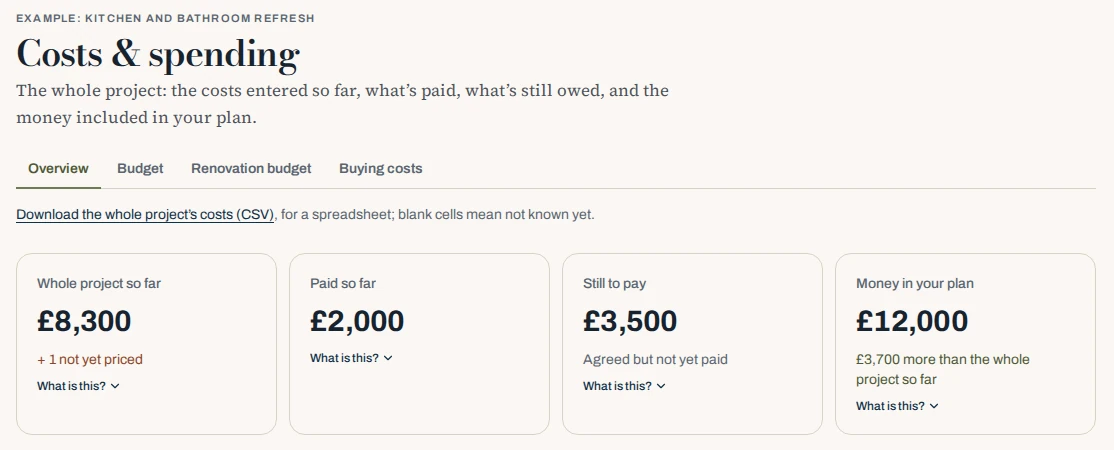
Mekozo shows everyone on the project the same figures, such as what is paid and what is still to pay; partners and helpers join free, and you choose whether they can see the money.
When you are away, messages pile up across email, text and calls, and the one decision that mattered gets lost. Keep one shared record of the project instead:
Jobs and their status: planned, underway, finished.
Open questions and decisions, with who needs to answer and by when.
Photos filed against the room and job they show.
Quotes, invoices and payments against the job they belong to. An invoice is the bill for agreed work; record it, then the payment against it.
Changes, each with its price and effect on the dates.
Invite the people who need it: a partner, a family member nearby, or the person keeping an eye on the house. Decide what each of them should see; not everyone needs to see the money.
Step 4: agree a photo and update routine
Photos are how you see the work when you cannot visit. Agree a routine at the start, not after something goes wrong.
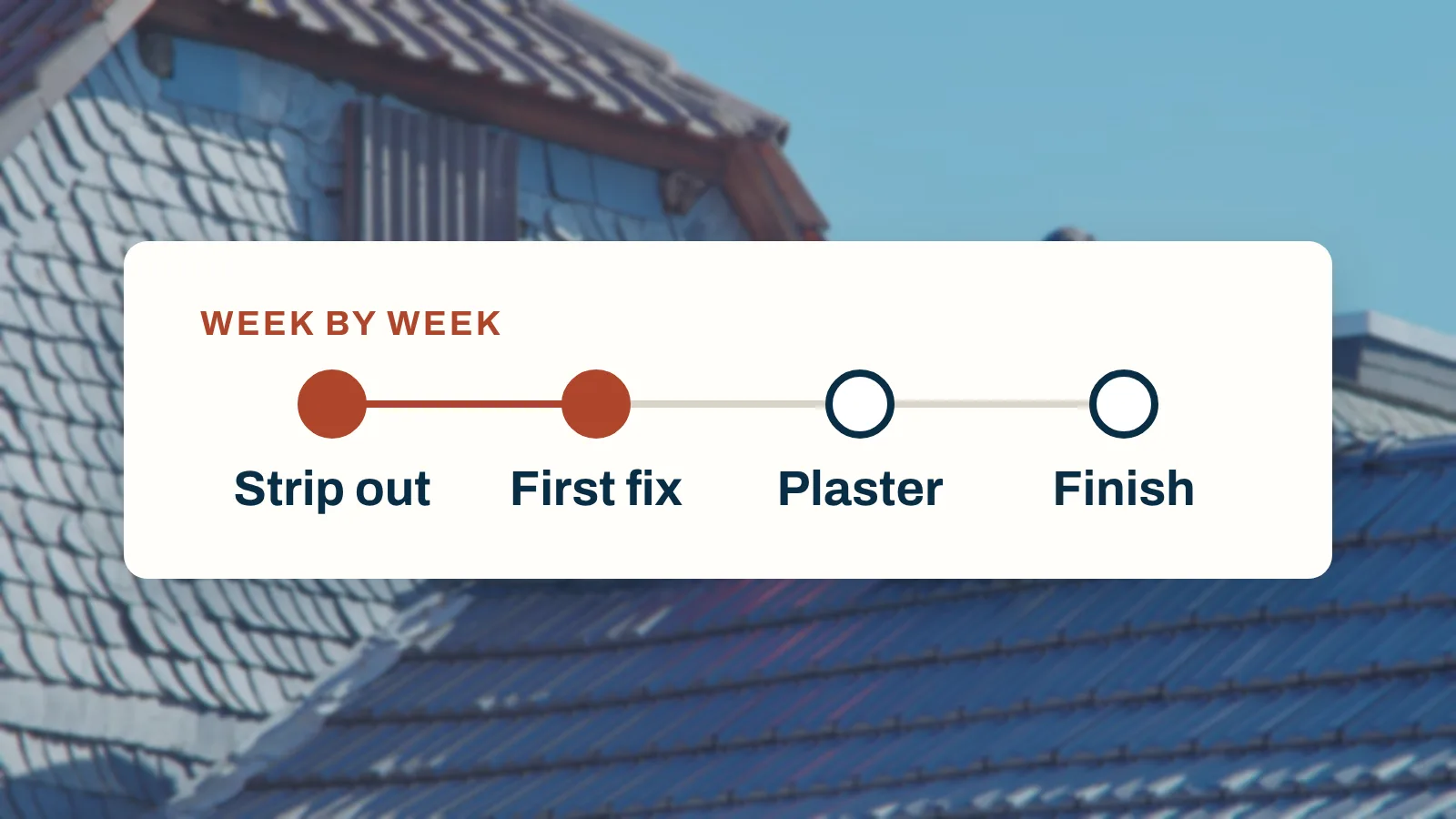
A weekly update from your lead: what was done, what is next, any problems, any decisions needed.
Dated photos of each room from the same spots, so you can compare week to week.
Photos before anything is covered: pipes, cables, joists and damp proofing, with a tape measure in shot.
Photos of every problem, wide and close up, with a note of the trade.
A short video walk-round before each stage payment.
Connectivity at rural properties can be patchy. Check the mobile signal and internet at the house early, so the photo routine does not collapse in the first week.
Step 5: pay safely from a distance
Paying from abroad adds risk: currency, bank fees and the temptation to pay ahead to avoid delays.
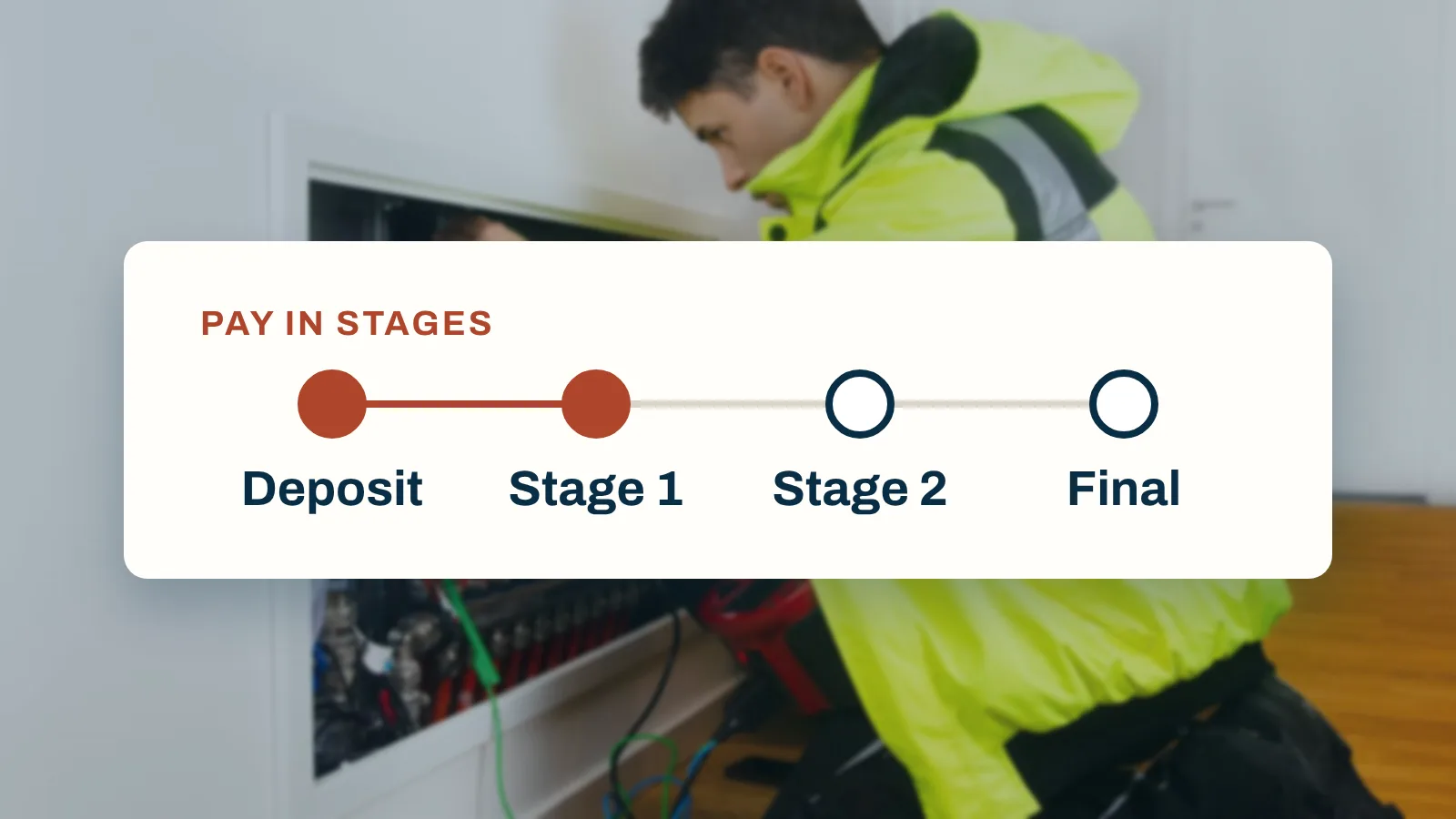
Pay for finished stages, seen in person, in dated photos or by someone you trust.
Keep deposits small, and get a receipt.
Check any change of bank details by phone, using a number you already had, before you pay.
Allow for international transfer fees. GOV.UK lists international bank transfer fees among the extra costs of buying abroad, and suggests discussing them with your bank in advance.
Record every payment against the job, with the date, amount, currency and reference.
Our guide to paying a contractor explains how to set the stages, and how to keep the final payment until the job is finished.
In the UK (England)
For work in England, Citizens Advice suggests getting the trader's full contact details before work starts, so problems are easier to deal with, and agreeing in writing how and when you will pay. Abroad, check the official consumer guidance in that country.
Step 6: budget for the costs of distance
The building work is only part of the cost. Distance adds its own lines, and they grow with every month the job runs.
Cost
Why it adds up
Travel
Flights, trains, fuel, vehicle hire, every visit
Accommodation
Every night you are there and the house is not habitable
Translation and interpreting
Contracts, permits and meetings
Bank and transfer fees
Every international payment
Power of attorney
If someone must sign for you while you are away
Local help
Someone to let trades in, take deliveries or check the house
A longer timeline
More visits, more nights, more months of everything above
GOV.UK's guidance for buying property abroad lists several of these, including translation fees, international bank transfer fees and fees to arrange a power of attorney. Put them in the budget from the start, with their own contingency. Our guide to renovation contingency shows how to size one, and our renovating a house on a budget guide covers costs outside the build.
Step 7: plan visits around decisions
Some things need you there. Plan your visits around them, rather than visiting whenever you can and hoping the right moment falls inside it.
Before work starts: walk the job with your lead and mark positions on the walls
Before first fix is covered: check cable, pipe and heating routes
Before tiles and finishes are ordered: see samples in the light of the actual rooms
Before the kitchen and bathroom are fitted: check the layout on site
At the end: walk the snagging list before the final payment
Tip
Think about what happens to the house when nobody is there. Water, security, deliveries and anything that needs regular attention, such as a garden, can all go wrong in a few weeks of absence.
On the Operation Sicily villa
From the villa in Sicily. Jonathan left the UK to renovate an abandoned villa in the province of Trapani, bought for €21,500 after standing empty for more than twenty years, as he explains in Moving from the UK to Sicily to restore a villa. His project has run between the two countries ever since. The purchase took under six weeks, but the renovation runs on local timescales. His answer to managing it from a different country is a reliable local team and a great deal of planning: the geometra manages the permits and technical oversight in his absence, and the electrician and other trades work from specific briefs prepared in advance, communicated through a translator while his Italian was still basic. Work can continue while he is away when the brief is specific enough, but most of his own DIY and most decisions need him on site (The real timeline). Absence has its own risks: an irrigation system built to water the fruit trees while he was in the UK kept siphoning water from a 2,000 litre tank after the pump stopped, with five weeks of absence ahead; an air-break pipe taken four metres up to the roof fixed it. Even the electricity supply started with a visit to the energy company's office with a translator friend. And the line that went most over budget was not the building work: he is on track with the renovation budget but significantly over on accommodation, after choosing short-term lets for flexibility instead of a fixed rental; travel costs, he notes, are consistently underestimated by people managing a renovation from the UK (What I wish I had known). That is his own experience, not a general rule, but it is a line worth budgeting for.
This guide explains a practical approach to managing building work at a distance. It is not legal, tax or financial advice. Rules on building work, permits and payments differ by country: check the official sources where the property is.
Questions people ask
Can you renovate a house while living abroad?
Yes, but it needs a reliable local team, specific written briefs, a regular routine of photos and updates, and visits planned around the decisions only you can make. The Operation Sicily villa owner found that work could continue while he was away when the brief was specific enough, but that most decisions and his own DIY work needed him on site.
Who should manage a renovation when you are not there?
Choose one local person to be your eyes and point of contact: a main builder who coordinates the trades, or a local professional such as a surveyor, architect or, in Italy, a geometra. Agree in writing what they can decide on their own, what they must check with you first, and how often they will report.
How do you keep track of a renovation from a distance?
Agree a weekly update with dated photos of each room and each job, a list of open questions and decisions with deadlines, and a record of every quote, invoice and payment against the job it belongs to. Invite a trusted helper to see the same records, so you are not relying on messages alone.
What are the hidden costs of renovating abroad?
Travel, accommodation while you are there, vehicle hire, translation, international bank transfer fees and the cost of a longer timeline. GOV.UK's guidance for buying property abroad lists costs such as translation, international transfer fees and arranging a power of attorney. The villa owner found accommodation was the line he went most over budget on.
How do you deal with the language barrier when renovating abroad?
Use an independent translator or interpreter for contracts, permits and important meetings, as GOV.UK advises for buying property abroad. For day to day messages, write short, specific briefs with photos and measurements, and confirm anything important in writing so both sides have the same version.
Jonathan Smith is the founder of Mekozo and Operation Sicily. Jonathan bought an abandoned villa in Sicily and is rebuilding it on camera, every week. Mekozo is the app Jonathan built to keep that renovation's money in one picture.
A renovation schedule is more than a list of dates. How to build one from the jobs, their dependencies, lead times and decision dates, and how to keep it on track when something slips.
A good payment schedule keeps your money roughly level with the work done. How to set the deposit, the stages and the final payment, how to pay safely, and what to record each time.
Before and after photos are more than a reveal. How to take matching shots room by room, what to record while the walls are open, and how the photos help with snags, neighbours, claims and a sale.