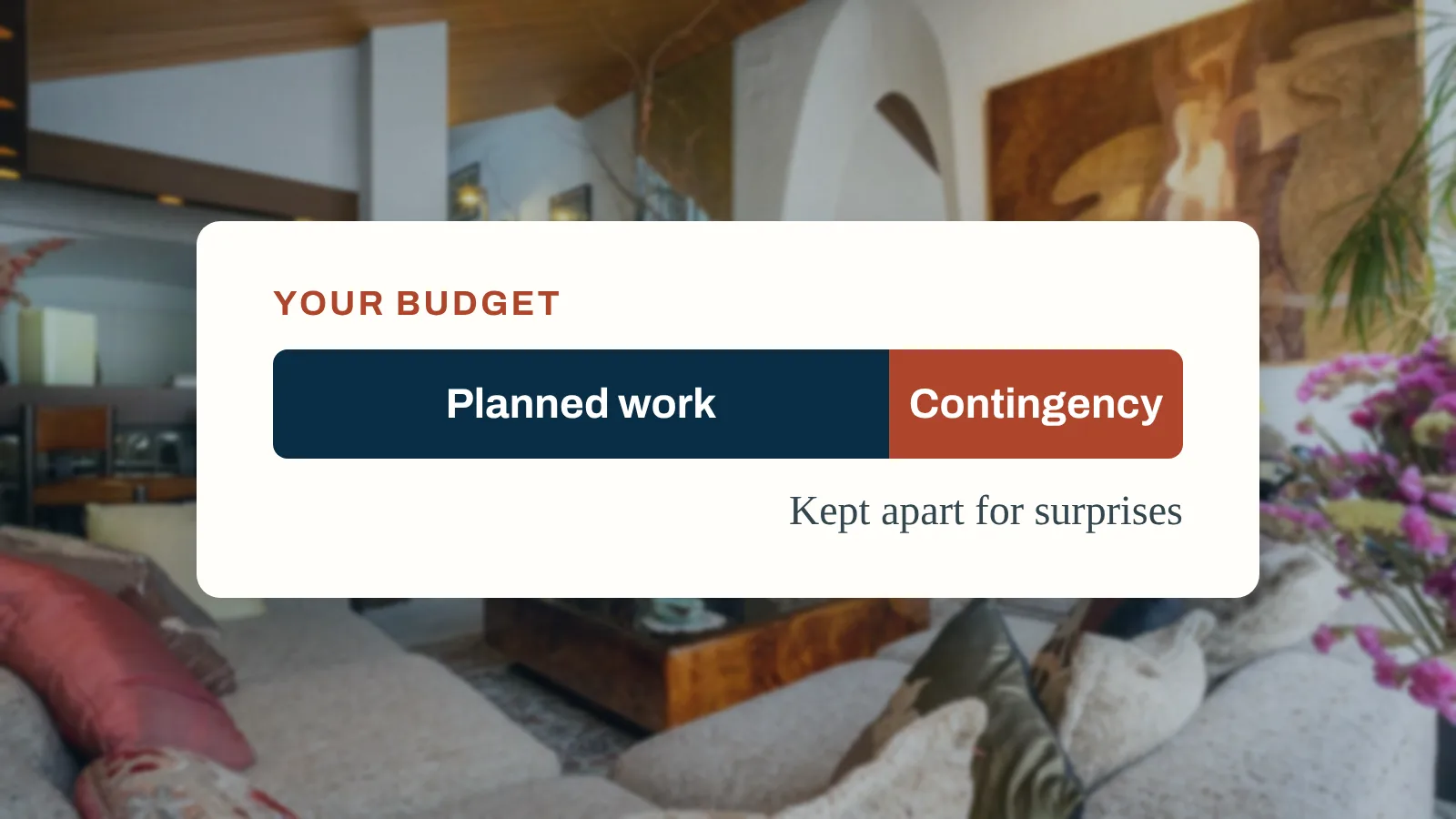
Most UK guides suggest a renovation contingency of 10% to 15% of the build cost, and more for an older house: Which? advises around 10% to 15%, and the Federation of Master Builders suggests 15% or more for older homes or structural work. Treat that as the starting point, then check it against your own project's unknowns.
A percentage on its own tells you nothing about your house, so list the genuine unknowns, such as what is behind the walls, under the floors and in the roof, which items are only allowances and which prices are not fixed, and cover those. Keep upgrades out of it, and recheck it after every change. This guide shows you how to size, protect and track a contingency that has a clear job to do.
What a renovation contingency is, and what it is not
A contingency is money you hold back for costs you cannot know yet. It is not a second budget for things you would like.
| Belongs in contingency | Does not belong in contingency |
|---|
| Rot, damp or structural problems found when opening up | An upgrade to a better kitchen worktop |
|---|
| Old wiring or pipework that must be replaced once exposed | The extra room you already know you want |
|---|
| Items priced only as allowances or provisional sums | A change of mind about the tile you chose |
|---|
| Price rises on materials not yet ordered | Furniture and decoration after the build |
|---|
| Delays that add to rent or living costs | Anything already in the scope with a price |
|---|
Tip
If you already know you want something, put it in the scope and the budget with its own price. Calling it contingency does not make it cost less, it just hides it.
Why renovation costs move once work starts
Three forces push costs up during a project, and a contingency is there to absorb them.
Hidden conditions
Some problems only appear when walls, floors and roofs are opened. A survey reduces the unknowns but cannot remove them. RICS notes that its most thorough survey, the Level 3 Home Survey, is the one to choose for large, older or run-down properties or if you are planning major works.
Changes after work begins
RICS's consumer guide to home extensions and improvements warns that changes made after work starts are usually very expensive, and recommends agreeing a method for making changes before work begins.
Prices that are not fixed
Under a quote, Citizens Advice says the price can only go up if you ask for extra work, agree to extra work the trader tells you about, or there was a genuine mistake (Before you get work done on your home). Anything that is only an estimate, a daily rate or an allowance can move. And material prices change: the UK government's construction building materials commentary, published 4 November 2026, showed the material price index for all work up 7.2%, and for repair and maintenance up 6.2%, between September 2025 and September 2026.
How to size your renovation contingency, step by step
Step 1: list the genuine unknowns
Walk through the project and write down every cost you cannot yet pin down. Group them:
- Hidden conditions: areas not yet opened, such as under floors, behind plaster, in the roof, below ground.
- Open decisions: items where you have not chosen the specification, so the price is a guess.
- Allowances: items in the quote marked as provisional sums or "allow for".
- Unfixed prices: estimates, day rates and materials not yet ordered.
- Time: what a delay would cost you in rent, travel or a second home.
Watch out
Open decisions are not contingency. They need a decision, not a fund. Make the decision, price it, and move it into the budget. What remains on the list is genuine uncertainty.
Step 2: put a range on each one
For each unknown, write a low and a high figure. Ask your builder or surveyor where you can: "If the joists under the bathroom are rotten, what would replacing them cost?" A rough range is far more useful than a blank.
Step 3: decide how much of the risk to cover
You do not need to cover every worst case at once; they will not all happen. A practical approach:
- Cover in full anything that would stop the job or make the house unsafe if it happened, such as structure, roof, drainage and electrics.
- Cover part of the rest, more for older houses and less where quotes are fixed.
- Add the cost of a realistic delay.
The total is your contingency. You can sense-check it as a share of the build cost, but the list is what tells you whether it is enough.
| Risk | Low | High | Cover |
|---|
| Floor joists under bathroom | £0 | £1,500 | £1,500 (structural) |
|---|
| Rewire beyond quote if old cable found | £0 | £2,000 | £2,000 (safety) |
|---|
| Plaster failing when tiles removed | £200 | £900 | £600 |
|---|
| Tile allowance overspend | £0 | £600 | £300 |
|---|
| Four weeks' delay, extra rent | £0 | £1,200 | £600 |
|---|
| Contingency | | | £5,000 |
|---|
Illustrative figures only. Use your own builder's and surveyor's figures.
Step 4: track what is left after every change
The useful question is not whether the contingency looked comfortable at the start. It is how much flexibility remains after the latest commitment.
- Keep the contingency as its own line, never mixed into the build cost.
- When an unknown becomes a real cost, move the money out of contingency into an agreed cost, with a note saying why.
- Cross the risk off the list once it has passed, for example once the floor is open and found sound.
- Before agreeing any extra, check the contingency left after everything already committed.
Our renovation budget tracker explains how to keep estimates, agreed prices and payments apart so this stays visible.
How the risks change from one project to another
The same list method works for any job, but the kinds of risk differ. Use this as a prompt when you write your own list. Our line-by-line kitchen renovation budget shows where those unknowns sit in a single room.
| Type of project | Where the unknowns usually sit | What reduces them |
|---|
| Decorating and cosmetic work in a newer home | Plaster and surfaces once old finishes come off | Fixed quotes, a sample area stripped first |
|---|
| A new kitchen or bathroom | Pipes, drains, wiring and floors behind and below the old fittings | Lifting a floorboard or panel before quotes, a clear scope |
|---|
| An older house being opened up | Structure, damp, roof timbers, old wiring and drainage | A Level 3 survey, specialist checks, opening up the riskiest areas first |
|---|
| An extension or loft | Ground conditions, structure, connections to the existing house, permissions | Full design, structural input, fixed prices for the main package |
|---|
| A project managed from a distance | Delays, decisions waiting for your next visit, travel | Clear decision rules, someone trusted on site, a time allowance |
|---|
Watch out
A common mistake is to set a contingency once and never look at it again. The project changes every week; the list of risks should too. Another is to borrow from it for a nicer finish early on, then have nothing left when the floor comes up.
How to protect your contingency
- Do not spend it on upgrades. If you want to upgrade, fund it from savings in another line, or decide to reduce the risk cover knowingly.
- Price changes before agreeing them. RICS advises agreeing in advance how changes will be made and what their time and cost implications will be. Agree each variation or extra (change order) in writing, with its price and its effect on the timetable, before the work goes ahead, as our guide to variations and extras explains.
- Reduce the unknowns early. Open up the riskiest areas first where it is safe to do so, so you learn the worst early while you still have choices.
- Release it late. Keep the contingency until the risks it covers have passed.
In the UK
Citizens Advice suggests paying for building work in stages, so problems can be put right before the final payment, and RICS suggests holding back 5% of the price until the work is satisfactorily complete. Neither is contingency, but both protect your budget at the end of the job.