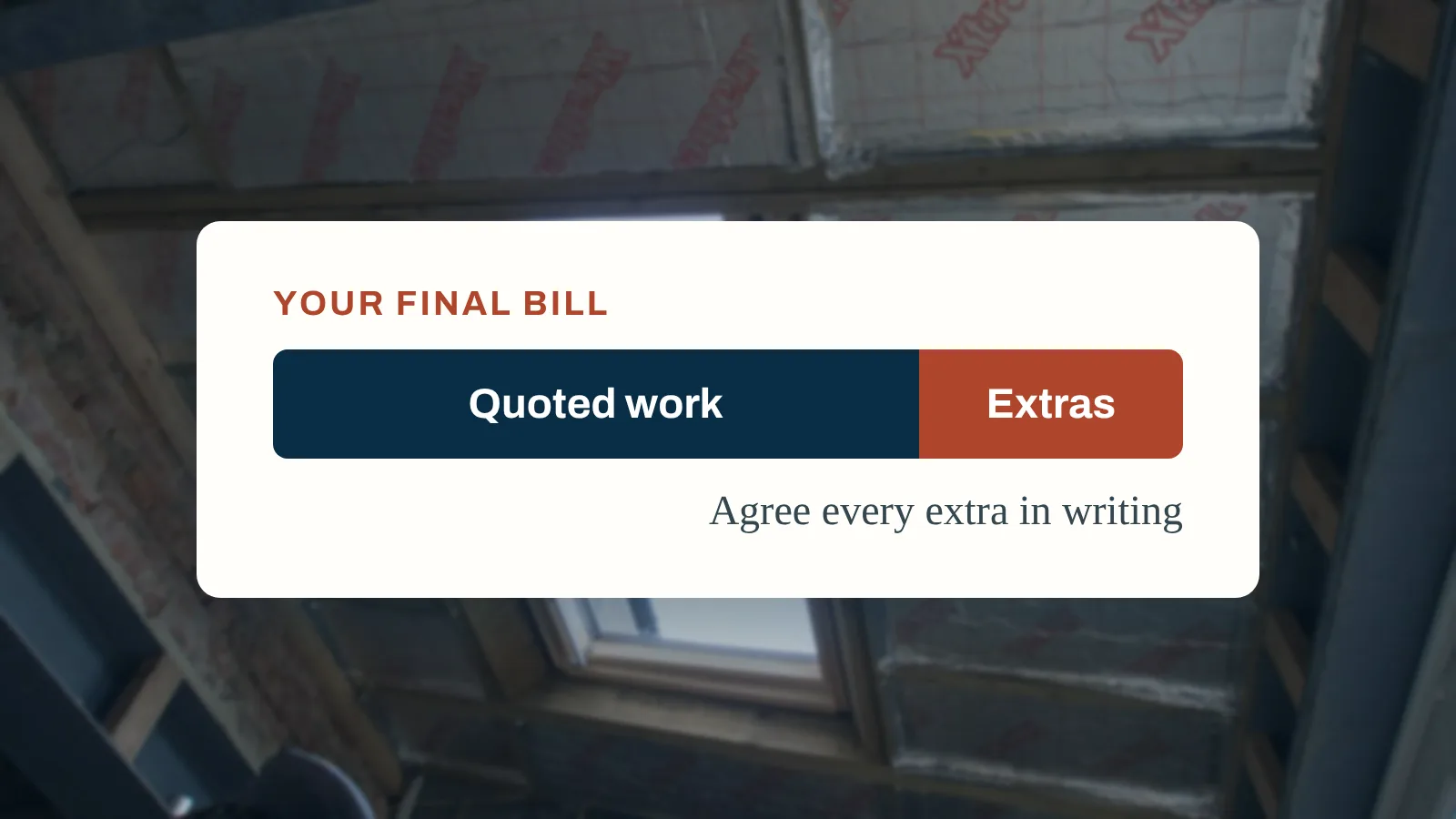
Changes and extras are where renovation budgets drift. What a variation is, the four kinds of change, a five step way to agree each one before the work, and a change log you can copy.
A variation, or extra, is a written agreement to change building work after the price is agreed: what changes, what it costs and how it affects the timetable.
Some changes are upgrades you choose and some are problems found once work starts; both need a price before they go ahead.
No change should go ahead until it has a description, a price and your written yes.
Citizens Advice says a trader in England cannot charge more than their quote unless you asked for extra work, agreed to pay more for work they told you about, or they made a genuine pricing mistake.
Keep a change log and work to the current contract sum: the original price plus every agreed change.
In England, a builder can usually charge more than the quote only if you asked for extra work, agreed to pay more for extra work they told you about, or they made a genuine pricing mistake, according to Citizens Advice. So agree every change in writing before the work. In the UK the written agreement is called a variation or an extra (a change order in American usage): what changes, what it costs and how it affects the timetable. The rule: no change goes ahead without a description, a price and your written yes.
Every agreed change then goes on a running total next to the original contract price, so you always know what the job really costs.
This guide explains where changes come from, a five step way to agree each one, and a change log you can copy.
What counts as a change or an extra
Anything that differs from the work and price you agreed is a change. Most fall into four groups:
Type
Example
Who usually pays
Your choice
A different tile, an extra socket, moving a door
You
Something found
Rotten joists, failed lintels, old wiring behind a wall
Usually you, from the contingency
Gap in the scope
Work nobody priced, such as making good after a new opening
Depends on what the quote said
Mistake
Work done wrong and redone
Usually whoever made it
The type matters because it tells you where the money comes from. A choice is a new decision. A discovery is what your contingency is for. A gap in the scope is often a sign the quote was vague. A mistake is not an extra at all.
Watch out
"while we're at it" is how budgets drift. Each small addition seems reasonable on the day. Ten of them can add up to more than your contingency, and none of them were planned.
Can a builder charge more than the quote?
This is the question most people ask once extras start appearing, and the answer depends on what was agreed and where you are.
In the UK (England)
Citizens Advice says a quote is a fixed price, while an estimate is a rough guess. A trader cannot charge you more than the price on their quote unless you ask for extra work that is not included in the quote, they let you know they have to do extra work and you agree to pay more for it, or they made a genuine mistake when writing down or calculating the price. It also suggests a quote should say when the price can go up, for example only if you agree to extra work, and that a written contract should cover delays and why they might happen. Advice differs in Scotland, Wales and Northern Ireland.
Two parts of the Consumer Rights Act 2015, which covers contracts between a trader and a consumer in the UK, are worth knowing:
What the trader says can become part of the contract. Under section 50, anything said or written to you by the trader about the service is treated as a term of the contract if you take it into account when deciding to go ahead or when making a decision about the service later, subject to any change you both expressly agree. A price for an extra confirmed by email is far easier to rely on than one mentioned on site.
No agreed price means a reasonable price. Under section 51, if the contract does not fix a price and does not say how it will be fixed, you must pay a reasonable price for the service, and no more. What is reasonable is a question of fact, which is exactly the kind of argument a written price avoids.
This guide explains the method; it is not legal advice. If a dispute is building, get advice for your own situation.
How to agree a change: five steps
Use the same steps for every change, large or small. It takes minutes and saves arguments.
Name it. Give the change a number and a one line description: "C07: add two double sockets, kitchen island."
Describe it in writing. What exactly changes, in which room, and what it replaces or adds.
Price it before the work. Ask for the cost, any extra materials, and the effect on the finish date. A change can cost time as well as money.
Agree it in writing. A short email reply is enough: "Agreed, C07, £X, finish date unchanged." Keep it with the quote.
Record it against the budget. Add the agreed price to the running total and decide whether it comes from the contingency or is a new choice.
Tip
If the work has to happen today to keep the job moving, agree the scope and a price limit in writing before it starts, and the final price as soon as it is known. "Up to £X without checking with me first" is better than no figure at all.
What to put in a written variation
A written variation is a one page record of a single change. On a home job it does not need to be a formal document: an email or a page with these fields does the job, as long as both of you confirm it in writing.
Change number and date, such as C07, 14 March.
Who asked for it: you, the builder or another trade.
Description and location: exactly what changes, in which room, and what it replaces or adds.
Reason: your choice, something found, a gap in the scope or a correction.
Price: labour and materials shown separately, with VAT stated, or a written price limit if the final figure is not yet known.
Time: the effect on the finish date, or "none".
Payment: which stage payment the change will be added to.
Sign-off: your written yes and the builder's confirmation, with the date.
Tip
Keep every written variation with the original quote, in number order. When the final invoice arrives, you can check it against them line by line.
Keep a change log
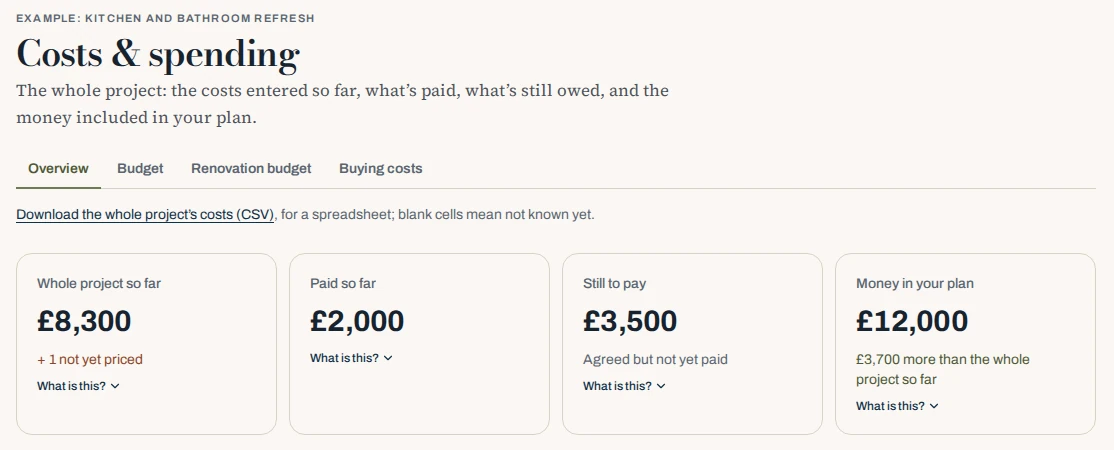
Mekozo's Costs & spending view shows the whole project so far, what is paid, what is agreed but still to pay, and any work not yet priced, so an extra with no price stays visible.
A change log is one list, kept from the first day of work to the last payment. Each line has:
No.
Date
Change
Type
Asked by
Price
Time
Status
C01
Week 2
Replace two cracked lintels found when window removed
Found
Builder
Quoted
+2 days
Agreed
C02
Week 3
Two extra sockets, kitchen island
Choice
You
Quoted
None
Done
C03
Week 4
Making good around new door opening, not in quote
Gap
Builder
Not priced
Unknown
Open
Move each change through the same statuses: open, priced, agreed, done, invoiced, paid. Then keep three totals in view:
Original contract price. What you agreed at the start.
Agreed changes. The sum of every change marked agreed or later.
Current contract sum. The two added together. This, not the original quote, is what you are working to.
Watch out
A change marked "not priced" is not free. Keep it visible until it has a figure, and do not let unpriced work build up. Five small unpriced extras are a large invoice in waiting.
A contingency is there for what you could not know. It is not there for what you decide to add. Keep them apart:
Found problems draw on the contingency. Record each draw so you can see how much is left.
Choices are new money. Decide them on their own merits, and if the budget cannot take them, say no or swap something out.
Scope gaps go back to the quote. If the quote covered the work, it is not an extra.
Mistakes are snags, not changes. They belong on the snagging list, not the change log.
Our guide to renovation contingency shows how to size it from your own risks. Before the last payment, check the change log against the invoices: every agreed change invoiced once, nothing invoiced that was never agreed, and the final figure matching the current contract sum.
Prevent changes before they happen
The cheapest change is the one decided before work starts.
Decide finishes before you ask for quotes. Tiles, sockets, taps and handles, by model.
Agree how changes will be handled in the contract: in writing, priced before work, and added to the stage payments.
On the Operation Sicily villa
From the villa in Sicily. Jonathan Smith, Mekozo's founder, who films his villa renovation on Operation Sicily, did much of the work at his villa himself, so most changes there show up as new jobs and new costs rather than invoices, but the pattern is the same. When the kitchen window came out, the concrete lintels above it turned out to have broken up: the rebar inside had rusted, expanded and cracked the concrete, so replacing the lintels became work of its own (Episode 59). The drainage could have been far worse. Before the cesspit test, Jonathan said that if the system did not work it would mean months of delay and thousands in extra cost, and that bringing it up to modern standards could have cost upwards of €12,000; the test passed and no digging was needed (Episode 57). Trades added work too. With the chasing and ducting for the electrics, just as he thought he was close to finishing, the electrician pointed out more to be done (Episode 50). And one change came from a mistake: a toilet waste pipe meant to sit 25cm from the finished wall had been laid at 35cm, so it was capped off and a new route planned through the external wall (Episode 90). Found, chosen, added or corrected: each one is a line in a change log.
This guide explains a method for managing changes. It is not legal or financial advice; for a dispute, get advice for your own situation.
Questions people ask
What is a variation in building work?
A variation, often simply called an extra, is a written agreement to change the work after the contract is agreed: what changes, what it costs, and how it affects the timetable. It protects both sides, because the builder is paid for the extra work and you know the price before it is done.
Can a builder charge more than the quote?
For work in England, Citizens Advice says a trader cannot charge more than the price on their quote unless you ask for extra work not included in it, they tell you they have to do extra work and you agree to pay more, or they made a genuine mistake writing down or calculating the price. Other countries have their own rules.
What happens if no price was agreed for extra work?
Under section 51 of the Consumer Rights Act 2015, which covers consumer service contracts in the UK, if no price is fixed or agreed for a service, the consumer must pay a reasonable price for it, and no more. What counts as reasonable is a question of fact, which is why agreeing the price in writing first is simpler.
How do I keep track of changes during a renovation?
Keep a change log: one line per change with a number, the date, a description, who asked for it, the agreed price, the effect on the timetable, and whether it is agreed, done, invoiced and paid. An invoice is the bill for agreed work; record it, then the payment against it. Add the agreed total of changes to the original price so you always know the real contract sum.
Should extras come out of the contingency?
Only the unknowns should. A problem found behind a wall is what a contingency is for. An upgrade you choose, such as a better shower, is a new decision to price and approve, not a call on the contingency. Keep the two apart so the contingency is still there when something unexpected turns up.
What should a written variation include?
A change number, the date, who asked for the change, a description of exactly what changes and where, the reason, the price split into labour and materials, the effect on the finish date and on the payment schedule, and a written yes from both of you. On a home job, an email with these details is enough.
Jonathan Smith is the founder of Mekozo and Operation Sicily. Jonathan bought an abandoned villa in Sicily and is rebuilding it on camera, every week. Mekozo is the app Jonathan built to keep that renovation's money in one picture.
Renovating a house you cannot visit every day takes a different kind of planning. The local team, written briefs, photo routines, payments and travel costs, with lessons from a villa renovated between the UK and Sicily.
A simple system for renovation paperwork: capture every receipt and invoice the day it arrives, file it against the job it belongs to, check it, and keep what you will need later.
Before and after photos are more than a reveal. How to take matching shots room by room, what to record while the walls are open, and how the photos help with snags, neighbours, claims and a sale.