
Planning a renovation
What a good builder's quote includes, line by line
What a good builder's quote includes, what to ask every builder to send back, and how to compare quotes like for like rather than by the total.


What a scope of works should include, what each section should say, and a worked example that builders can price like for like.
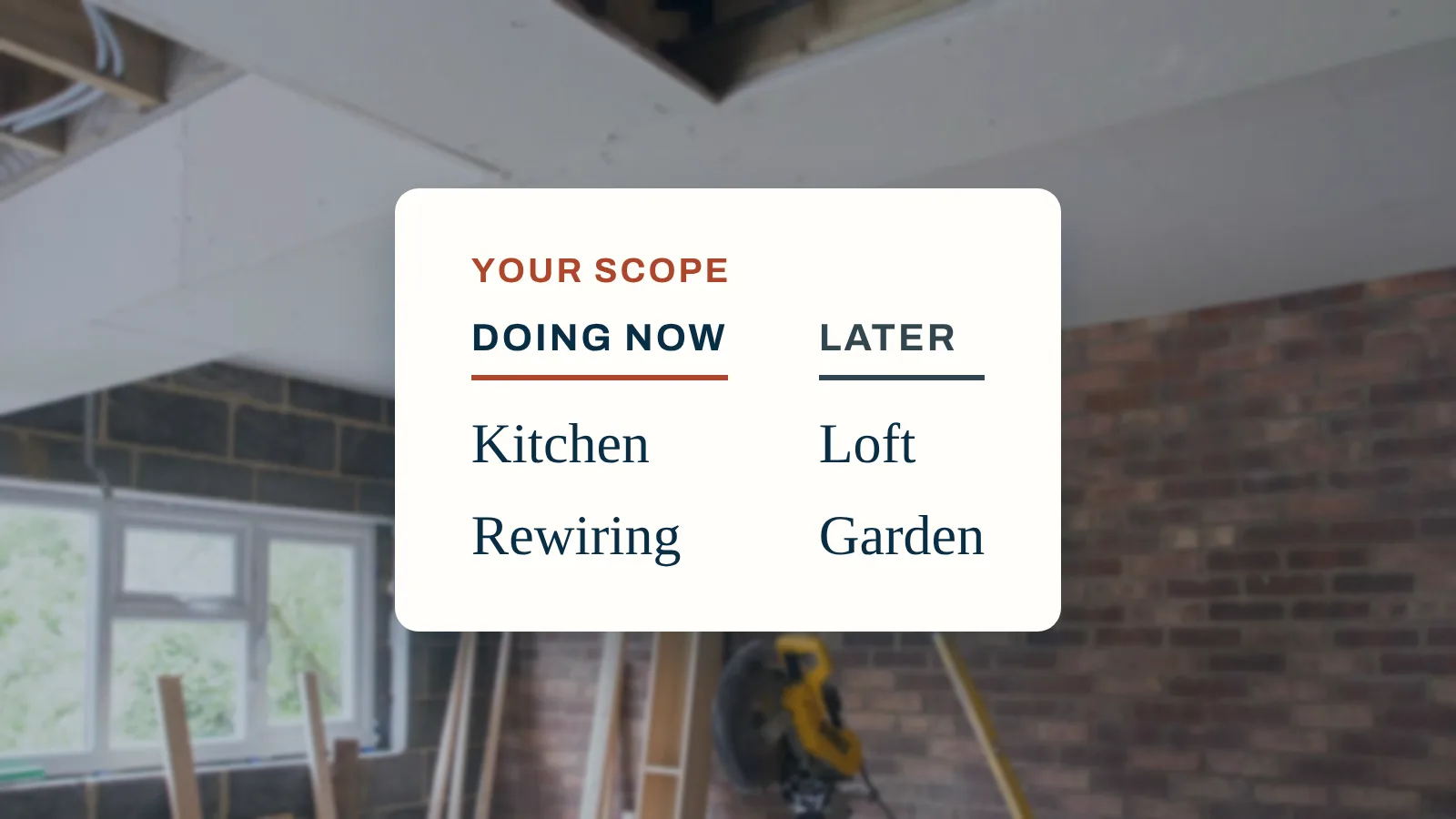
A scope of works is the written description of the job you want a builder to price: what is included, what is not, the materials and finishes, and what finished looks like. List the work room by room, name the materials, state the exclusions and flag open decisions. Then send the same document to every builder.
Without a scope, each builder quotes for the job they imagine. That is why two quotes for "a new bathroom" can be far apart and still both be reasonable.
A scope of works does three jobs at once.
Before listing tasks, write down what the work must achieve. "A kitchen we can cook in together", "a bathroom that does not get mouldy" and "a warm loft room for a teenager" are outcomes. They help you, and the builder, judge whether a proposed solution actually solves the problem.
Then walk the house and follow the connections. Changing one room often touches others:
Write each knock-on job into the scope, or into a list of open questions if you do not know the answer yet.
| Section | What it should say |
|---|---|
| 1. Project details | Address, your contact details, who is writing the scope, date and version |
| 2. The outcome | What the finished work must achieve, in one or two sentences per area |
| 3. Existing condition | What is there now, known problems, survey findings, photos |
| 4. The work, by room or area | Each task in plain words: strip out, build, install, make good, finish |
| 5. Materials and finishes | Brand, range or standard for each item, or "builder to propose" |
| 6. Who supplies what | Items you will buy, items the builder supplies, and who fits them |
| 7. Exclusions | What is not in this job, stated plainly |
| 8. Permissions and certificates | Planning, building regulations, party wall, certificates you expect at the end |
| 9. Site rules | Working hours, access, parking, toilet, waste and skips, protection of other rooms |
| 10. Programme | Preferred start date, any fixed deadlines, phasing if you live in during work |
| 11. Payments | How you want to pay: stages, retention, how extras will be agreed |
| 12. Open questions | Everything still undecided, with who needs to decide it |
Tip
Number every item. When quotes come back, you can ask each builder to price against the same numbers, which makes the comparison far quicker.
Use this outline as the order for your own scope, and leave out anything that does not apply.
1. Project details
2. Outcome
3. Existing condition
4. Work, by area
5. Materials and finishes
6. Supply
7. Exclusions
8. Permissions and certificates
9. Site rules
10. Programme
11. Payments and changes
12. Open questions
Here is how one area looks when filled in. It is an illustration of the level of detail, not a recommended specification. Our bathroom renovation budget shows how to price the same lines.
| No. | Item | Detail |
|---|---|---|
| 4.1 | Strip out | Remove bath, basin, WC, tiles and flooring. Remove waste from site. Protect landing carpet. |
| 4.2 | First fix | Move WC waste 600 mm to the window wall. New supply pipes to shower. Install extractor fan ducted to outside. New lighting circuit with two downlights. |
| 4.3 | Walls and floor | Board walls in the shower area with tile backer board. Level the floor. |
| 4.4 | Fit | Fit client-supplied shower tray, glass screen, basin and WC. Builder supplies valves and fittings to match. |
| 4.5 | Tiling | Floor-to-ceiling tiles in shower area, half height elsewhere. Tiles client-supplied; builder supplies adhesive, grout and trims. |
| 4.6 | Finish | Seal all joints, fit accessories, decorate ceiling and walls not tiled. |
| 5 | Materials | Shower valve: thermostatic, builder to propose two options with prices. |
| 7 | Exclusions | Heated towel rail (separate decision). Landing redecoration. |
| 8 | Certificates | Electrical work to be certified; certificate handed over at completion. |
| 12 | Open questions | Is the floor under the old bath sound? Builder to inspect after strip out and price any repair separately before proceeding. |
Notice what this does. Two builders reading it will price the same tray position, the same tiling height and the same extractor fan. The one genuine unknown, the floor under the bath, is named, and there is an agreed way to deal with it.
Watch out
"allow for" and "as required" are the two most expensive phrases in a scope. If you cannot specify an item yet, give it a clear allowance (for example "tiles: allowance of £30 per square metre, client to choose") so every quote uses the same figure.
Some work needs permission before it starts, and some needs certificates when it ends. Put both in the scope so they are priced and nobody assumes the other is handling them.
In the UK (England and Wales)
Citizens Advice says you usually need planning permission to build something new, make a major change to an existing building such as an extension, or change a building's use, and points to GOV.UK's planning permission guide to check. Separately, most plumbing, electrical and heating work and anything affecting energy efficiency falls under building regulations. GOV.UK says you do not need to get building regulations approval yourself if you use someone registered with a competent person scheme, and warns that without approval you will not have the certificates you may need when you sell. Other parts of the UK, and other countries, have their own systems.
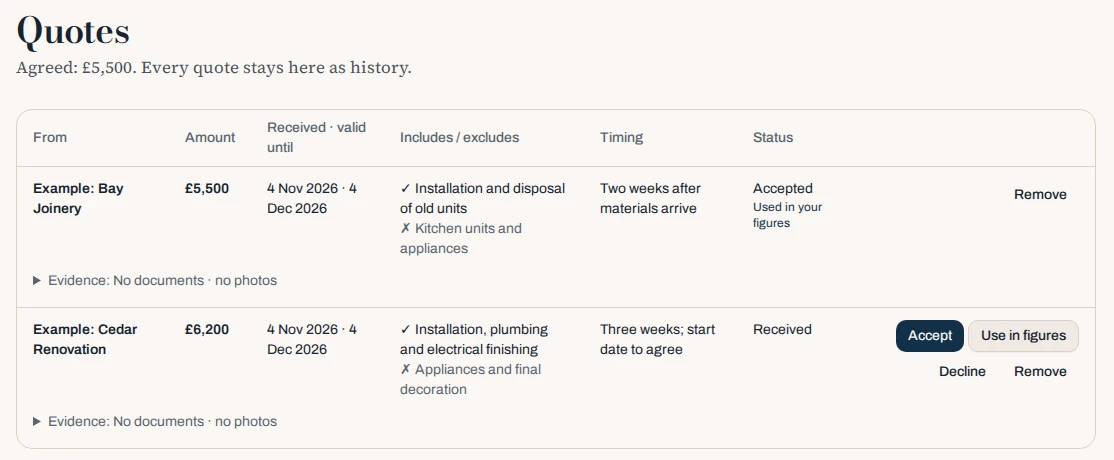
Mekozo lines up the quotes that come back on your scope side by side, with what each includes and excludes and its timing, and it turns your scope into a scope of works PDF you can send to every builder.
Try it free for 30 days, no card neededCitizens Advice suggests getting written quotes from at least three traders, and RICS suggests at least three detailed quotes. Our guide to what a good builder quote includes shows how to compare them line by line.
On the Operation Sicily villa
From the villa in Sicily. When Mekozo's founder, Jonathan Smith, needed plastering quotes for his villa, he sprayed green crosses on every wall and ceiling he wanted skimmed, so the plasterers could see exactly what to price, as he shows in Episode 29 of Operation Sicily, where he films the renovation. The scope was on the walls themselves. Earlier, his planning paperwork shaped the scope too: one SCIA notification, filed through a geometra, covered an outbuilding for the well pumps, a staircase to the roof terrace, a patio, new windows and the electrical work. He then asked electricians to quote for a complete rewire, air conditioning, a new consumer unit and the supply for a pool, garden lighting and the rear patio (Episode 11). Listing every item up front is what makes quotes from different trades comparable. His practical guide to renovating a house in Sicily covers the Italian permissions in detail.
Playing loads YouTube’s external player.
Watch directly on YouTube ↗A scope is not finished when the builder starts. Keep it as the reference for the whole job.
For where scoping sits in the wider plan, see our home renovation checklist, our guide to setting a home renovation budget, and our guide to planning a renovation, from the first idea to the quotes. When you are ready to put prices against your scope, the renovation budget tracker shows how to keep estimates, quotes and agreed prices apart. Your first step in Mekozo: set up your first project and write the scope against it.
This guide explains how to describe building work so it can be priced. It is not legal or professional advice; for structural, gas or electrical work, use qualified professionals.
A scope of works is a written description of the building work you want done: what is included, what is not, the standard of materials and finishes, and what finished looks like. It is what builders price from, so a clear scope is the first step to quotes you can compare.
It should include the project and property details, the outcome you want, the work room by room or trade by trade, the materials and finishes, what is excluded, who supplies what, permissions and certificates, site rules, and a list of open questions. Each item should be specific enough that two builders would price the same thing.
On a small job, homeowners often write it themselves and refine it with the builders who quote. On larger or structural work, an architect, surveyor or designer usually prepares drawings and a specification. RICS recommends that major extensions are fully designed so builders can give comparable quotes.
They overlap. A scope of works describes what will be done and to what standard; a schedule of works usually breaks that into itemised tasks, often with quantities and prices. Many homeowners combine them into one document, which is fine as long as it is specific.
Detailed enough that two builders reading it would price the same job. If an item could be done in a cheap way and an expensive way, say which you want or mark it as a choice still to make. Vague items are where quotes drift apart and extras appear later.

Jonathan Smith is the founder of Mekozo and Operation Sicily. Jonathan bought an abandoned villa in Sicily and is rebuilding it on camera, every week. Mekozo is the app Jonathan built to keep that renovation's money in one picture.
Real renovation experience and regional guidance from Operation Sicily.
What a good builder's quote includes, what to ask every builder to send back, and how to compare quotes like for like rather than by the total.
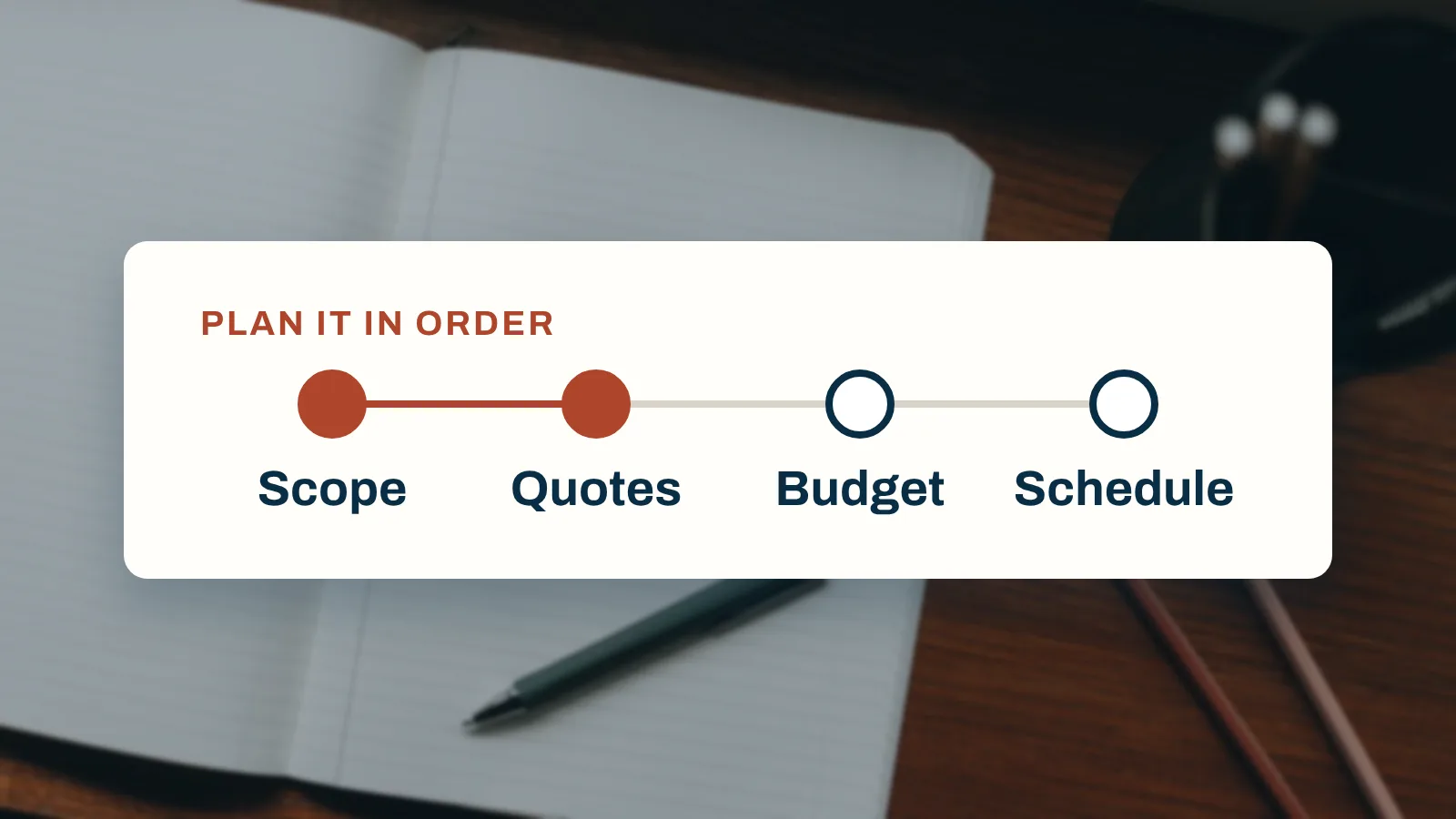
A renovation goes better when the decisions come in the right order. A phase-by-phase checklist from first idea to handover: what to decide, what to check, who to book and what order the work goes in, with the sources behind each step.
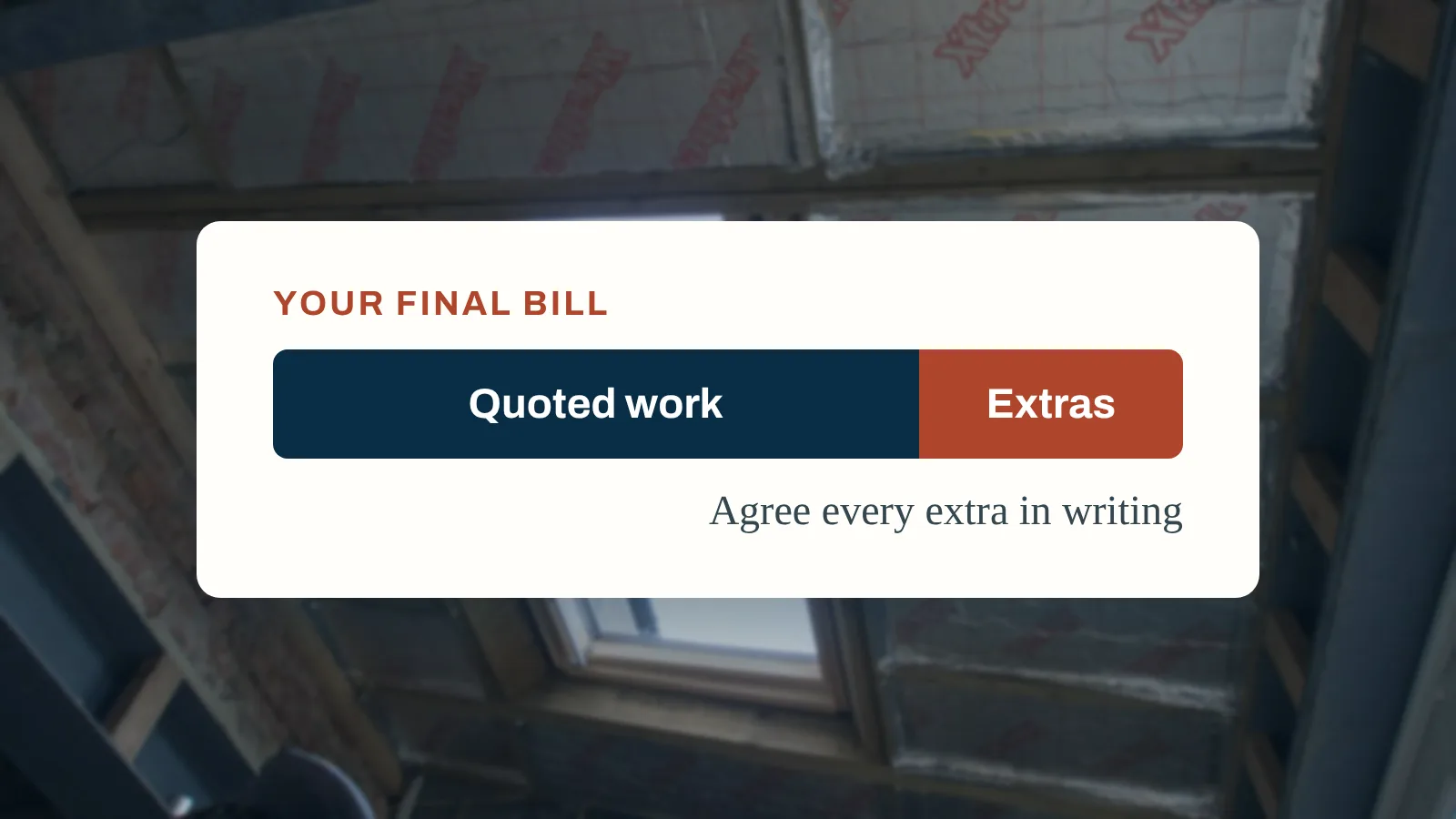
Changes and extras are where renovation budgets drift. What a variation is, the four kinds of change, a five step way to agree each one before the work, and a change log you can copy.
Budgets, quotes, payments, documents and decisions in one place
30 days free. No card needed.
Monthly, with no annual plan. The Terms of membership set out the details.