
Renovation work underway
How to find a good builder, and the questions to ask
Where to find builders worth calling, how to check they are who they say they are, and the questions to ask before you hire, with what a good answer sounds like.


A good payment schedule keeps your money roughly level with the work done. How to set the deposit, the stages and the final payment, how to pay safely, and what to record each time.
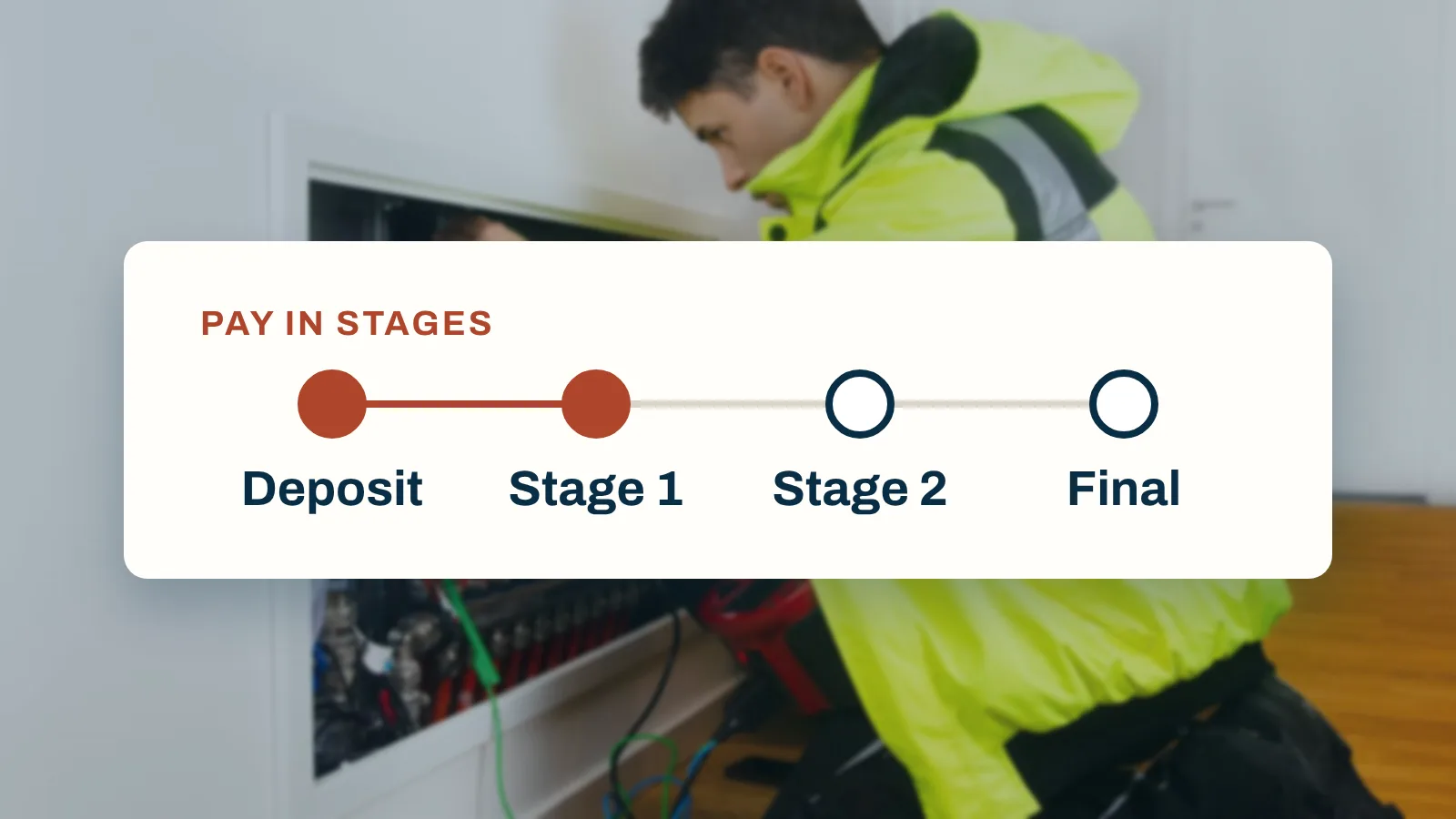
Pay a contractor in stages tied to finished work. Keep any deposit small, pay each stage only once that part of the job is done and checked, pay by card or bank transfer rather than cash, and keep a final payment back until the snagging list is closed. Agree the schedule in writing before work starts.
The aim of a payment schedule is simple: your money should stay roughly level with the work done. Pay too far ahead and you carry the risk if the builder disappears or the work goes wrong. Pay too far behind and a good builder ends up funding your job, which is not fair either. This guide shows how to set it up, how to pay safely, and what to record.
Most building jobs are paid in some version of four parts.
| Part | When it is paid | What it is for |
|---|---|---|
| Deposit (if any) | Before work starts | Usually materials or securing a start date |
| Stage payments | As each defined stage is finished | The work done in that stage |
| Payments for changes | When each agreed change is done | Extras agreed in writing |
| Final payment | When the job is complete and snags are closed | The last part of the work, and the finish line |
The amounts depend on the job, but the principle does not: each payment follows work you can see.
In the UK (England)
Citizens Advice says paying in stages is a good idea, because it means problems can be put right before you make the final payment, and suggests being clear about the points in the work when payments are due.
A deposit is money paid before any work is done. It is the payment most at risk if something goes wrong.
Watch out
A request for most of the money upfront, or for cash only, is a warning sign. Citizens Advice suggests avoiding traders who only accept cash or want you to pay everything upfront.
A stage payment should be triggered by something you can check, such as "first fix electrics complete", not "week 3". Dates slip; work done is a fact.
Good stages are:
An illustrative stage plan for a bathroom refit:
| Stage | Finished when | Share of price |
|---|---|---|
| Materials | You have bought them yourself, or a small deposit with receipt | Up to 10% |
| Strip out and first fix | Old bathroom out, pipes and cables run, checked before covering | 25% |
| Plaster and tiling | Walls plastered and tiled, floor laid | 30% |
| Fit-out and second fix | Sanitaryware, taps, lights and fan working | 25% |
| Completion | Snagging list closed, certificates and guarantees handed over | 10%, plus any share not taken as a deposit |
Illustrative only. Agree shares that match the value of each stage on your job.
Tip
Take a photo of each stage when it is finished, before you pay. Our guide to renovation before and after photos covers what to record while the walls are open.
How you pay changes what you can do if something goes wrong.
| Method | What Citizens Advice says |
|---|---|
| Credit card | Pay by card if you can. For a single item costing more than £100 and no more than £30,000, you can ask the card provider for your money back under Section 75 of the Consumer Credit Act |
| Debit card | You may be able to get money back through the chargeback scheme if something goes wrong |
| Bank transfer | Use if you cannot pay by card. It cannot be claimed through chargeback or Section 75; you might get money back if you were the victim of a scam |
| Cash | Do not pay with cash |
Sources: Citizens Advice, Before you get work done on your home and Getting your money back if you paid by card.
In the UK
Citizens Advice notes that a Section 75 claim can include a deposit paid by credit card, even if that deposit was less than £100, as long as the item itself fits the price range. It also warns that if you do not pay off a credit card on time, you will usually be charged interest. This is general information, not financial advice.
Watch out
If you receive an email or message saying the builder's bank details have changed, do not pay until you have checked by phone, using a number you already had. If you think you have been scammed after a bank transfer, Citizens Advice explains how to check if you can get your money back.
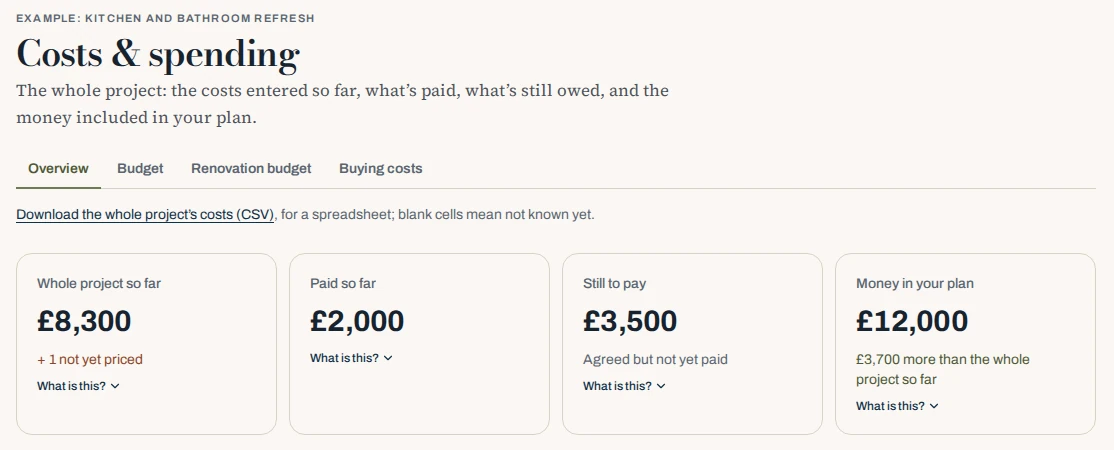
Mekozo's Costs & spending view shows what is paid so far and what is agreed but still to pay, across every job.
Try it free for 30 days, no card neededEvery payment needs a record that you can find in a minute. For each one, note:
An invoice is the bill for agreed work; record it, then the payment against it. Before paying any invoice, check it against the agreed price and the stage it claims. Our guide to organising renovation receipts and invoices covers the paperwork, and our guide to keeping agreed prices, invoices and payments apart explains why those figures need to stay separate for every job.
Extras are a new commitment, not a quiet change to the old price. Agree each change in writing with its price before it is done, then pay for it as its own line when it is finished. That written agreement is a variation or extra (change order), and our guide to variations and extras shows what to put in it.
That keeps two things separate that otherwise get tangled:
The final payment is your strongest reason for the builder to come back and finish properly. It should be large enough to matter and small enough to be fair for what is left.
Release it when:
Tip
Before the last payment, set three totals side by side: the agreed price plus agreed changes, what you have already paid, and the final invoice. If they do not add up, find out why before any more money goes.
Write the payment schedule into the agreement before work starts, so neither side has to remember it.
Our guide to the home improvement contract covers the rest of what to agree in writing.
In the UK (England)
If a builder asks for more than the quoted price, Citizens Advice explains that a trader cannot charge more than a quote unless there is a good reason, such as extra work you agreed to pay for, and that they cannot charge more just because their own costs have gone up since the quote. Check your paperwork, and put your position in writing.
If you see these, pause the next payment, talk to the builder, and agree in writing how the schedule will get back in line.
On the Operation Sicily villa
From the villa in Sicily. At the villa Mekozo's founder, Jonathan Smith, is renovating, the kitchen units were ordered and paid for months before they were fitted, because there was a three month lead time, as he shows in Episode 92 of Operation Sicily. For those months the money was committed but the kitchen was not there: exactly the kind of payment that needs a clear record of what was paid, to whom and what is still to come. Even at the reveal, the tap and the sink trap were still to fit, a small finish line before the job was truly complete. In his guide to renovation costs in Sicily, he suggests keeping dates, scope, materials and payment milestones visible so a change in cost can be traced to a change in the job, agreeing payment milestones and how extra work is approved in writing, and treating an informal cash price as no real comparison with a documented offer.
Playing loads YouTube’s external player.
Watch directly on YouTube ↗For the rest of this stage, see our guide to paying and managing builders while work is underway and how to find a good builder before you agree any payments. Our help guide shows how to track agreed, paid and still to pay for every job, and the renovation budget tracker puts it in one place.
This guide explains a practical method for paying for building work. It is not legal or financial advice. Payment protections differ by country and card provider: check the official guidance where you live.
As little as possible. Citizens Advice suggests avoiding deposits or upfront payments where you can, offering to buy materials yourself instead, and if a deposit cannot be avoided on a long job, pushing it down as far as possible and not agreeing to more than 25%. Always get a receipt for it.
One where each payment follows a defined stage of finished work, so you are never paying far ahead of what has been done, and the builder is not funding the whole job themselves. A small deposit or materials payment, several stage payments and a final payment after snagging is a common pattern.
Citizens Advice suggests paying by debit or credit card if you can, then by bank transfer, and not with cash. It says to avoid traders who only accept cash or want everything paid upfront, and notes that cash and bank transfer payments cannot be claimed back through chargeback or Section 75.
Pay for each stage once it is finished and you have checked it, not before. Keep a final payment back until the whole job is complete, the agreed snagging list is closed, and you have the certificates, guarantees and manuals for the work.
Keep it small, pay by credit card if you can, and get a receipt. Citizens Advice suggests checking whether the trader has insurance to protect your deposit if they go out of business, or uses an escrow scheme, and checking that any escrow company is registered with the Financial Conduct Authority.
Jonathan Smith is the founder of Mekozo and Operation Sicily. Jonathan bought an abandoned villa in Sicily and is rebuilding it on camera, every week. Mekozo is the app Jonathan built to keep that renovation's money in one picture.
Real renovation experience and regional guidance from Operation Sicily.
Where to find builders worth calling, how to check they are who they say they are, and the questions to ask before you hire, with what a good answer sounds like.
Changes and extras are where renovation budgets drift. What a variation is, the four kinds of change, a five step way to agree each one before the work, and a change log you can copy.

A snagging list (a punch list) records every defect left at the end of a job. How to write one room by room, agree it with your builder and close it before the last payment.
Budgets, quotes, payments, documents and decisions in one place
30 days free. No card needed.
Monthly, with no annual plan. The Terms of membership set out the details.