How do you buy a house in France?
Buying a house in France usually follows five steps: make a written offer, sign a preliminary contract (a promesse or compromis de vente) and pay a deposit, use your 10-day withdrawal period, let the notaire complete the checks, then sign the final deed and pay the balance. Budget for the notaire's costs, the taxes they collect, agency fees, a survey and running costs on top of the price.
This guide sets out each step, the cost headings to plan for, and the official French and UK sources to check. It explains the method; it is not legal or tax advice, and the figures that apply depend on the property and on you.
The steps of buying a house in France at a glance
| Step | What happens | Who is involved |
|---|
| 1. Budget and search | You set the whole-project budget and view homes | You, agents, sellers |
|---|
| 2. Written offer | You make an offer in writing at a stated price | You, the seller or agent |
|---|
| 3. Preliminary contract | A promesse unilatérale or compromis de vente, with a deposit | You, the seller, a notaire or agent |
|---|
| 4. Withdrawal period | 10 calendar days in which you can withdraw | You |
|---|
| 5. Checks and conditions | The notaire's searches, your loan and any survey | Notaire, lender, surveyor |
|---|
| 6. Final deed | The acte authentique is signed and the balance paid | Notaire, you, the seller |
|---|
| 7. Registration | The notaire registers the sale with the land registry service | Notaire |
|---|
Step 1: set the budget before you search
Work out the whole cost of the purchase, not only the price: the notaire's costs, any agency fee, the survey, translation, travel and the first year of running costs. Our guide to the full list of buying costs explains each heading. If the house needs work, price the essential work before you decide what you can offer.
Step 2: make a written offer
An offer to buy (offre d'achat) sets the price and how long the offer stands. Put it in writing and say what it depends on, for example a survey or a loan. If the seller accepts, the next step is the preliminary contract.
Step 3: sign the preliminary contract
Service-Public.fr describes two kinds of preliminary contract for an existing home:
- The promesse unilatérale de vente. The seller commits to sell to you for a set period, and you have the option to buy. The deposit, called an indemnité d'immobilisation, is usually between 5% and 10% of the price.
- The compromis de vente (promesse synallagmatique). Both of you commit to the sale. The deposit, called a dépôt de garantie, generally corresponds to about 10% of the price.
Either contract can include conditions (conditions suspensives), such as getting a loan, obtaining a planning certificate or the local authority not using its right of pre-emption. If a condition is not met, the sale does not go ahead.
Watch out
GOV.UK's purchaser's list says not to let agents or sellers hurry you into a binding decision, and to understand everything in the contract before you sign. If you need a loan or the sale of another property, make sure a condition to that effect is in the contract. If you plan work that needs planning permission, add a condition letting you withdraw if it is refused.
Step 4: use the 10-day withdrawal period
In France
A non-professional buyer of a home has a withdrawal period (délai de rétractation) of 10 calendar days, according to Service-Public.fr. It starts the day after the contract is first presented to you by registered letter. Withdraw within that time and you do not need to give a reason. After it, your deposit is at risk unless a condition in the contract is not met.
Use these ten days for the questions you could not answer before signing: read the diagnostics again, check the plans, and confirm your budget with the real figures.
Step 5: the checks, your loan and any survey
While the conditions run, the notaire carries out the legal checks and prepares the deed. This is also the time for your own checks.
GOV.UK makes three points worth building into your timetable:
- Local searches in France do not reveal as much as UK searches, so ask the agent or notaire in writing about the surrounding area and any major development plans.
- The seller's diagnostics are not the equivalent of a full survey. If you want a structural survey, arrange it before you sign, or include a properly worded condition that lets you withdraw if it is unsatisfactory.
- Two or more months may pass between contract and completion.
Step 6: sign the final deed
The final deed (acte authentique de vente) must be drawn up by a notaire, according to Service-Public.fr. The buyer, the seller or their representatives and the notaire sign it. At signing, the buyer pays the whole of the price and the notaire's costs.
Tip
GOV.UK advises arranging transfers to the notaire's client account at least 10 days before completion so the funds clear in time. It also warns never to agree to pay any part of the price in cash: pay only through established banking channels to the agent or notaire.
Step 7: registration
After signing, the notaire registers the sale at the land registry service (service de publicité foncière). Service-Public.fr explains that this makes the sale public and protects your right of ownership against third parties. Keep the deed and the notaire's final account with your purchase records.
The diagnostics the seller must provide
The seller has to give you a file of technical diagnostics (dossier de diagnostic technique). Which ones apply depends on the age, type and location of the home. Service-Public.fr lists them:
| Diagnostic | When it applies |
|---|
| Energy performance (DPE) | For a flat, and for a house of 50 m² or more |
|---|
| Energy audit | For a house rated E, F or G on the DPE |
|---|
| Lead (Crep) | If the home was built before 1 January 1949 |
|---|
| Asbestos | If the building permit was issued before 1 July 1997 |
|---|
| Electrical installation | If the installation is more than 15 years old |
|---|
| Gas installation | If the installation is more than 15 years old |
|---|
| Waste water and drainage | For a private system, and in some areas for mains drainage |
|---|
| Termites | In areas declared at risk by the prefecture |
|---|
| Natural and other risks | In a risk zone, including natural, mining, seismic and radon risks |
|---|
| Airport noise | Near an airport, in a noise exposure zone |
|---|
| Dry rot (mérule) | The contract must state whether there is a risk, in areas set by order |
|---|
| Home information record (CIL) | For work covered by a permit or declaration filed from 1 January 2023 |
|---|
GOV.UK links to the French government's directory of certified diagnostic companies. Read each report, not just the summary, and turn anything that worries you into a question for the notaire, a surveyor or a builder. A poor electrical or drainage report is a cost heading, not a footnote.
Watch out
A diagnostic records the condition on the day it was done. It does not tell you what the work will cost. If the house needs work, get written quotes for the items the reports raise before the end of your withdrawal period or the conditions.
The costs of buying a house in France
Every purchase has the same cost headings. The rates and who pays them depend on the property and your situation, so treat this as a list to price, not a set of figures.
| Cost heading | What it is | Where to check |
|---|
| Notaire's costs | Taxes collected for the state, the notaire's own fees and disbursements | The notaire's written estimate, Service-Public.fr |
|---|
| Estate agency fee | If an agent is involved; the contract says who pays | The agency mandate and listing |
|---|
| Deposit | Paid at the preliminary contract and counted towards the price | The contract |
|---|
| Survey | Optional, but worth considering for an older house | A written quote |
|---|
| Independent legal advice | If you want a lawyer as well as the notaire | A written quote |
|---|
| Translation | Of contracts, diagnostics and correspondence | A written quote |
|---|
| Currency transfer | Charges and the rate on the day you pay | Your bank or provider |
|---|
| Lender fees, if borrowing | Charged by the lender | The lender |
|---|
| Travel | Viewing trips, signing and handover | Your own estimate |
|---|
| Work the diagnostics raise | Electrics, drainage, roof or damp | Written quotes |
|---|
Notaires.fr puts the total at about 7% to 8% of the price for an existing home and 2% to 3% for a new one, because a new home carries a much lower rate of transfer duty. Service-Public.fr explains that the notaire's costs (often called frais de notaire) are made up of three parts: the duties and taxes the notaire collects and passes to the state (registration duty, land registration tax or VAT), the notaire's own pay for drawing up the deed and related work, and costs paid out on behalf of the buyer and seller, such as a cadastral extract.
In France (tax)
The taxes on a purchase depend on the type of property, for example whether it is new and subject to VAT or an existing home. Service-Public.fr publishes a simulator for the costs of acquisition on its buying a home page. Transfer duty is set partly by each département, and Service-Public.fr reports that départements may raise their rate by 0.5 points from 1 April 2025, which many have done, so check the current rate where you are buying. Of the two local taxes, taxe foncière is paid by owners, and taxe d'habitation has been abolished for main homes since 2023 but still applies to second homes. Mekozo does not give tax advice: ask the notaire for a written estimate and check the current rules for your circumstances.
Running costs after you buy
Budget for these from the first year:
- Local taxes. Taxe foncière every year, and taxe d'habitation as well if it is a second home.
- Service charges. For a flat in a copropriété, GOV.UK says the charges for shared areas vary with the size and quality of the building, and are found in the minutes of the last annual meeting of co-owners. Ask for them before you sign.
- Insurance, utilities and maintenance. Including any private drainage system that needs emptying or servicing.
- Travel and stays. If it is a second home, every visit has a cost.
Buying off-plan in France
GOV.UK says payments for a property bought off-plan should not exceed set limits at each stage of the build:
- 35% of the price before the foundations are complete.
- 70% before the building is watertight.
- 95% before the building is complete (85% for an individual house).
- The balance only on handover.
For the reservation contract, the French Ministry of Justice says the buyer can withdraw within 10 calendar days of the contract being notified, and GOV.UK notes limits on the deposit depending on how far away completion is. Ask for a clear completion date in writing.
Put every cost in one list before you sign
Questions to ask before you commit
- Who pays the agency fee, and how much is it?
- What does the notaire estimate for the total costs, in writing?
- Which diagnostics apply, and what do the full reports say?
- Does the contract include every condition you need, such as a loan, a survey or planning permission?
- When exactly does your 10-day withdrawal period end?
- What are the yearly local taxes and, for a flat, the service charges?
- Are there development plans nearby, confirmed in writing by the agent or notaire?
- If you plan work, will it need permission, and from whom?
For more questions across the whole purchase, see our guide to questions to ask when buying a house, and for a structured look at the building, our house survey checklist.
Buying a house in France checklist
- Whole-project budget set, including the notaire's costs and running costs
- Written offer made, with its conditions
- Preliminary contract read in full, translated if needed, and explained before signing
- Deposit paid only through the notaire or agent, never in cash
- Withdrawal period end date noted
- Every diagnostic report read and its issues priced
- Survey arranged before signing, or a survey condition in the contract
- Written enquiries made about the surrounding area
- Notaire's written estimate of costs received
- Funds sent at least 10 days before completion
- Final deed signed and the notaire's final account kept
- First-year running costs planned
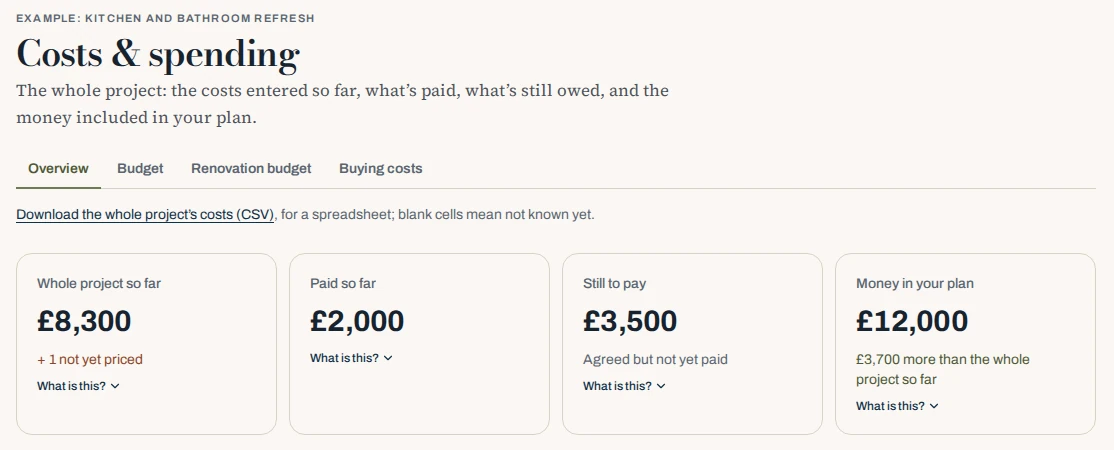
If you are also looking further afield, compare this with our guides to buying a house in Spain, buying a house in Italy and buying a house in Portugal. For the earlier stages, see our guide to finding and comparing homes before you buy. To keep a French purchase and all its costs together, see how Mekozo keeps every buying cost in one list.
This guide explains the steps and cost headings of a purchase. It is not legal or tax advice; check the current rules with the official French sources, the notaire and a qualified, independent adviser.