House survey checklist: what to check before you buy
A house survey tells you about a home's condition before you commit. Which RICS level to book, what it covers and leaves out, a checklist to use alongside it, and how to act on the report.
A house survey is a professional check of a home's condition before you commit to buy.
In the UK, RICS Home Surveys come in three levels; Level 3 is for large, older, run-down, unusual or altered homes, or where major works are planned.
Surveys are visual: RICS says its surveys do not test the safety of electrics, gas, plumbing, heating or drainage, so book specialist tests separately.
In the UK, check whether the home is in a radon Affected Area on the UKHSA and British Geological Survey radon map at ukradon.org.
Turn the report into a list of questions, quotes and decisions before you exchange contracts.
What is a house survey, and what should it check?
A house survey is a professional check of a home's condition before you commit to buy; it is called a home inspection in the US. It should cover the structure, roof, walls, windows, floors, the visible parts of the electrics, plumbing, heating and drainage, and the outside, and tell you what needs repair, how urgently, and what needs a specialist.
This guide gives you a checklist to use around the survey: which level to book, what to check yourself, what the surveyor will not look at, and how to turn the report into decisions. It does not replace a qualified surveyor.
What a house survey covers
Most surveys work through the same parts of the house. Use this as a checklist to compare against the sample report your surveyor gives you.
Part of the home
What is usually checked
What usually is not
Structure
Visible cracks, movement, sagging
Foundations below ground
Roof
Covering, chimneys, flashings, gutters, roof space
Areas without safe access
Walls
Condition, damp signs, render, pointing
Inside the wall
Windows and doors
Condition, operation, glazing
Every seal and fixing
Floors
Level, springiness, visible damage
Under fitted floor coverings
Electrics
Visible condition, consumer unit, sockets
Safety testing of the installation
Plumbing and heating
Visible pipes, boiler, radiators
Pressure tests, flue internals
Drainage
Visible parts, inspection chambers (varies)
Drain runs underground
Outside
Boundaries, paths, outbuildings, trees near the house
Detailed garden or boundary disputes
Health and safety
Obvious hazards
Specialist tests (radon, asbestos, lead)
Watch out
Surveys are visual. RICS says its Level 2 and Level 3 surveys do not assess the efficiency or safety of electrical, gas or other energy sources, and do not investigate the plumbing, heating or drainage installations or the inside of any chimney, boiler or flue (RICS, February 2021). If those matter, book the specialist test.
Choosing the right survey level
In England and Wales, RICS Home Surveys come in three levels (RICS):
RICS level
Usually suits
What you get
Level 1
A conventional home in good condition
The condition of each part, with urgent defects highlighted
Level 2
A conventional home in reasonable condition
Adds a more extensive roof space and drainage chamber inspection, and advice on repairs and maintenance; with or without a valuation
Level 3
A large, older or run-down home, an unusual or altered building, or major works planned
The most comprehensive survey and report
Reports give each part of the house a condition rating: 3 for serious or urgent defects, where RICS says written quotations for repairs should be obtained before legal commitment to purchase; 2 for repairs that are not serious or urgent; and 1 where no repair is currently needed.
In the UK
RICS says a survey is not a legal requirement in England and Wales. In Scotland, sellers must provide a Home Report.
Questions to ask before you book:
What will you inspect, and what will you not?
Can I see a sample report?
Will you go into the roof space and lift drain covers?
Do you give an idea of repair costs or only describe the defect?
When will I get the report, and can I call you about it?
Are you qualified and insured, and with which professional body?
What to check yourself before the survey
You know things the surveyor does not: what you plan to do with the house, what you saw at the viewings and what the seller told you. Give the surveyor a short brief. Our guide to questions to ask when viewing a house covers what to look for at the viewing itself.
Your plans: extension, loft, new kitchen, removing walls
Anything that worried you at the viewings: cracks, smells, stains, slopes
Alterations the seller mentioned: extensions, removed walls, new windows
The age of the boiler, the roof and the electrics, if the seller knows
Trees close to the house
Rooms or areas you could not see
In the UK (England and Wales)
For any alteration, ask the seller's side for the paperwork. GOV.UK lists jobs that might need building regulations approval, including replacing windows and doors, replacing roof coverings, installing a bathroom that involves plumbing and replacing fuse boxes, and notes that without approval the owner will not have the certificates they may need when they sell.
Specialist tests to consider
A general survey may recommend further investigation. Some tests are worth booking straight away, depending on the house:
Test
When to consider it
Electrical installation test
Older wiring, no recent certificate, or any doubt
Gas safety check
Any gas appliances or boiler
Drain survey (camera)
Older homes, trees near drains, slow drains, septic or cesspit systems
Damp and timber
Damp signs, older or altered homes
Structural engineer
Cracks, movement, removed walls
Roof inspection
Older roofs, signs of leaks
Radon
In the UK, look up the address on the UKHSA radon map, which UKHSA and the British Geological Survey updated for Great Britain; test if it is in an Affected Area
Asbestos, lead paint, mould, pests
Ask the surveyor whether these are relevant to your home, especially if it is older
Tip
Book specialist tests before you are committed, not after. A drain camera survey or an electrical test costs far less than putting right what it finds once the house is yours.
What to do with the survey report
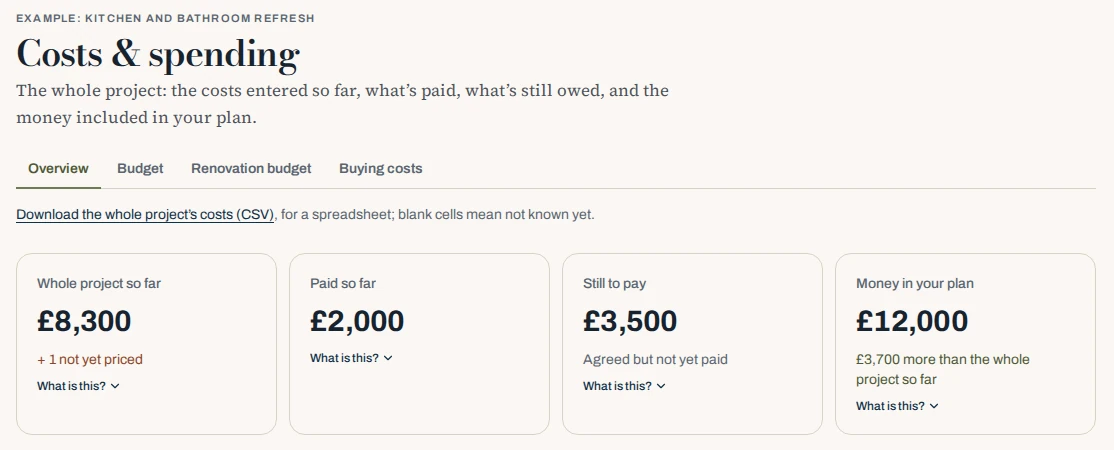
Mekozo's Costs & spending view adds the repair quotes to the rest of the project and shows what is paid, what is still to pay and what is not yet priced, so you can decide with the numbers in front of you.
Older and run-down homes need more than a standard survey. If the house has been empty, altered or extended, or you are planning major works:
Book a RICS Level 3 survey, the most detailed level
Add a drain camera survey and an electrical test
Ask about the roof structure as well as the covering
Check for damp, timber decay and pests
Ask the seller for every document about past work
Get rough quotes for the big items before you offer, not after
Our guide to buying a fixer-upper shows how to work out the real cost before you offer.
On the Operation Sicily villa
From the villa in Sicily. When Mekozo's founder, Jonathan Smith, viewed the abandoned villa he now films for Operation Sicily, he worked through the same checks a surveyor would. The walls were solid with no structural cracks, there was no peeling paint or damaged plaster, and there was no staining on the ceilings, which suggested the roof was sound. The rodent infestation, though, was far worse than the photos had shown (Episode 9). Some things cannot be seen at all. The old cesspit had to be tested: if it had failed, replacing the system could have cost upwards of €12,000, and it passed (Episode 57). Before choosing the villa he had walked away from two other deals when the documents and plans revealed problems. His guide to the biggest red flags when buying property in Sicily covers what to check there.
This guide explains a practical method. It is not survey, legal or financial advice; use a qualified surveyor for your home, and a solicitor or conveyancer for legal points.
Questions people ask
What is the difference between a home inspection and a survey?
They are the same idea under different names. In the US a home inspector examines the home's condition before you buy; in the UK this is a survey, carried out by a surveyor. The scope and standards differ, so in England and Wales check which RICS Home Survey level you are booking and what it covers.
What does a house survey cover?
A survey usually covers the structure, roof, walls, windows and doors, floors, the visible parts of the electrics, plumbing, heating and drainage, and the outside. RICS Level 2 and Level 3 reports give each part a condition rating, from 1 where no repair is currently needed to 3 for serious or urgent defects. Ask for a sample report to see exactly what is included.
What does a survey not include?
Surveys are visual and non-invasive. RICS says its Level 2 and Level 3 surveys do not assess the efficiency or safety of electrical, gas or other energy sources, or investigate the plumbing, heating or drainage installations. Hidden parts such as inside walls, under floors and inside chimneys are usually not inspected.
Which level of RICS survey do I need?
RICS suggests Level 1 for a conventional home in good condition, Level 2 for a conventional home in reasonable condition, and Level 3 for a large, older or run-down property, an unusual or altered building, or if you are planning major works. Talk to the surveyor about the property before you book.
Can I negotiate after a survey?
Yes, you can ask the seller to repair, reduce the price or contribute, based on written evidence such as a quote. In England and Wales, raise it before you exchange contracts, because exchange is the point of legal commitment. The seller does not have to agree, so decide in advance what you would do if they say no.
Should I go to the survey?
If the surveyor allows it, going lets you ask questions and see problems for yourself. If you cannot attend, ask for a call after the survey to talk through anything serious, and make sure you get photos with the report.
Jonathan Smith is the founder of Mekozo and Operation Sicily. Jonathan bought an abandoned villa in Sicily and is rebuilding it on camera, every week. Mekozo is the app Jonathan built to keep that renovation's money in one picture.
The questions that matter across the whole purchase, from the first viewing to the binding contract, grouped by who can answer them, with a checklist you can reuse for every house.
Old houses are built differently from modern ones. What to check element by element, which permissions to confirm, the survey to ask for and how to turn what you find into a budget before you offer.