How do you buy a house in Italy?
Buying a house in Italy usually follows six steps: get your codice fiscale, find and view homes, have the building and its documents checked, make a written offer, sign the preliminary contract (compromesso) with a deposit, then sign the final deed (rogito) before a notary. Budget for purchase taxes, the notary, agency commission and professional checks on top of the price.
This guide sets out each step, the cost headings to plan for, and the official Italian sources to check, alongside notes from a real purchase by Jonathan Smith, Mekozo's founder, who films his villa renovation on Operation Sicily. It explains the method; it is not legal or tax advice, and the taxes that apply depend on the property and on you.
The steps of buying a house in Italy at a glance
| Step | What happens | Who is involved |
|---|
| 1. Codice fiscale | You get your Italian tax code | Agenzia delle Entrate or an Italian consulate |
|---|
| 2. Budget and search | You set the whole-project budget and view homes | You, agents, sellers |
|---|
| 3. Checks | The building is compared with the plans; title and charges are checked | Geometra, notary, your lawyer if you use one |
|---|
| 4. Written offer | A proposta d'acquisto, often with a deposit to the agent | You, the agent, the seller |
|---|
| 5. Preliminary contract | The compromesso, with a deposit (caparra) | You, the seller, often the notary |
|---|
| 6. Final deed | The rogito is signed and the balance and taxes paid | Notary, you, the seller |
|---|
| 7. Registration and handover | The deed is registered and the utilities change hands | Notary, you, the providers |
|---|
Step 1: get your codice fiscale
Every buyer needs an Italian tax code. Agenzia delle Entrate explains how foreign citizens can apply, including through the Italian consulate in the country where they live. From his own purchase, Jonathan's practical guide advises arranging it early, keeping the official certificate with your passport and purchase documents, and not relying on unofficial online number generators.
Step 2: set the budget and search
Work out the whole cost of the purchase, not only the price: taxes, notary, agency commission, the geometra, translation, travel and the first year of running costs. Our guide to the full list of buying costs explains each heading. If the house needs work, price the essential work before you decide what you can offer.
Step 3: have the building and the documents checked
This is the step that protects you most, and it comes before you sign anything. The notaries' council explains the notary's checks, and Jonathan's guide to the compromesso adds the checks he made first:
- A geometra's pre-purchase assessment. Does the building match the cadastral plan? Are there structures built without permission? What does the planning history at the town hall (comune) show? Where are the boundaries, and what is the land classified for?
- The notary's title checks. Is the seller the registered owner, with authority to sell? Are there mortgages, charges or registered disputes?
- The energy performance certificate (APE). Make sure it is in place.
- Outbuildings and extensions. Resolve any question about their planning status before you sign.
Watch out
In Italy, older houses often have extensions or changes that were never recorded. An unrecorded room or outbuilding can delay the deed or bring costs to regularise it. Ask the geometra to put any mismatch in writing, with what it would take to resolve. Our guide to what to look for when buying an old house covers the building side in more detail.
Step 4: make a written offer
A written offer (proposta d'acquisto) is usually made on the agent's form, states the price and terms, and comes with a deposit paid to the agent. Once the seller signs to accept it, it can become a binding preliminary contract on the terms stated, with the deposit at risk in the same way. Treat it as a contract, not a gesture: include any conditions you need, such as the checks above or a loan.
Step 5: sign the compromesso and pay the deposit
The compromesso (contratto preliminare di compravendita) commits both of you to complete at a stated price, on stated terms, by a stated date. It does not transfer ownership; that happens at the final deed. The deposit is agreed between you; in Jonathan's experience it is typically 10% to 20% of the price.
In Italy
With a deposit paid as a caparra confirmatoria, article 1385 of the Civil Code means a buyer who withdraws loses the deposit, and a seller who withdraws must pay back double. If the sale completes, the caparra counts towards the price. Every written compromesso must be registered with Agenzia delle Entrate within 30 days of signing, according to Agenzia delle Entrate's home buying guide (a notary registers one made before them). Registration costs a fixed €200, plus 0.5% of any caparra and 3% of any advance payment not subject to VAT; the percentage parts are credited against the tax on the final deed. Ask the notary or your lawyer to confirm the figures for yours.
Step 6: sign the final deed before the notary
The notary prepares the final deed (rogito or atto di compravendita), checks the transaction and collects the taxes on the deed for the state. The notaries' council explains what the notary does and does not do. If you do not speak Italian well, you may need an interpreter at the signing; ask the notary in advance.
Step 7: registration and handover
After signing, the notary registers the deed. Then change the utilities into your name, confirm the local property tax position with the comune, and keep the deed, the plans and every receipt together with your purchase records.
The costs of buying a house in Italy
Every purchase has the same cost headings. The rates and who pays them depend on the seller, the property and your own situation, so treat this as a list to price, not a set of figures.
| Cost heading | What it is | Published guide figure or where to check |
|---|
| Purchase taxes | Registration, mortgage and cadastral taxes, or VAT on some new homes | The notary's written estimate, notaries' council |
|---|
| Notary | Preparing and registering the deed, title checks | €1,500 to €3,500 (Jonathan's own figures, Sicily, 2026) |
|---|
| Estate agency commission | Often paid by both buyer and seller | Typically 3% to 4% from each side (Jonathan's own figures, Sicily, 2026) |
|---|
| Geometra | The pre-purchase check of the building and records | €500 to €2,500 (Jonathan's own figures, Sicily, 2026) |
|---|
| Registering the compromesso | Fixed tax plus a percentage of the deposit and advances | €200, plus 0.5% of the caparra and 3% of advances not subject to VAT (Agenzia delle Entrate) |
|---|
| Deposit | Paid at the offer or compromesso and counted towards the price | Agreed between you; 10% to 20% in Jonathan's experience |
|---|
| Independent lawyer | If you want advice on your side as well as the notary | A written quote |
|---|
| Translation and interpreting | Of contracts, plans and the signing | A written quote |
|---|
| Regularising past work | If the geometra finds unrecorded changes | The geometra's written estimate |
|---|
| Currency transfer | Charges and the rate on the day you pay | Your bank or provider |
|---|
| Travel | Viewing trips, signing and handover | Your own estimate |
|---|
The professional fee figures above are Jonathan's own, from his 2026 guide to buying property in Sicily, and apply to Sicily. Prices for professionals elsewhere in Italy can differ, so get written quotes for your own purchase.
In Italy (tax)
The Consiglio Nazionale del Notariato sets out the taxes on a home purchase. For a purchase from a private party without incentives, it lists a registration tax of 9%, with mortgage and cadastral taxes of €50 each, and a minimum registration tax of €1,000. Lower rates can apply in some circumstances, which the notary will confirm. For a private individual buying a home, the buyer may ask for the registration tax to be calculated on the cadastral value rather than the price. A purchase from a builder or renovator is usually subject to VAT instead, plus fixed taxes. Which rules apply depends on the seller and on you. Mekozo does not give tax advice: ask the notary to confirm the taxes in writing before you sign.
Running costs after you buy
Budget for these from the first year:
- Local property and waste taxes. IMU, the municipal property tax, is normally due on a second home, and TARI, the waste tax, is charged on homes connected to services. The comune sets the rates and dates, so ask it what applies to your home.
- Insurance, utilities and maintenance. Including any private water or drainage system.
- Condominium charges. For a flat in a shared building, ask for the last accounts before you sign.
- Travel and stays. For a second home, every visit has a cost.
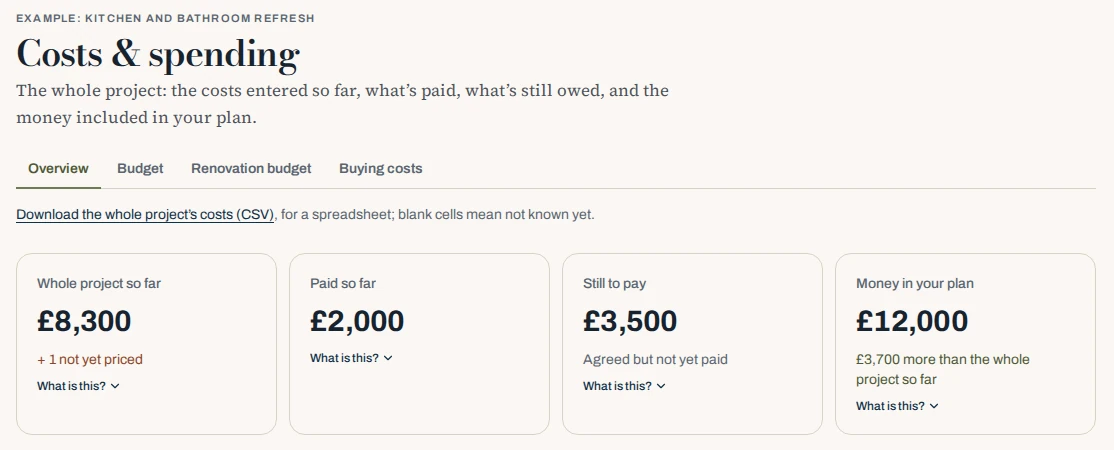
Put every cost in one list before you sign
A cheap house, a 1 euro house or a ready home?
Italy has very different markets side by side: ready-to-live homes, houses that need work sold on the open market, and the symbolic 1 euro houses offered by some towns. The steps above apply to all of them, but the budget does not. A cheap house usually needs the biggest renovation budget, and a 1 euro house comes with deadlines and a deposit. Our guide to 1 euro houses in Italy covers those schemes, and our guide to buying a fixer-upper shows how to work out the real cost of any house that needs work before you offer.
Questions to ask before you commit
- Does the building match the cadastral plans, and is every room and outbuilding authorised?
- Who is the registered owner, and are there any mortgages or charges?
- Is the deposit a caparra confirmatoria, and what happens if either side pulls out?
- What deadline does the compromesso set for the final deed?
- What does the notary estimate for the taxes and fees, in writing?
- What commission does the agent charge you, and when is it due?
- Is there a valid energy certificate?
- What local taxes and, for a flat, condominium charges will you pay each year?
For more questions across the whole purchase, see our guide to questions to ask when buying a house, and for a structured look at the building, our house survey checklist.
Buying a house in Italy checklist
- Codice fiscale applied for early, through an official route
- Whole-project budget set, including taxes, notary, commission and running costs
- Geometra's check of the building, plans and planning history done before any signature
- Notary's title and charges check requested
- Written offer made with the conditions you need
- Compromesso read in full, translated if needed, and explained before signing
- Deposit terms understood
- Notary's written estimate of taxes and fees received
- Interpreter arranged for the signing, if needed
- Final deed signed and registered
- Utilities and local taxes moved into your name
- First-year running costs planned
If you are comparing countries, see our guides to buying a house in Spain, buying a house in France and buying a house in Portugal. For the earlier stages, see our guide to house hunting and comparing homes. To keep an Italian purchase and all its costs together, see how Mekozo keeps every buying cost in one list.
This guide explains the steps and cost headings of a purchase. It is not legal or tax advice; check the current rules with the official Italian sources, the notary and a qualified, independent adviser.