There is no single right figure for home maintenance. Build the budget from your own house in three parts: regular servicing, an allowance for small repairs and a fund for the big replacements, checked against named UK prices.
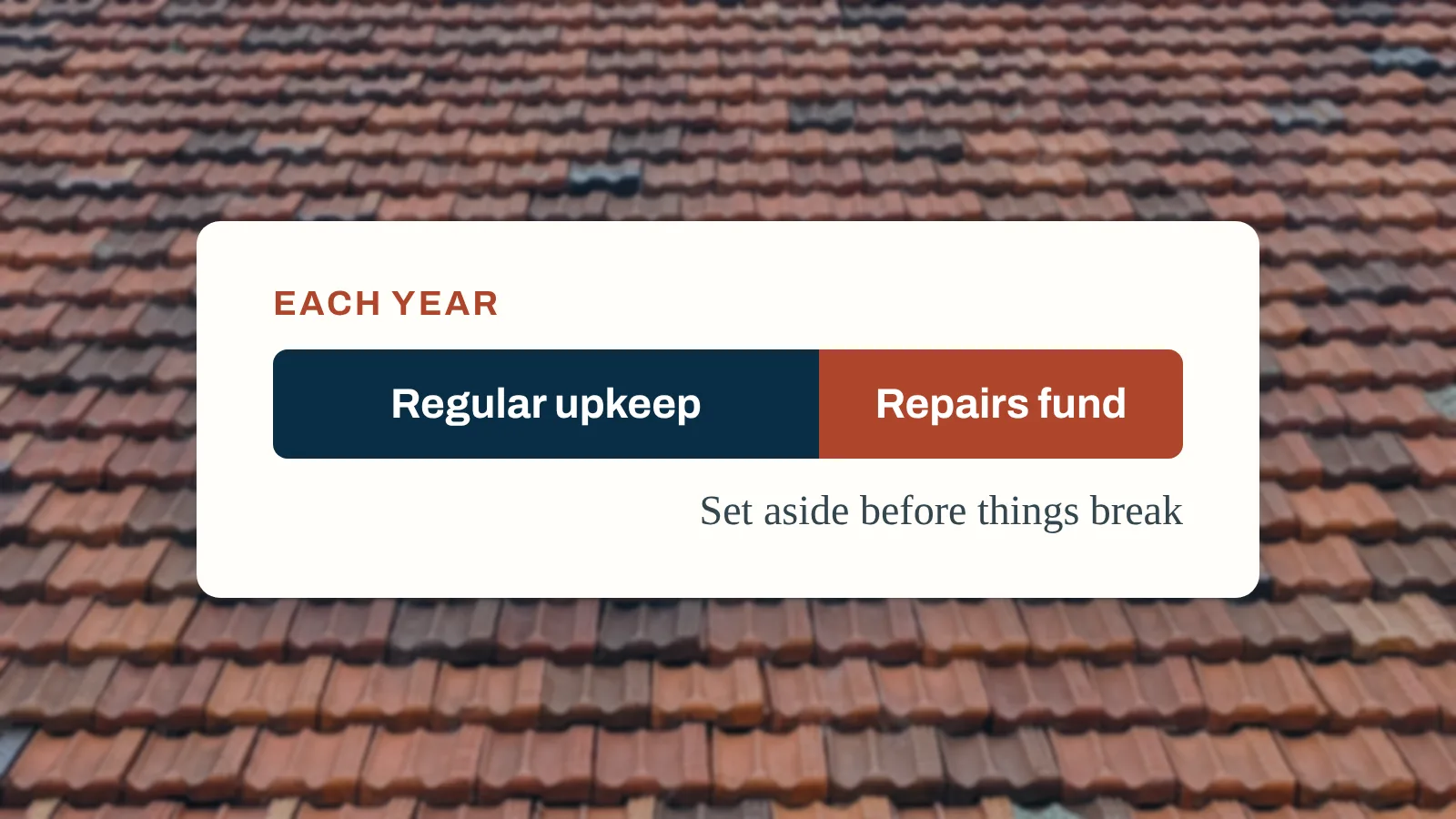
Build a home maintenance budget in three parts: regular servicing, an allowance for small repairs, and a fund for big replacements such as the boiler or roof.
Percentage rules of thumb are widely repeated, but a budget built from your own house, its age and its records is more reliable.
Which? found a one-off gas boiler service usually costs £70 to £110, with an average of around £79 (survey of boiler customers, June 2025).
Which? Trusted Traders priced clearing all gutters at £75 to £350 and replacing one to six roof tiles at £75 to £400, excluding VAT (November 2025).
Record what you actually spend each year, so next year's budget is based on your home rather than a guess.
Budget for home maintenance by building the figure from your own house in three parts: the regular servicing it needs, an allowance for small repairs based on what you spent last year, and a yearly amount towards replacing big items such as the boiler or roof. Check each line against named prices and your own quotes, then record what you really spend.
That gives you a figure you can trust, rather than a percentage that knows nothing about your roof. This guide walks through each part, with named UK prices to check against, and shows how your records make next year's budget easier.
Why a percentage rule is not enough
You will often see a home maintenance budget given as a percentage of the home's value, such as the so-called 1% rule. It is easy to remember, but it has two problems:
It follows the house price, not the house. Two homes worth the same can need very different upkeep: one has a new roof and boiler, the other has both near the end of their life.
We have found no official UK source for it. It is a rule of thumb, repeated widely, not a measured figure.
Use a rule of thumb as a rough sense check at most. The budget that works is the one built from your home's own needs.
The three parts of a home maintenance budget
Part
What it covers
How to size it
1. Regular servicing
Boiler service, chimney sweep, gutter clearing, septic tank emptying
Known jobs at known intervals, priced from last year or quotes
2. Small repairs
Slipped tiles, dripping taps, a failed extractor fan, a stuck lock
Last year's spend, or a set monthly allowance if you have no history
Age of each item, a price range, and the years left before it needs replacing
Keep improvements, such as an extension or a new kitchen, out of this budget. They are projects, and our guide to setting a home renovation budget covers them.
Step 1: price the regular servicing
Start with the jobs that come round on a schedule. Our home maintenance checklist lists them month by month and year by year. Then put a price against each.
Some published prices help as a check:
Job
How often
Price
Source
Gas boiler service (one-off)
Every year
£70 to £110, average around £79
Which?, survey June 2025, article updated 7 October 2026
Gas Safe Register recommends an annual safety check and service for any gas appliance unless the manufacturer's guidelines say otherwise (Gas Safe Register). For a job that comes round less than once a year, divide its cost by the number of years between visits and budget that amount every year.
In the UK
The intervals above are UK guidance for owner-occupied homes. Rented homes have different rules, and so do other countries; check the official guidance where your home is.
Step 2: set an allowance for small repairs
Small repairs are the hardest to predict and the easiest to underestimate. Which? found that the average cost people paid for a one-off repair following a boiler service was £156 (survey of boiler customers, June 2025). Its Trusted Traders priced replacing one to six broken or missing roof tiles at £75 to £400, and a single ridge tile at £80 to £300, excluding VAT (November 2025).
How to set the allowance:
If you have last year's records, total what you spent on repairs and use that as the starting figure.
If you have no records yet, pick a monthly amount you can afford, and review it after a year of real spending.
If the house is older or you know of problems, raise the allowance. A survey report is a good guide to what is coming.
Tip
A call-out fee is part of the repair cost. Record it with the job, or your repair allowance will always look too low.
Step 3: build a fund for big replacements
Big replacements are not surprises if you know how old things are. They only feel like surprises when the records are missing.
List the big items: boiler or heat pump, roof covering, windows, electrics, hot water cylinder, kitchen appliances.
Find each item's age from your records, the installer, or the paperwork from when you bought.
Estimate the years left. Ask the engineer at the next service or check the manufacturer's guidance and your survey report.
Put a price range on each from named sources and quotes.
Divide the price by the years left. That is the yearly amount to set aside.
A worked example: the boiler
Which? puts a new boiler installation at around £1,400 to £7,000 (Which?, October 2026). If your engineer thinks your boiler has about five years left:
Low end
High end
Replacement cost
£1,400
£7,000
Years left
5
5
Set aside each year
£280
£1,400
The range is wide because boilers, homes and installations differ. A quote for your own home narrows it. Do the same for the roof: Which? Trusted Traders priced a new tiled roof for an average three-bedroom house at £7,000 to £21,000 excluding VAT (November 2025), and our guide to new roof cost explains what drives that range.
Watch out
The items you cannot see, such as drains, wiring and the roof structure, are the ones most likely to be missing from the plan. If you do not know their age or condition, find out before you set the fund.
Step 4: track what you actually spend
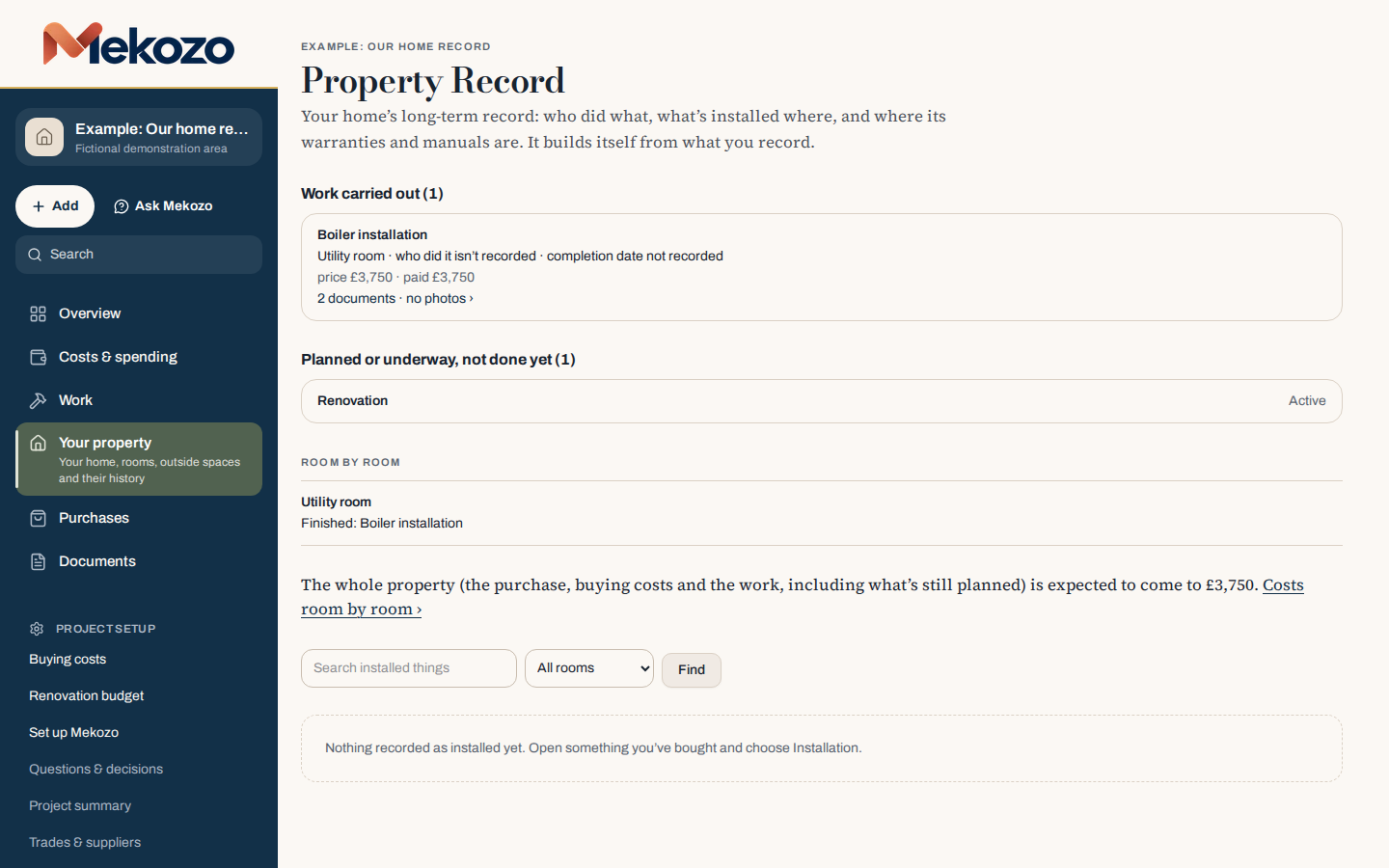
Mekozo's Property Record shows what each job cost, the room it was in and the documents attached, so next year's maintenance budget starts from what your home really needed.
The first budget is an estimate. The second is much better, because it is based on a year of real spending. Each time you pay for maintenance, record:
What the job was, and the room or system
The date
Who did it
What it cost, including call-out and parts
Whether it was servicing, a small repair or a replacement
The receipt, invoice and any certificate
At the end of the year, total each of the three parts and compare them with your budget. Our guide to the home maintenance log shows how to keep that record, and choosing a home maintenance app or spreadsheet covers the tools.
Mekozo records what each job cost, who did it and when, by room, with the receipt and any warranty attached. You can ask Mekozo to explain a figure or test a what-if, such as replacing the boiler next year instead of in five; it gives rough planning figures that can be wrong, so check them against your own quotes.
Putting the budget together
Add the three parts together for the year, then divide by 12 for a monthly figure.
Part
Your yearly figure
1. Regular servicing
Total of each job's cost, divided by its interval in years
2. Small repairs
Last year's spend, or your chosen allowance
3. Big replacements
Sum of each item's cost divided by its years left
Total
Your home maintenance budget for the year
Review it once a year, ideally when you book the boiler service. Move anything that has turned into a bigger job, such as a full re-roof or a rewire, into its own project budget with quotes. Our guide to renovation contingency explains how to size the allowance for unknowns on a project.
What makes a home cost more to maintain
Some homes need a larger budget than others. Raise each part if your home has:
Older systems near the end of their life, such as an original boiler or old wiring
An older or historic building, with materials that need specialist repair
A large roof or many chimneys, or trees overhanging gutters
Private drainage, such as a septic tank or cesspit that needs emptying
Gaps in the records, so you do not know the age or condition of key items
A second home or a home far from you, where small problems go unnoticed for longer
On the Operation Sicily villa
From the villa in Sicily. A check can be the cheapest line in a maintenance budget. Before deciding whether to replace the villa's three chamber cesspit and soakaway, Jonathan Smith, Mekozo's founder, tested it: 90 litres poured into the soakaway drained as fast as they went in, then about 700 litres of stored rainwater were pumped through the chambers to prove the overflow worked. Bringing the whole system up to modern standards would have meant excavating and replacing everything, at a cost that could have gone upwards of €12,000, so the test settled it (Episode 57). Knowing the condition of a big item is what turns a possible bill into a planned one. The test is filmed on Operation Sicily, where he documents the villa renovation.
This guide explains a budgeting method. It is not financial advice, and published prices are a check on quotes, not a quote for your home.
Questions people ask
How much should I budget for home maintenance each year?
Build the figure from your own house: add up the regular servicing it needs, add an allowance for small repairs based on what you spent last year, and add a yearly amount towards replacing big items as they near the end of their life. Check each line against named prices, such as Which?'s, and against your own quotes.
What is the 1% rule for home maintenance?
It is a rule of thumb that suggests setting aside about 1% of a home's value each year for maintenance. It is widely repeated, but we have not found an official UK source for it, and it ignores the age and condition of your house. Use it as a rough check at most, and build your real budget from your home's own needs.
How much does a boiler service cost?
Which? says a one-off service for a gas boiler should cost somewhere from £70 to £110, with an average of around £79, based on its June 2025 survey of boiler customers. Gas Safe Register recommends an annual safety check and service for any gas appliance unless the manufacturer says otherwise.
Is home maintenance the same as home improvement?
No. Maintenance keeps the home as it is: servicing, repairs and replacing like for like. Improvement adds something new, such as an extension or a better kitchen. Keep them in separate budgets, because improvements are usually planned and priced as projects.
Should I keep a separate savings pot for home repairs?
Many households find it easier to set aside a fixed amount each month for maintenance and big replacements, so a broken boiler or a roof repair does not land on the monthly budget all at once. How you hold that money is a personal choice; this guide covers how to size it, not where to keep it.
Jonathan Smith is the founder of Mekozo and Operation Sicily. Jonathan bought an abandoned villa in Sicily and is rebuilding it on camera, every week. Mekozo is the app Jonathan built to keep that renovation's money in one picture.
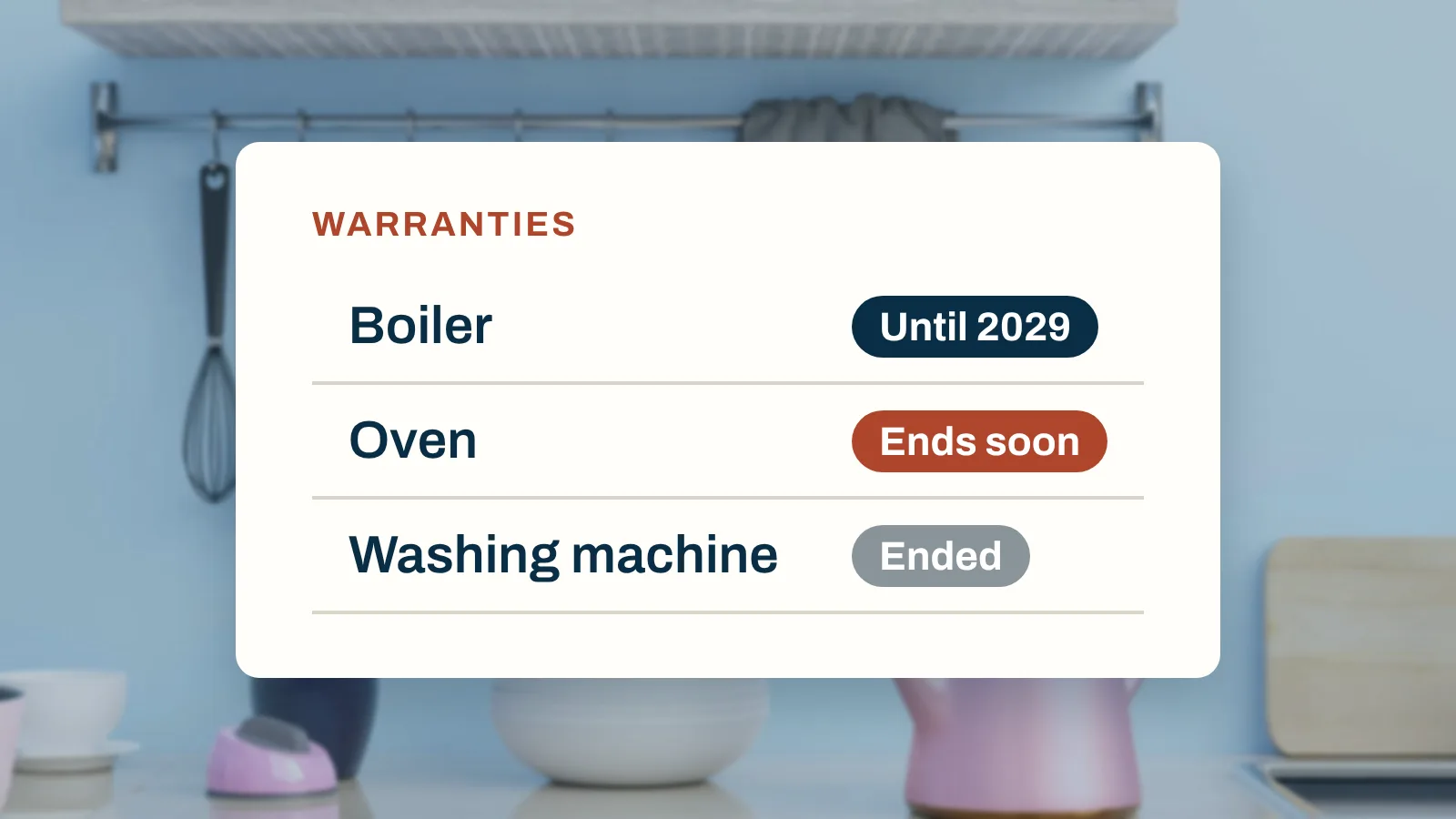
How to find a lost appliance manual, what to keep for a warranty claim, and a simple way to file every manual and warranty with the item it covers, so the next breakdown starts with the paperwork to hand.
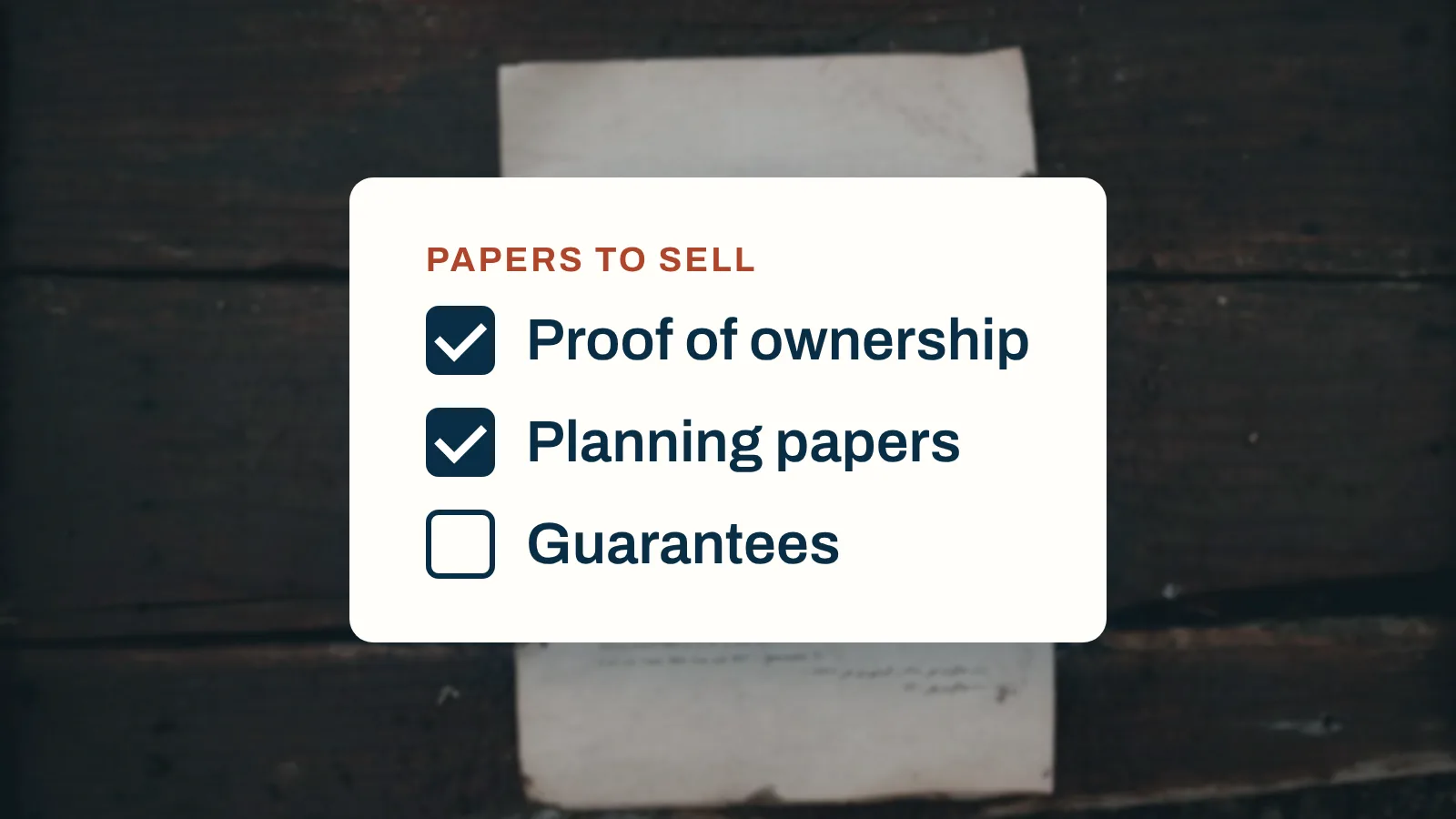
The documents you need to sell a house, from proof of ownership and the energy certificate to the certificates, guarantees and records of work that answer a buyer's questions, with country rules in labelled boxes.
A step by step method for tracing the history of your house, from the title register and old maps to census returns, local archives and planning files, and a way to keep what you find.