Home maintenance log: what to record and why buyers care
A home maintenance log is the dated record of every check, service and repair your home has had. What to record for each job, a layout to copy, and why buyers, their solicitors and warranties all care about it.
A home maintenance log is a dated record of every check, service and repair: what was done, when, by whom, what it cost, what was found and the paperwork.
Log every job, even when nothing was wrong, because a clean check is evidence too.
The Law Society's notes for the TA6 form say warranty claims are often only possible if the item was properly and regularly maintained, which is often difficult to prove.
Sellers in England and Wales are asked for documents such as guarantees, competent person certificates and the most recent heating inspection report.
Keep the log by room and by system, and keep planned jobs separate from finished ones.
A home maintenance log is the dated record of every check, service and repair your home has had. For each job, record what was done, when, by whom, what it cost, what was found and where the paperwork is. Log clean checks as well as repairs. Buyers care because it backs up the certificates, guarantees and answers their solicitor will ask for.
A maintenance checklist tells you what to do. The log proves it was done. This guide shows what to record, gives you a layout to copy, and explains why the log matters most on the day you sell.
Log or checklist: what is the difference?
The two work together, but they are not the same thing.
Maintenance checklist
Maintenance log
What it holds
Jobs and how often they come round
Jobs actually done, with dates and results
Looks
Forward, to what is due
Back, at what happened
Changes
Rarely
With every job
Proves anything?
No
Yes, with its paperwork
Our home maintenance checklist sets out the schedule month by month and year by year. This guide is about the record that sits behind it.
What to record for every job
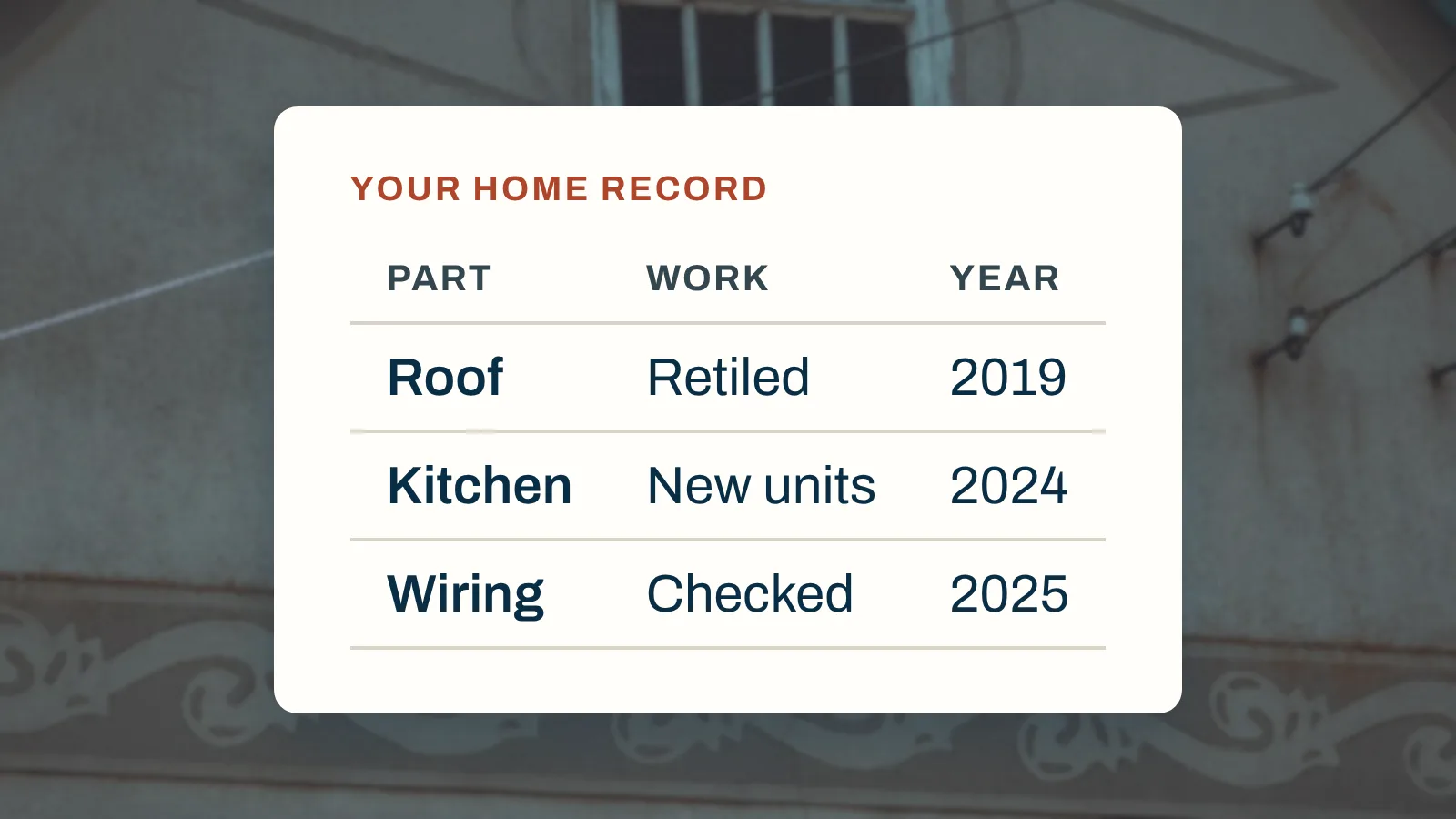
Mekozo's Property Record logs the work carried out, such as a boiler installation, with its room, what it cost and its documents, and keeps planned work separate.
Each entry in the log should answer the same eight questions:
When? The date the work was done.
Where? The room or system: kitchen, roof, heating, electrics, drainage.
What? The check, service or repair, in plain words. "Annual boiler service" or "Replaced cracked roof tile above back bedroom".
Who? You, or the company and person, with contact details and any registration number.
How much? The total, including call-out fees and parts.
What was found? Even "nothing wrong" is worth writing down.
What was recommended? Any follow-up work, with a rough timescale.
Where is the paperwork? Certificates, service records, receipts, guarantees and photos.
Tip
If a check finds a problem, the repair becomes its own entry with its own date, price and paperwork. Do not leave it as a note on the check, where it is easy to lose.
Log checks where nothing was wrong
It is tempting to only write down repairs. But "gutters cleared, no damage found" is useful twice: the next time water appears on a wall, and when a buyer's surveyor asks how the roof has been looked after.
Keep planned jobs separate
The log is for work that has happened. Keep quotes and planned jobs elsewhere until they are done, so nobody mistakes a plan for a finished repair.
A home maintenance log layout you can copy
Whether you keep it on paper, in a spreadsheet or in an app, one line per job works best. Our guide to choosing a home maintenance app or spreadsheet covers the tools.
Date
Room or system
Job
Who
Cost
Found
Next step
Paperwork
14 Oct 2026
Heating
Annual gas safety check and service
Gas Safe registered engineer
Your invoice total
Pressure low, topped up
Next service Oct 2027
Service record, receipt
10 Nov 2026
Roof
Gutters and downpipes cleared
Gutter cleaner
Your invoice total
One downpipe joint loose
Refix joint
Receipt, photos
18 Nov 2026
Roof
Downpipe joint refixed
You
Cost of parts
Fixed
None
Photo
Never overwrite an old line. The value is in the history.
Watch out
A log without paperwork is only your word. Keep the certificate, service record or receipt with every entry that has one.
Why buyers care about your maintenance log
When you sell, the questions about your home come from three directions: the property information form, the buyer's surveyor and any guarantees that come with the house. A log helps with all three.
The property information form
In England and Wales
Sellers usually answer the Law Society's TA6 property information form. The Law Society's explanatory notes for the 6th edition list documents you may need, including planning permissions and building control consents, competent person certificates, any guarantees and warranties, and information about any works you have carried out. For the heating system, the notes say sellers should provide details of the installation and supporting documents together with the most recent inspection report. They also say that if you do not know an answer, you must say so, and that incomplete answers may delay the sale or cause the buyer to withdraw. Your solicitor or conveyancer will tell you exactly what is needed for your sale.
A log turns those questions from a search through old emails into a quick look-up.
Guarantees that depend on maintenance
This is the part most people miss. The Law Society's notes tell buyers that guarantee claims can often only be made if the item has been properly and regularly maintained and used in line with the supplier's instructions, and that this is often difficult to prove. A guarantee on a boiler, windows or a roof is worth more to a buyer when you can show the servicing that keeps it valid.
Gas Safe Register recommends an annual safety check and service for any gas appliance unless the manufacturer's guidelines say otherwise (Gas Safe Register). A log with a service entry every year, each with its record attached, is the proof.
Certificates for past work
GOV.UK warns that without building regulations approval you will not have the certificates of compliance you may need when you want to sell your home (Building regulations approval). Logging each job with its certificate the day it arrives means you are not chasing a contractor years later.
The surveyor's questions
A buyer's surveyor may ask about the roof, the electrics, damp or past alterations. Electrical Safety First recommends that the electrics in an owner-occupied home are inspected every 10 years, and before selling (Electrical Safety First). If your log shows the last inspection and what it found, you can answer from the record rather than from memory.
Photograph work before it is covered up. A photo of pipes or cables before a wall is closed tells the next plumber, electrician or buyer exactly what is behind it.
Keep the log useful
A few habits keep a log readable after ten years:
Same words every time. "Boiler service", not "boiler check" one year and "heating visit" the next.
By room and by system. Most people look things up by what broke.
Costs as you go. At the end of the year, the total tells you what to set aside for next year's home maintenance budget.
Shared access. Anyone who looks after the home should be able to add to it and find things.
On the Operation Sicily villa
From the villa in Sicily. One of the most useful entries in a home's record is the one that shows what is hidden behind a wall. When Jonathan Smith, Mekozo's founder, fitted the bathroom plumbing at the villa he films for Operation Sicily, he set recessed valves for the shower, shower head, bath, sink and a bidet spray, using a mock tile to get each valve to the right depth, and the pipework was flushed and pressure tested before the wall chases were filled. A bidet or bidet spray was also needed for the geometra to sign the bathroom off (Episode 79). A dated entry with photos of those pipes, the test and the sign-off is exactly the kind of record a future plumber or buyer will want.
This guide explains how to keep maintenance records. It is not legal advice; your solicitor or conveyancer will tell you what your own sale needs.
Questions people ask
What is a home maintenance log?
A home maintenance log is a dated record of every check, service and repair carried out on a home. Each entry says what was done, when, by whom, what it cost, what was found and where the paperwork is. Over time it becomes the history of the house.
What should I record in a home maintenance log?
For every job, record the date, the room or system, what was checked or done, who did it with their contact details, the cost, what they found and what they recommended, and the paperwork: certificates, receipts, service records and photos. Record checks where nothing was wrong as well as repairs.
Why do buyers care about maintenance records?
Records answer the questions a buyer's solicitor and surveyor raise about past work, certificates and guarantees. The Law Society notes that guarantee claims often depend on an item having been properly and regularly maintained, so a log of servicing helps show a guarantee still has value.
How long should I keep home maintenance records?
Keep them for as long as you own the home, and hand the relevant ones to the buyer when you sell. Certificates, guarantees and service records for the boiler, electrics, windows, roof and any building work are the ones most often asked for.
Can I start a maintenance log for a house I already own?
Yes. Start with what you can prove: gather the service certificates, invoices, guarantees and receipts you already have, and add one line for each with its date. Then ask installers or the previous owner for anything missing, and add every new job the day it is done.
Jonathan Smith is the founder of Mekozo and Operation Sicily. Jonathan bought an abandoned villa in Sicily and is rebuilding it on camera, every week. Mekozo is the app Jonathan built to keep that renovation's money in one picture.
A step by step method for tracing the history of your house, from the title register and old maps to census returns, local archives and planning files, and a way to keep what you find.
A practical home maintenance schedule: what to check every month, every season, every year and every few years, with the UK guidance behind each check and how to keep a record of it.