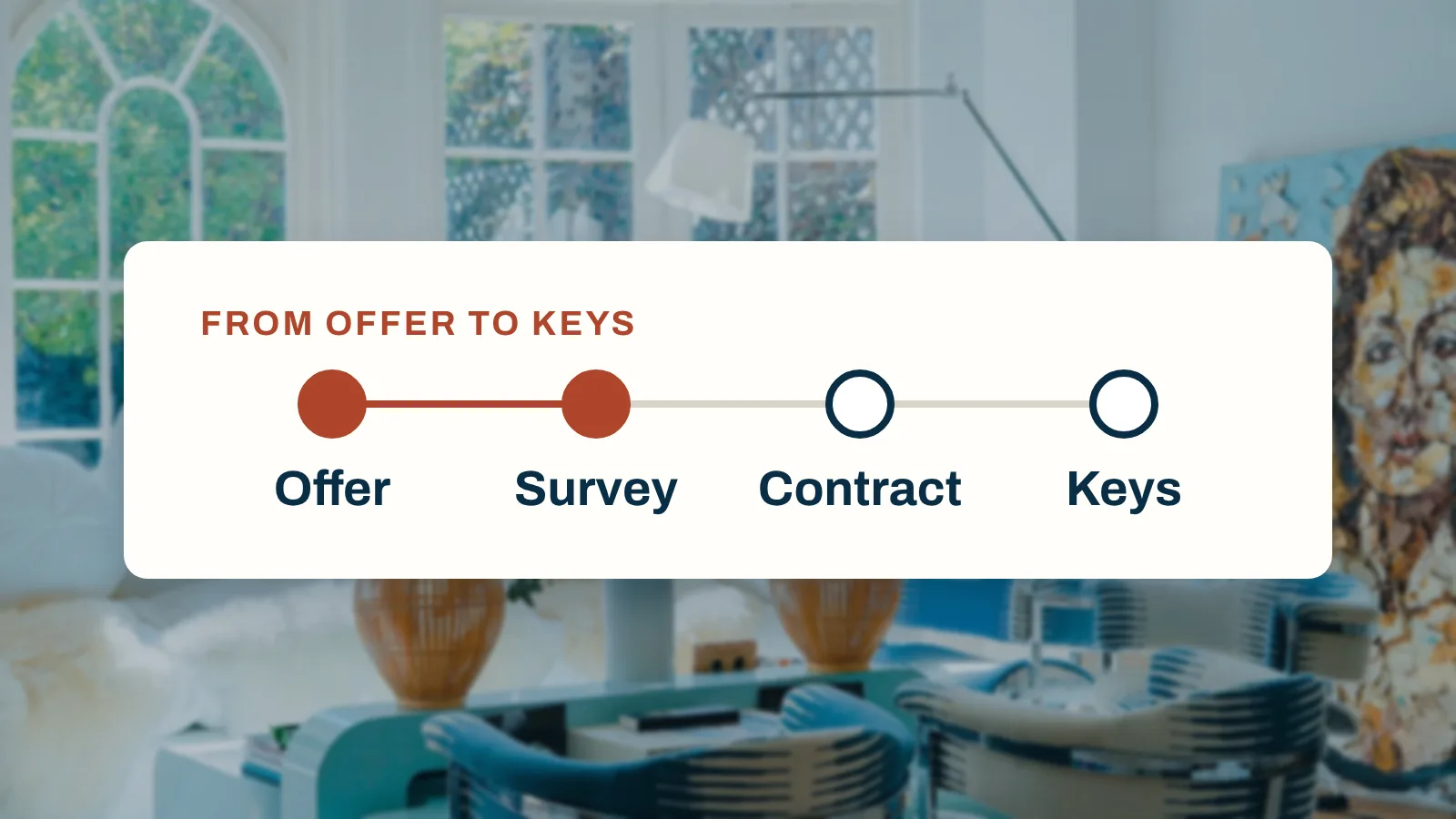
In England, buying a house takes around 120 days on average from offer accepted to completion, according to the government's home buying and selling reform roadmap (June 2026). That is about four months, on top of the time spent searching and viewing.
The same roadmap says the journey is now around 60% longer than it was in 2007, and that around one in three transactions fall through.
This guide breaks those months into stages, shows what slows each one down, and what you can do to keep your own purchase moving.
The home buying timeline at a glance
| Stage | What happens | Who sets the pace |
|---|
| 1. Getting ready | Budget, deposit, choosing a solicitor | You |
|---|
| 2. Searching and viewing | Shortlisting, viewing, comparing | You and the market |
|---|
| 3. Offer accepted | Price agreed, sale agreed, solicitors instructed | You and the seller |
|---|
| 4. Legal work | Searches, property information, enquiries, survey, any lender checks | Solicitors, surveyor, council, any lender, the chain |
|---|
| 5. Exchange of contracts | Contract becomes binding, deposit paid, completion date fixed | Everyone in the chain |
|---|
| 6. Completion | Money moves, keys released | Solicitors and lender |
|---|
| 7. After completion | Tax return and payment, registration of ownership | Your solicitor |
|---|
The government's 120-day average covers stages 3 to 6. Stages 1 and 2 are up to you, and they are where you can save the most time later.
Stage 1: getting ready before you search
The quickest purchases are usually prepared before the first viewing. Before you start:
- Work out your full budget, including every buying cost, not just the price
- Have your deposit in an account you can move money from quickly
- If you are borrowing, know your limits early from a qualified adviser
- Choose a solicitor or conveyancer and get their written quote
- Gather your ID, proof of address and proof of where your deposit comes from
Tip
Solicitors, and any lender, need to check where your money comes from. Having bank statements and evidence for any gifted deposit ready can save weeks of back and forth later.
Our guide to the costs of buying a house lists every cost to include in that budget.
Stage 2: searching and viewing
There is no standard length for this stage. It depends on how clear you are about what you want, how many homes match it and how quickly they sell. A written wish list and notes from every viewing make the decision faster, because you compare homes on the same points. Our guides to questions to ask at a viewing and comparing houses you have viewed cover both.
Stage 3: offer accepted
Once the seller accepts your offer, the clock on the 120 days starts. Do three things straight away:
- Instruct your solicitor and send them the estate agent's memorandum of sale.
- Tell your lender, if you are borrowing, so its checks can start.
- Book your survey so it is not waiting behind the lender's valuation.
In the UK (Scotland)
The process is different. Your solicitor notes your interest and makes a formal offer by letter, the seller's solicitor replies with a "qualified acceptance", and the two solicitors then exchange letters called missives. mygov.scot explains that once the missives are accepted and both sides agree the terms, you have a binding contract. The seller also provides a Home Report before you offer.
Stage 4: the legal work
This is the longest stage, and the one you control least. Several things run side by side:
Searches
Your solicitor orders searches covering things like local planning, roads, drainage and environmental risks. Their speed depends on the council and the search providers.
Property information and enquiries
The seller's solicitor sends forms describing the property: boundaries, alterations, fixtures and fittings, guarantees and, for a leasehold, the lease and service charges. Your solicitor raises questions on anything unclear. Each round of questions and answers can add days or weeks.
Survey
Your own survey tells you about the property's condition. If the survey finds problems, you may need quotes for repairs and a fresh conversation about the price, which takes time but is far cheaper than finding out after you own it.
Lender checks, if you are borrowing
A lender makes its own checks, including a valuation, before it confirms the loan, and your solicitor needs that confirmation before exchange. A qualified adviser can explain what applies to you.
Watch out
A chain moves at the speed of its slowest link. If your seller is also buying, their purchase has to be ready to exchange on the same day as yours. Ask early how long the chain is and whether everyone in it has a buyer and their money in place.
Stage 5: exchange of contracts
At exchange, in England and Wales, the contract becomes legally binding, you pay your deposit and the completion date is fixed. Before exchange either side can walk away; after it, pulling out has serious financial consequences. Your solicitor will usually want buildings insurance in place from exchange.
Stage 6: completion
On the agreed date your solicitor sends the money to the seller's solicitor, and the estate agent releases the keys once the seller's solicitor confirms it has arrived. Then work through a new home checklist. Completion can be the same day as exchange or weeks later, depending on what you agree.
Tip
Ask the seller for any gas safety records. Gas Safe Register recommends getting your gas appliances safety checked before you move in, and arranging a check if the seller cannot provide a record or it has been more than 12 months since the last one.
Stage 7: after completion
Two things happen after you have the keys, neither of which stops you moving in:
- Tax on the purchase. In England and Northern Ireland, GOV.UK says the Stamp Duty Land Tax return must be sent and the tax paid within 14 days of completion, even if no tax is owed, and HMRC charges an automatic penalty and interest if you are late. In Scotland, Revenue Scotland gives 30 days from the day after the effective date for Land and Buildings Transaction Tax, and in Wales the Welsh Revenue Authority guidance gives the same 30 days for Land Transaction Tax. Your solicitor usually handles this.
- Registering your ownership. Your solicitor applies to HM Land Registry to register you as the owner. Some applications are completed quickly and others take months, and HM Land Registry publishes its current processing times on GOV.UK, so check there for the latest figures.
What slows a purchase down
| Cause | What you can do |
|---|
| A long chain | Ask about the chain before you offer; weigh a chain-free home more highly |
|---|
| Slow searches | Ask your solicitor to order them as soon as you instruct |
|---|
| Missing property information | Ask the agent early what the seller has ready |
|---|
| Survey findings | Book the survey quickly; get repair quotes fast if needed |
|---|
| Lender paperwork, if borrowing | Send documents the day they are asked for |
|---|
| Leasehold information | Ask early for the lease, service charges and management pack |
|---|
| Your own response times | Reply to every request within a day or two |
|---|
How to keep your purchase moving