Home improvement contract: what to agree in writing
A written agreement with your builder does not need legal language. It needs the work, the price, the dates, the payments, how changes are handled and what happens at the end. Here is what to put in it.
A home improvement contract is the written record of what you and your builder have agreed: the work, the price, the timing, the payments and what happens if things change.
You make a contract as soon as you tell a trader to go ahead, even verbally; writing it down is what lets you prove what was agreed.
It does not need legal language, but it should refer to the quote and cover dates, delays, payments, changes, materials, subcontractors, tidying up and guarantees.
Agree how changes will be priced and approved before work starts, and tie the final payment to the finished, checked job.
In England, work arranged away from the trader's premises usually comes with a 14 day cooling-off period; check the official guidance where you live.
What is a home improvement contract?
A home improvement contract is the written agreement between you and your builder: what work will be done, for what price, when, how you will pay, how changes are agreed and what happens at the end. It does not need legal language. It needs to be clear, specific and agreed before work starts.
You make a contract with a trader as soon as you tell them to go ahead, even if nothing is written down. Writing it down is what lets you both check what was agreed and prove it later. This guide sets out what to include, in plain English. It is not legal advice; for your own situation, use the official guidance where you live and, for a large or unusual job, speak to a qualified adviser.
Why get the agreement in writing?
Most disagreements on building jobs are not about bad faith. They are about two people remembering a conversation differently. A written agreement settles:
What is included, so "I thought that was in the price" does not come up.
When things happen, so delays can be discussed against a date.
How money moves, so each payment matches work done.
What happens when plans change, which they will.
What "finished" means, so the last payment has a clear trigger.
In the UK (England)
Citizens Advice says that when you tell the trader you would like them to do the work, you have made a contract, even if it is not written down. It suggests always trying to get a contract in writing before you say yes, because if the trader does not do what you agreed, a written contract can help you get what you paid for, or at least some of your money back.
Quote, estimate and contract: which is which?
Document
What it is
What it commits you to
Estimate
The trader's best guess at the cost
Nothing fixed; the final bill can differ
Quote
A promise to do the work at an agreed price
A binding agreement once you accept it
Contract
The full agreement: quote plus dates, payments, changes and terms
Both sides, in writing
Make sure the contract refers to a quote, not an estimate. Citizens Advice explains that a trader cannot charge more than the quoted price unless you ask for extra work, you agree to pay more for extra work they tell you is needed, or there was a genuine mistake in the quote. Our guide to what a good builder quote includes covers the quote itself.
What to put in a home improvement contract
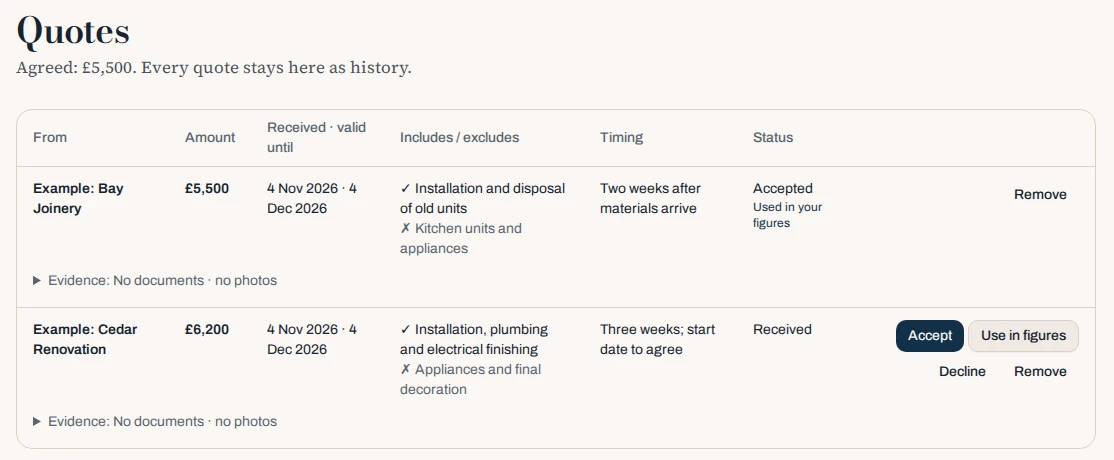
Mekozo keeps every quote for a job side by side, with what each includes and excludes, its timing and which one you accepted, and the history stays when the price changes.
Any change is agreed in writing before the work is done
Each change states what it is, its price and its effect on the dates
Who can approve a change on your side
Each change should be written down with its price and its effect on the timetable before the work goes ahead. This is a variation or extra (change order), and our guide to variations and extras shows what the record looks like.
Materials, equipment and subcontractors
Who buys which materials, and who pays for equipment hire
For items the trader buys, how they will give you receipts and paperwork
Who owns materials delivered to site
Whether subcontractors will be used, for which trades, and that the main trader stays responsible for their work
Site, safety and tidying up
How and when rubbish will be removed, and who pays for skips
Protection for floors, furniture and the parts of the house not being worked on
Access, parking, toilet and welfare arrangements
Who arranges building control or other approvals, and which certificates you will receive
Finishing, guarantees and problems
What "complete" means, including the snagging walk-round
Guarantees: what they cover, for how long, whether they are insurance-backed and whether they pass to a future owner
Manuals and certificates to be handed over
Insurance the trader holds, with the policy dates
How either side can raise a problem, and how disputes will be handled
Attach the quote, the scope and any drawings to the contract, and initial each page. "As per quote 0412 dated 3 March, attached" is much stronger than "as discussed".
Timings, tidying up, materials and payments
These four are where most arguments start, and they are the ones Citizens Advice singles out. Its guidance on getting work done on your home says the contract should cover:
Topic
What to agree
Timings
Start and finish dates; for a daily rate, the number of days and working hours in a day; why delays might happen and what the trader will do about them
Tidying up
How and when rubbish is removed; who pays for delivery and collection of skips
Materials, equipment and subcontractors
Who pays to buy or hire them; how the trader gives you receipts; if and when subcontractors are used
Payment
How and when you pay: by card not cash, in stages, avoiding deposits or upfront payments where you can
In the UK (England)
Citizens Advice suggests that if a deposit cannot be avoided, you push it down as far as possible and do not agree to more than 25%, always get a receipt for it, and check whether the trader has insurance to protect your deposit if they go out of business.
Cancelling: the cooling-off period
Your right to cancel depends on where you agreed the work, whether it has started and what was ordered.
In the UK (England)
Citizens Advice says that if you arranged the work away from the business's premises, for example at your home, online or over the phone, you have a cooling-off period of at least 14 days to cancel and get a refund. You may not get one for made to measure items, such as windows, or if you invited the business in for urgent repairs. If you asked for work to start within the cooling-off period, you may have to pay for the part already done. If the business does not give you details of how to cancel, the cooling-off period is extended, up to a maximum of a year. If you arranged the work at the trader's own premises, there is no automatic cooling-off period. Rules differ in Scotland, Wales and Northern Ireland.
In the UK
Whatever the contract says, section 49 of the Consumer Rights Act 2015 treats every contract to supply a service as including a term that the trader must perform it with reasonable care and skill, and section 57 stops a contract term excluding that duty. Outside the UK, consumer rules for building work vary a great deal, so check your own country's official consumer body before you sign.
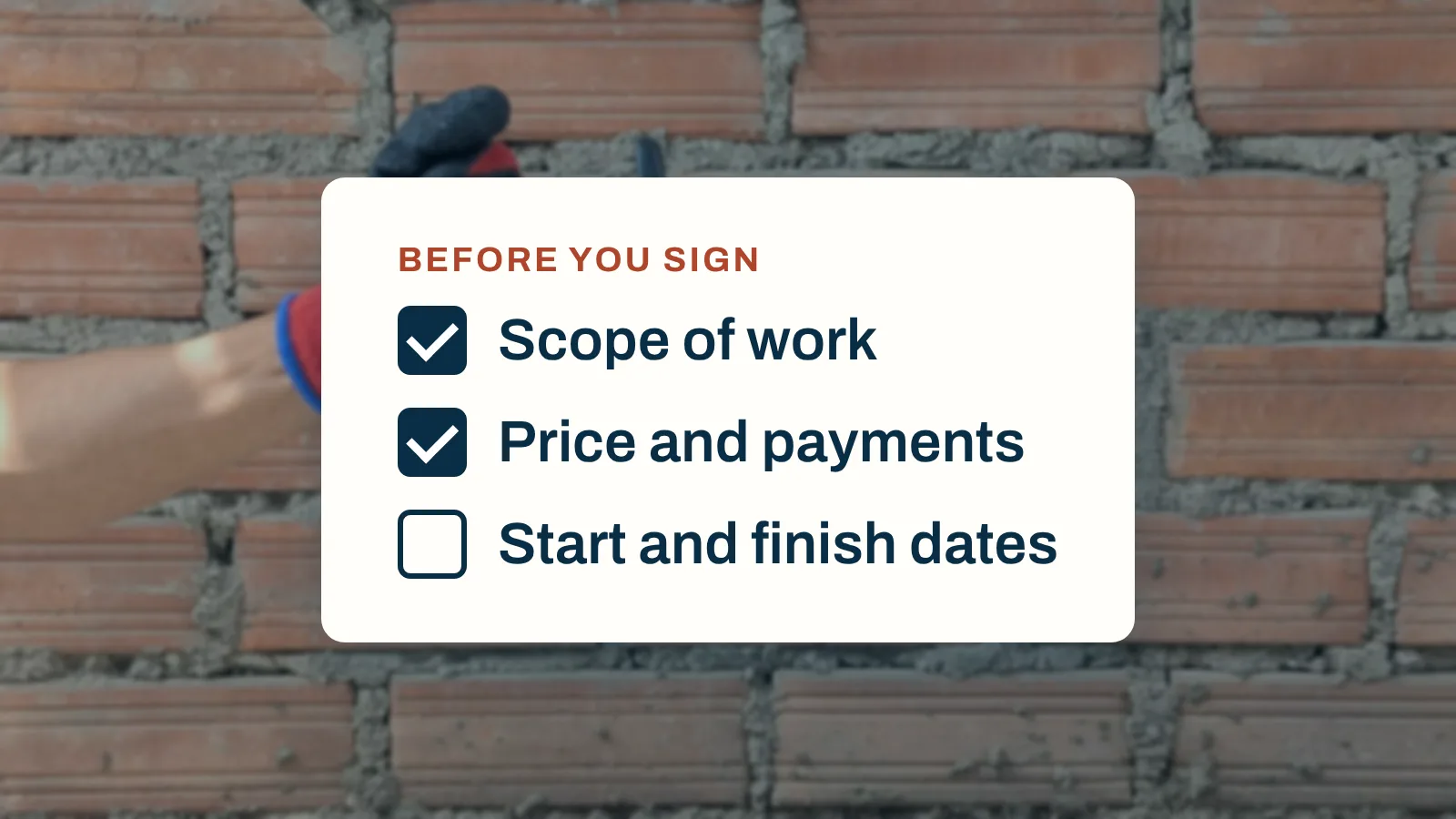
Before you sign: five checks
Read every line. If you do not understand a term, ask what it means and get the answer in writing.
Check it matches the quote. Same work, same price, same exclusions.
Check the payment stages add up to the total, and that no stage is paid before the work it covers.
Check the insurance is in date for the whole job.
Keep a signed copy, with the quote and scope attached, where you can find it.
Watch out
Be wary of a trader who will not put anything in writing. Citizens Advice says it is a sign they might be dishonest. A good builder usually prefers a clear agreement, because it protects them too.
Keeping the contract alive during the job
A contract only helps if the job stays in line with it.
Record every change as it is agreed, with its price, and update the agreed total.
Pay against the stages, and record each payment against the job.
Put concerns in writing as soon as they come up, with photos and dates.
Keep the paperwork together: contract, quote, changes, invoices and receipts for each job. An invoice is the bill for agreed work; record it, then the payment against it. Our guide to keeping agreed prices, invoices and payments apart shows how.
In the UK
The Health and Safety Executive says homeowners can help make sure work is done safely by allowing sufficient time and money in the agreed contract for it to be carried out safely. A finish date that only works if corners are cut is a risk, not a saving.
On the Operation Sicily villa
From the villa in Sicily. Before the plasterers came to quote at the villa Mekozo's founder, Jonathan Smith, is renovating on camera for Operation Sicily, he sprayed green crosses on every wall and ceiling he wanted skimmed, so they could see exactly what to price (Episode 29). It is the same idea as attaching a scope to a contract: the price is for a defined job, not a conversation. In his guide to renovation costs in Sicily, he suggests asking whether a price is a fixed contract sum, an estimate, a day rate or a measured-quantity arrangement, agreeing the work, payment milestones and how extra work is approved in writing, asking for the VAT basis and included amount in writing, and checking qualifications, insurance and completion documents. Clear communication matters on any project, he notes, especially when you are working in a second language.
This guide explains what people commonly agree in writing with a builder. It is not legal advice. For your rights, use the official guidance where you live, and for a large or complex contract, speak to a qualified adviser.
Questions people ask
What should be included in a home improvement contract?
The work to be done, referring to the quote or scope; the total price and what it includes; start and finish dates and what happens if there are delays; the payment stages; how changes are priced and agreed; who supplies materials; whether subcontractors will be used; tidying up and rubbish; guarantees; and the trader's full contact details.
Do I need a written contract with a builder?
You have a contract as soon as you tell a trader to go ahead, even if nothing is written down. Citizens Advice suggests always trying to get a contract in writing before you say yes, because a written contract helps you get what you paid for if the trader does not do what was agreed.
Can I write my own contract with a builder?
Yes. Citizens Advice says written contracts do not need to be in legal language. They need to set out exactly what you are paying for, which can refer back to the quote, and everything you have agreed, such as timings, tidying up, materials and payments. If the trader gives you a contract, check it covers everything you agreed.
Can I cancel a contract with a builder?
It depends on where and how you arranged the work, whether it has started and what was ordered. In England, Citizens Advice says work arranged away from the trader's premises, such as at your home, online or by phone, usually has a 14 day cooling-off period, with exceptions for made to measure items and urgent repairs.
What happens if the builder does not stick to the contract?
Raise it with the trader in writing as soon as you notice, with photos and dates, and refer to what the contract says. In England, Citizens Advice explains your rights if work is not done with reasonable care and skill, not done as agreed or not done on time, and how to ask for a fix or a refund.
Jonathan Smith is the founder of Mekozo and Operation Sicily. Jonathan bought an abandoned villa in Sicily and is rebuilding it on camera, every week. Mekozo is the app Jonathan built to keep that renovation's money in one picture.
Renovating a house you cannot visit every day takes a different kind of planning. The local team, written briefs, photo routines, payments and travel costs, with lessons from a villa renovated between the UK and Sicily.
Before and after photos are more than a reveal. How to take matching shots room by room, what to record while the walls are open, and how the photos help with snags, neighbours, claims and a sale.
A simple system for renovation paperwork: capture every receipt and invoice the day it arrives, file it against the job it belongs to, check it, and keep what you will need later.