Planning a renovation
How much renovation contingency should you allow?
Size your renovation contingency from the real unknowns in your project, keep upgrades out of it, and watch what is left after every change.


The renovation costs people forget are usually predictable: waste, access, what is behind the walls, fees and VAT. Here are 20 of them with sourced UK ranges, and how to find and track them before they surprise you.
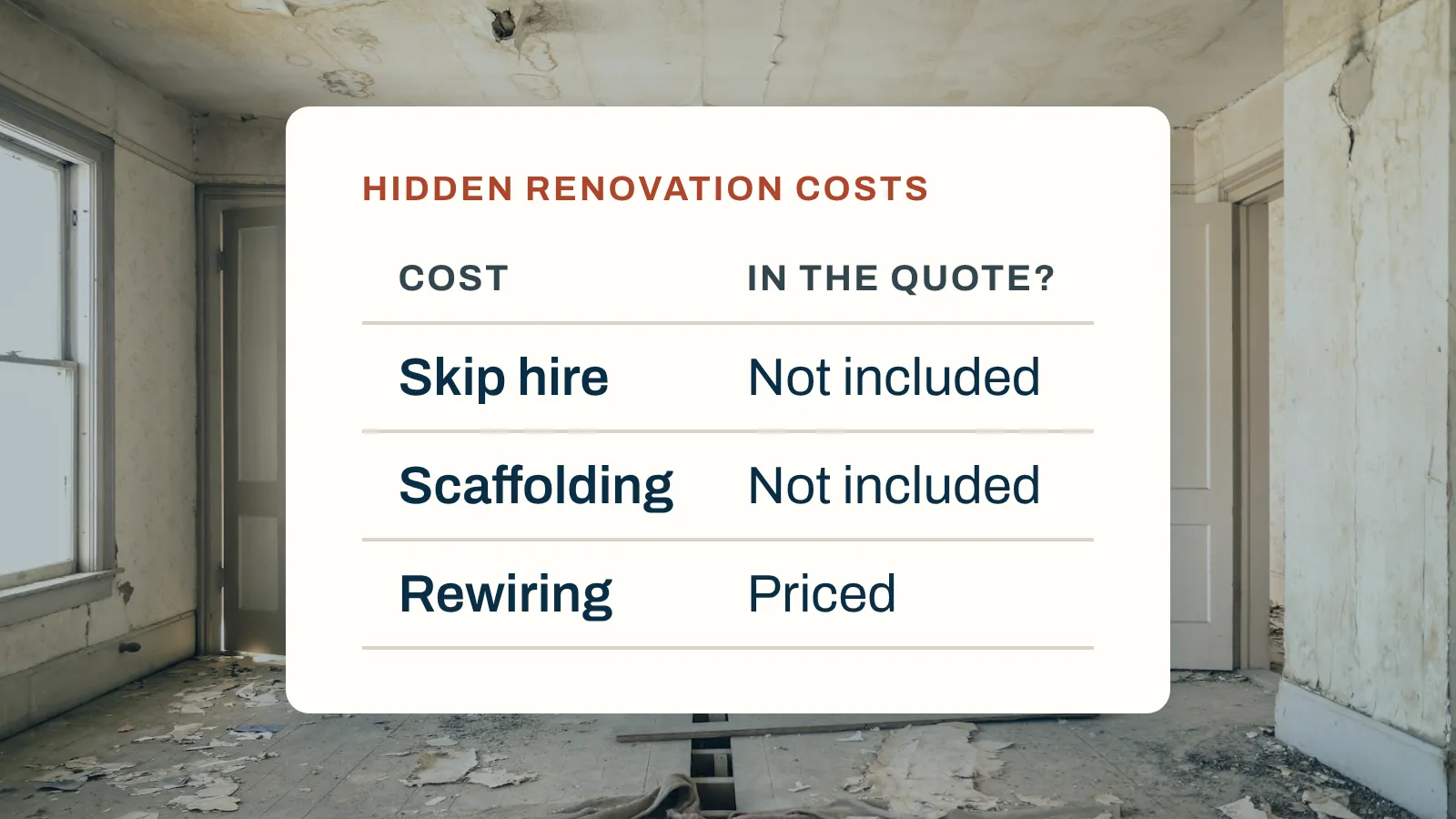
Hidden renovation costs are mostly the jobs and charges that sit outside the main quote: waste and scaffolding, what turns up behind walls and under floors, wiring and heating that has to be brought up to standard, professional fees and approvals, and VAT or price rises. Most of them can be found or priced before you commit, if you know where to look and ask each builder what their price leaves out.
This guide lists 20 renovation costs people forget, with a sourced UK range for each, then shows how to uncover them before you sign and track them as they appear. It covers the work itself; for the costs of buying the house, see our guide to the costs of buying a house.
A hidden cost is not always a nasty surprise. Most fall into one of three types:
The first type is a planning gap and can be closed with a better list. The second is genuine uncertainty and belongs in your contingency. The third can usually be predicted once you know which jobs lead to which.
These are published UK ranges and averages, not quotes. Prices vary by region, size of house and access, and are usually higher in London and the South East. Check whether each figure includes VAT before you compare it with a quote.
| Hidden cost | Why it is missed | Typical UK range | When you find out |
|---|---|---|---|
| Skip hire and waste | Left out of quotes, or one skip priced when the strip-out needs several | £75 to £450 a week by size, plus a council permit of about £15 to £60 if the skip sits on the road (Checkatrade, June 2026) | When the strip-out starts |
| Scaffolding | Priced for a set number of weeks, then the job runs over | £650 to £1,100 a week for a two-storey semi; extending the hire often adds around 10% (Checkatrade, October 2026) | When roof or wall work takes longer |
| Asbestos survey | Easy to forget when you already paid for a survey when buying | £200 to £1,000, from a small flat to a large detached house (Checkatrade, April 2026) | Before demolition, if the builder asks for one |
| Asbestos removal | Only known once ceilings, tiles or boarding are tested | £175 to £350 per m² for textured ceilings and tiles; £950 to £3,750 for an asbestos roof (Checkatrade, April 2026) | After the survey results |
| Damp survey | Fresh paint and furniture hide the signs at viewings | £100 to £600 (Checkatrade, June 2026) | When plaster comes off or units are removed |
| Damp treatment | The cause is behind the wall or below the floor | £1,000 to £3,000 for injection treatment; £2,500 to £7,500 to retrofit a new damp proof course (Checkatrade, June 2026) | After a specialist inspection |
| Replastering and making good | Rewiring and plumbing are chased into walls; old plaster comes away | Around £1,100 for a small room and £1,900 for a large one, averages (Checkatrade, June 2026) | Once first fix is done |
| Electrical inspection (EICR) | Skipped because the lights work | £100 to £250 (Checkatrade, October 2026) | Before rewiring quotes, if you ask |
| Rewiring | Old cable is hidden in walls and under floors | £3,000 to £12,000 for a two-bedroom terrace; £4,000 to £18,000 for a three-bedroom semi, excluding VAT (Which?, trader survey November 2025) | After an inspection, or when walls are opened |
| Fuse box replacement | Needed when circuits are added or the old one will not pass | £500 to £1,500 for a three-bedroom semi, excluding VAT (Which?, trader survey November 2025) | When the electrician tests the installation |
| New boiler | The old one fails, or cannot cope with a new bathroom | Around £1,400 to £7,000 installed (Which?, October 2026) | When the heating engineer sees the system |
| Lintels | Cracks above windows are hidden by render or sealant | £650 to £1,000 for a window lintel (Checkatrade, September 2026) | When old windows come out |
| Structural engineer | Needed for any removed wall or new opening, often after the builder looks | Around £300 a site visit, £200 for a steel beam calculation and £700 for a report, averages (Checkatrade, June 2026) | When the design is drawn, or when a wall is opened |
| Roof repairs | Only visible once scaffolding is up | £75 to £400 to replace one to six tiles; £80 to £300 for a ridge tile, excluding VAT (Which?, trader survey November 2025) | From the scaffold |
| Drain survey | Drains are underground and rarely mapped | £85 to £450 for a CCTV drain survey (Checkatrade, October 2026) | When a kitchen or bathroom moves, or a drain blocks |
| Building control fees | Seen as paperwork, not a cost | From around £60 to more than £900, depending on the council and the job (Checkatrade, September 2026) | When the work is found to need approval |
| Planning application | Assumed not to apply to your project | £548 for a typical householder application in England (Planning Portal, checked November 2026) | When the designer checks the rules |
| Party wall surveyor | The neighbours' side of the process is forgotten | Around £200 an hour; a party wall award around £1,000, averages (Checkatrade, June 2026) | Before work on or near a shared wall |
| VAT | Some quotes are given without it | 20% standard rate on most goods and services (GOV.UK) | When the invoice arrives |
| Material price rises | Prices are not fixed until the order is placed | Material prices for repair and maintenance work rose 6.2%, and for all work 7.2%, from September 2025 to September 2026 (GOV.UK, published 4 November 2026) | When items are ordered months after the quote |
Figures are published ranges and averages from named sources, not quotes. Ask your own trades for written prices.
One cost is missing because no published figure fits every household: living elsewhere while the work happens. Rent, storage, travel and eating out run for as long as the job does, so put your own weekly figure on it and multiply by a realistic number of weeks.
Watch out
The smallest lines are often the most predictable, and the easiest to leave out. A few weeks of skips, scaffolding and making good can add up to more than one of the headline jobs, without anything going wrong at all.
There are four common reasons.
You cannot remove every unknown, but you can shrink the list before you sign. Work through these steps in order.
The survey you had when buying may not have been designed for the work you now plan. RICS says to choose its Level 3 Home Survey if you are dealing with a large, older or run-down property, a building that is unusual or altered, or if you are planning major works. RICS says costs start at a few hundred pounds for its Level 1 survey, with some bespoke Level 3 services costing over £1,000.
Then add specialist checks for the riskiest areas:
A survey or report tells you what a qualified person found. It does not replace their advice, so ask them what they would check next.
Some answers only come from looking. Before quotes are final, ask your builder whether it is safe to lift a floorboard in the bathroom, take a panel off behind the kitchen units, look into the loft or remove a small area of plaster. Do this with the builder or a specialist, not on your own, and not where asbestos might be present until it has been tested.
The aim is to move a cost from "behind a surface" to "known" while you still have choices.
Two quotes for the same job are only comparable if they cover the same things. Ask each builder to state, in writing, whether the price includes:
Citizens Advice explains that a quote is a fixed price and an estimate is just a rough guess, so you might end up paying more. Under a quote, the trader cannot charge more unless you ask for extra work, they tell you extra work is needed and you agree to pay, or they made a genuine mistake. Ask for quotes, not estimates, wherever the scope allows. Mekozo lines quotes up side by side with what each includes and excludes, so you can see whether the cheaper one leaves out the making good. Our guides to comparing builders' quotes and writing a renovation scope show how to make the prices line up.
Tip
Ask every builder the same question: "What could make this price go up?" Their answers are a ready-made list of the hidden costs in your job.
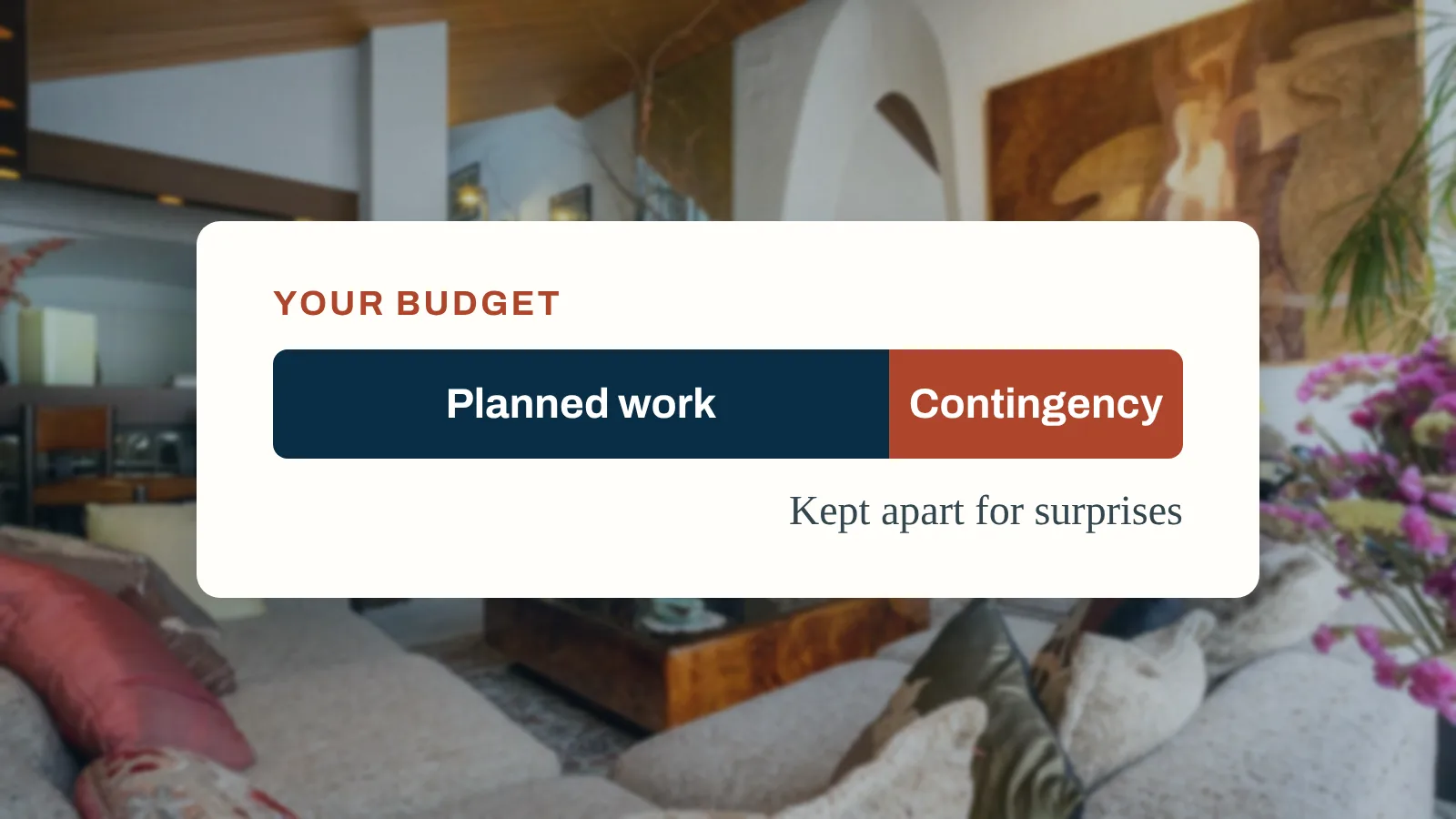
Whatever is left on the list after Steps 1 to 3 is genuine uncertainty. The Federation of Master Builders suggests setting aside around 10% of the total project cost as a contingency, and 15% or more for older homes or projects involving structural alterations, and says the fund should be for genuine unexpected issues, not optional upgrades.
Use the percentage as a sense check, not the answer. Put a low and high figure on each remaining unknown, such as the joists under the bathroom or the wiring behind the kitchen, and compare the total with your percentage. If the list is bigger, the percentage is too small. Our guide to how much renovation contingency to allow shows the method in full.
Some hidden costs will still turn up. Record each one the day you hear about it, with a clear status, so the total never looks smaller than it is.
When the builder says "we've found something", record it as a separate line, not a note on the original job, with the room, who told you and when. That keeps the original price intact and shows exactly what the surprise added.
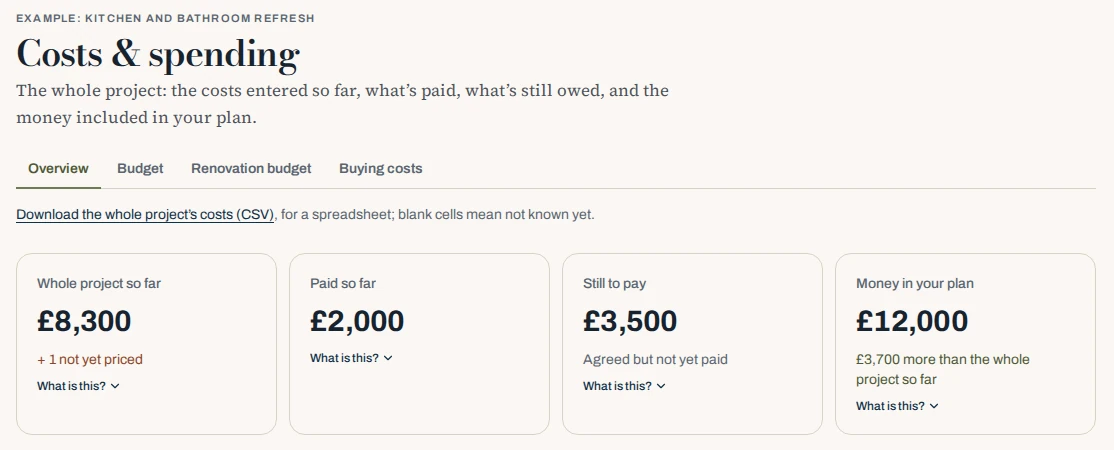
Mekozo's Costs & spending view shows the whole project so far, what is paid, what is agreed but still to pay and any line not yet priced, so a hidden cost has somewhere to go the day you hear about it.
Try it free for 30 days, no card neededThe most dangerous figure in a renovation budget is a zero that should be a question mark. If a cost is real but has no price yet, record it without a figure rather than as nothing. In Mekozo, a line with no price shows as "not yet priced" and is never counted as zero, so the total tells you there is more to come.
A builder's warning that "it might need" something is not the same as an agreed extra. Keep the two apart:
Mekozo keeps each cost's estimated, agreed and paid figures apart and works out still to pay. It also keeps any amount that may still be owed apart from still to pay, so a possible extra is visible without being counted as money you have agreed. Before you agree any extra, price it and confirm it in writing, as our guide to variations and extras explains.
When an unknown becomes a real cost, move the money out of contingency into an agreed cost, and note why. Mekozo lets you set the contingency as a percentage or a fixed amount within your plan, so you can see what is left after each draw. Check what remains every time you agree something new, not only at the end.
Keep the survey report, the photos of what was found, the quote, the agreement and the receipt with the cost they belong to. In Mekozo, receipts and documents attach to each cost, so the reason for an extra is still there months later when you check the final account. Our guide to organising renovation receipts covers the habit in more detail.
On the Operation Sicily villa
From the villa in Sicily. Jonathan Smith, Mekozo's founder, who films his villa renovation on Operation Sicily, bought the villa for €21,500 after it had stood empty for twenty years. It had no electricity, water, gas or drainage, and every window needed replacing, so the big costs were never hidden. In Episode 14, he split his budget into labour, materials, and permits and fees, then set a backup fund of 10 to 15% on top. Hidden costs still came: drainage nobody had documented, electrical back boxes that had been plastered over and forgotten, and roof sections that looked sound but were not. In his real-world breakdown of renovation costs in Sicily, he writes that on an abandoned property he would now hold back 20 to 25% of the build cost. One test shows how much can ride on what you cannot see: a cesspit test decided whether the system could stay or would need replacing at a cost upwards of €12,000. It passed (Episode 57). Those are Sicilian figures for a Sicilian house; price your own from UK sources and quotes.
Playing loads YouTube’s external player.
Watch directly on YouTube ↗Take your current quote and go through the table above line by line. For each hidden cost, write "included", "not included" or "does not apply", and ask the builder about every one you cannot answer. What is left is your list of unknowns, and the starting point for your contingency. For the wider plan, see our guides to how much it costs to renovate a house, renovating an old house and budgeting and planning a renovation before work starts. To keep every cost and its status in one place, see the renovation budget tracker and how to track costs and payments in Mekozo.
This guide explains how to find and track renovation costs. Figures are published ranges and averages, not quotes, and nothing here is survey, legal, tax or financial advice; ask a qualified professional about your own house and get written prices for your own job.
The ones people forget most are waste removal and skips, scaffolding that runs longer than planned, asbestos testing and removal in older homes, damp, rewiring and a new fuse box, replastering after services are chased in, structural engineer and building control fees, and VAT on quotes given without it. Most can be found or priced before work starts.
The Federation of Master Builders suggests setting aside around 10% of the total project cost as a contingency, and 15% or more for older homes or structural work. Treat that as a starting point, then check it against a list of the genuine unknowns in your own house.
Usually because something could not be seen until walls, floors or roofs were opened, because an item was only an estimate or allowance, because the plan changed, or because material prices moved. GOV.UK figures showed the material price index for repair and maintenance up 6.2% in the year to September 2026.
Sometimes, and sometimes not. Ask each builder to say in writing whether waste removal, skip permits and scaffolding are included, for how many weeks, and what happens if the job runs over. If one quote includes them and another does not, the two prices are not comparable.
Citizens Advice says a trader cannot charge more than the quoted price unless you ask for extra work, they tell you extra work is needed and you agree to pay for it, or they made a genuine mistake in the price. An estimate is only a rough guess, so it can move. For a dispute, get advice from Citizens Advice or a legal professional.
Older houses are more likely to hide damp, failed lintels, old wiring, asbestos in materials and drains nobody has mapped. RICS recommends its Level 3 Home Survey for large, older or run-down properties and for anyone planning major works, and specialist checks such as an electrical inspection or a drain survey can price the riskiest areas early.
Jonathan Smith is the founder of Mekozo and Operation Sicily. Jonathan bought an abandoned villa in Sicily and is rebuilding it on camera, every week. Mekozo is the app Jonathan built to keep that renovation's money in one picture.
Real renovation experience and regional guidance from Operation Sicily.
Size your renovation contingency from the real unknowns in your project, keep upgrades out of it, and watch what is left after every change.
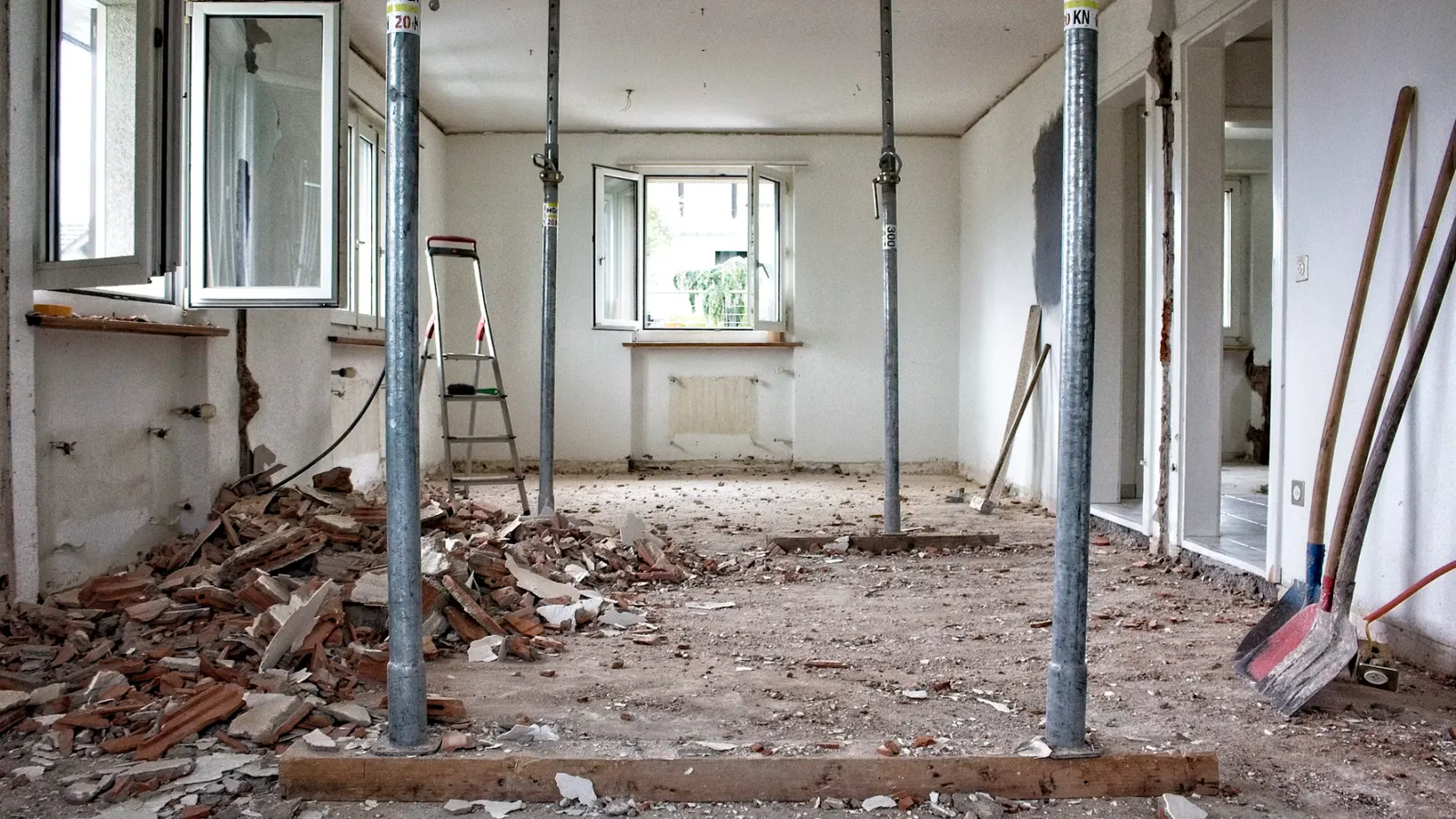
There is no honest single figure for renovating a house. Here is how to build your own estimate from the size, the depth of work and the finish, using named, dated figures for each job.
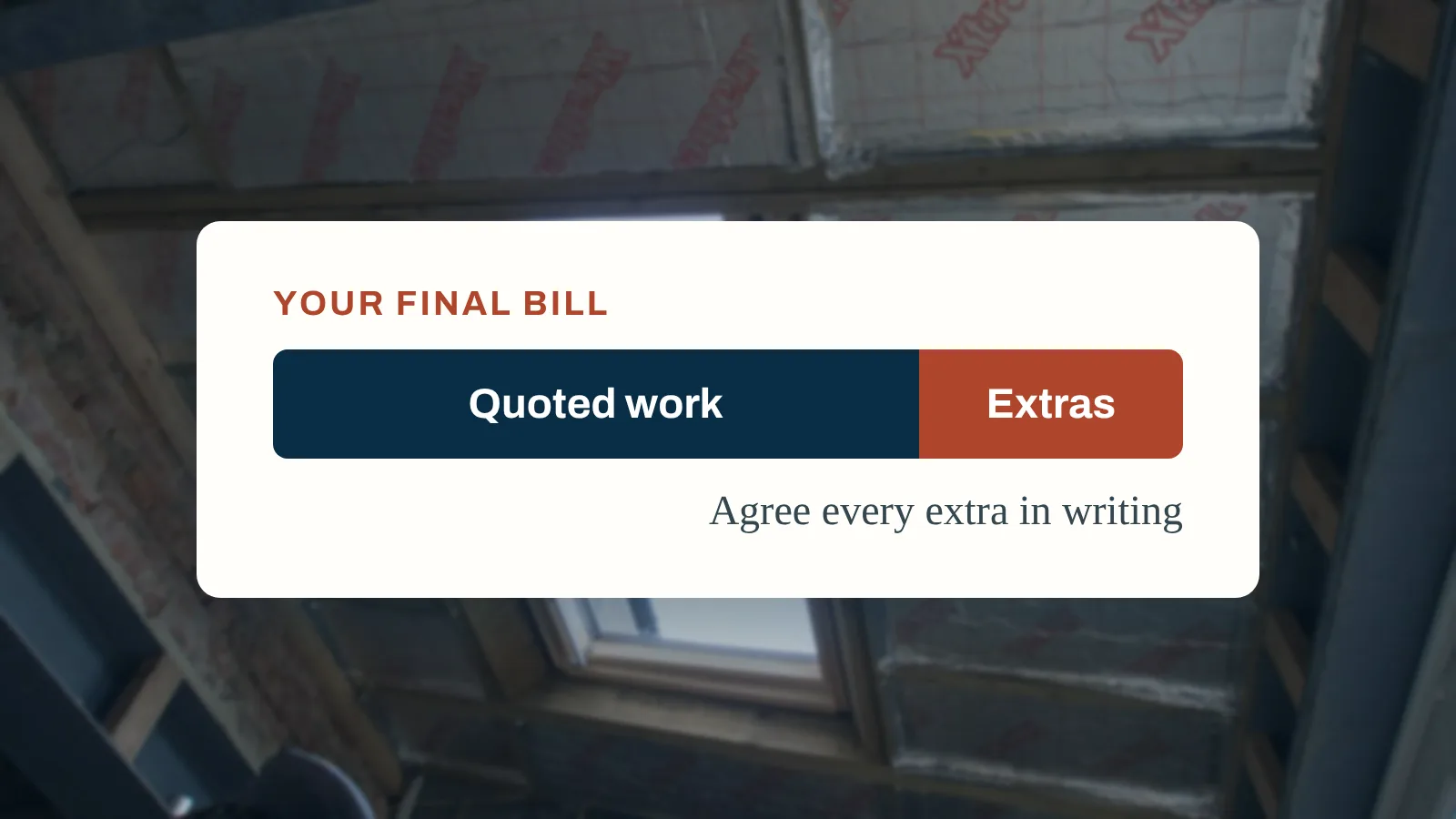
Changes and extras are where renovation budgets drift. What a variation is, the four kinds of change, a five step way to agree each one before the work, and a change log you can copy.
Budgets, quotes, payments, documents and decisions in one place
30 days free. No card needed.
Monthly, with no annual plan. The Terms of membership set out the details.