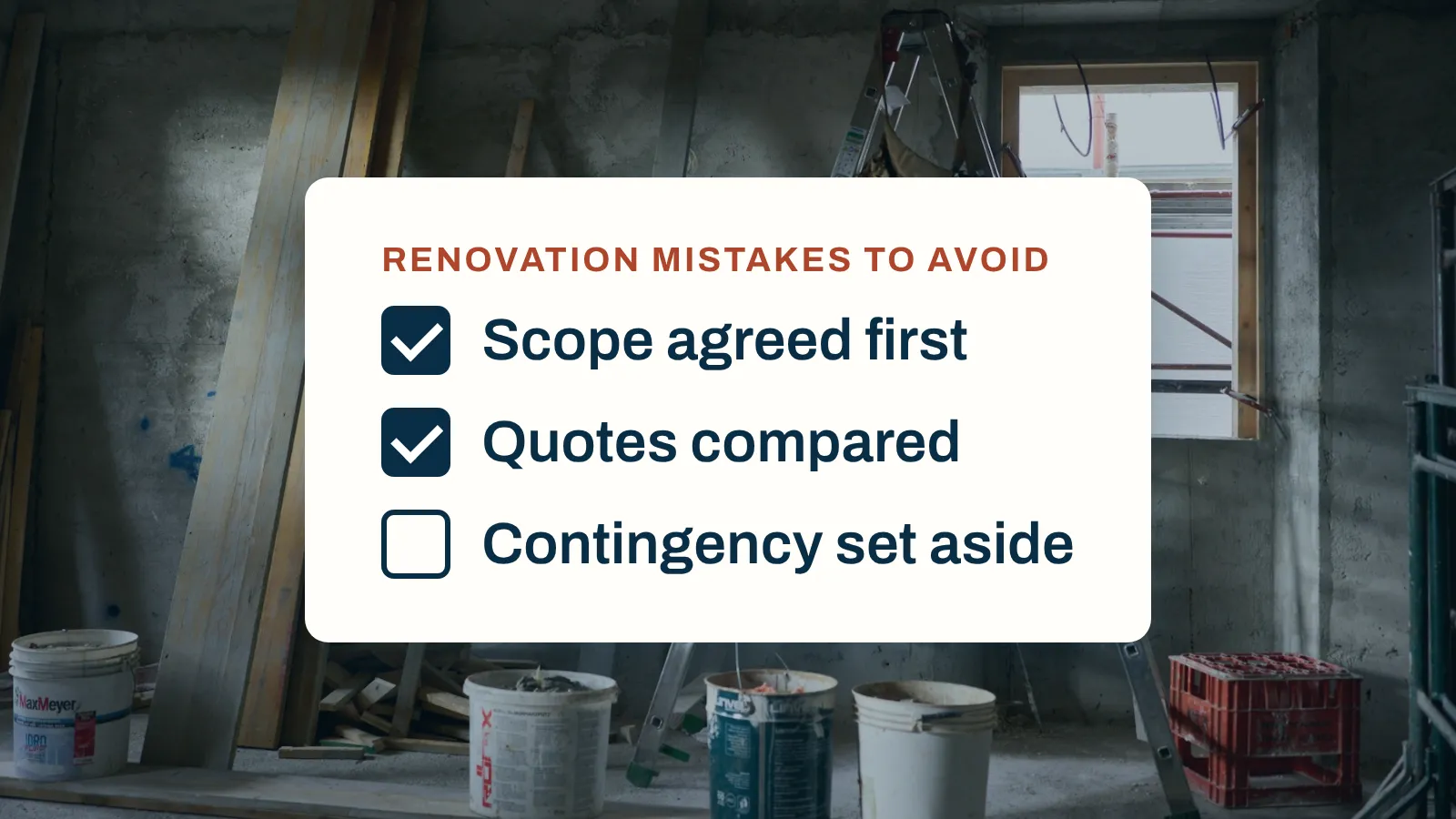
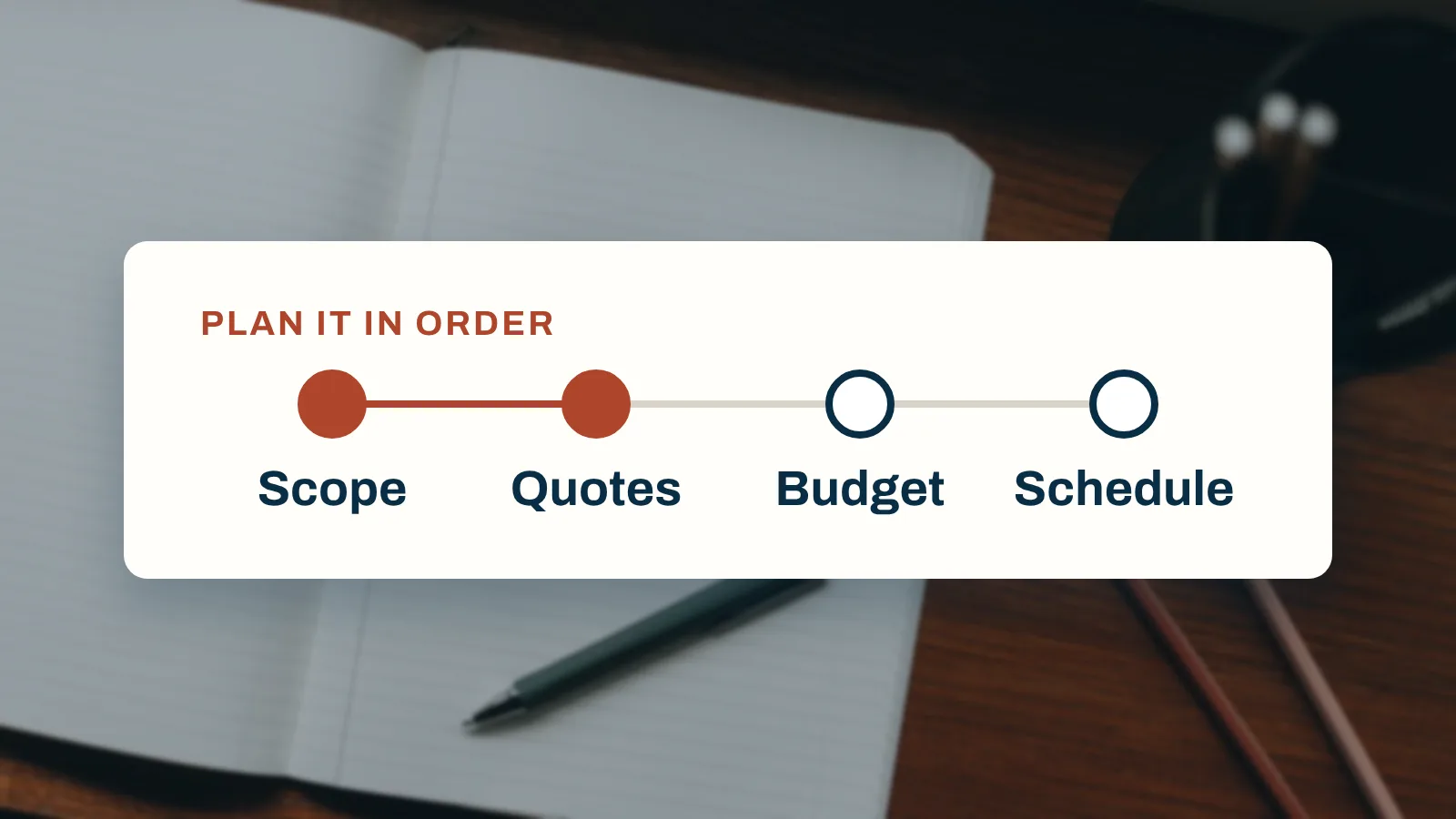
The most expensive renovation mistakes are made before anyone picks up a tool: starting without a written scope, budgeting only for the builder's quote and leaving no real contingency. The others follow from those three, from comparing quotes by their totals and paying too much up front to skipping building control, doing the work in the wrong order and paying in full before the snags are fixed.
Most come down to a decision made without the full picture in writing. Below are twelve mistakes, what each typically costs or causes, the fix, and a short checklist.
The twelve mistakes at a glance
| Mistake | What it typically causes | The fix |
|---|
| 1. No written scope or contract | Quotes for different jobs, disputes over what was agreed | Write a numbered scope and agree it in writing |
|---|
| 2. Budgeting for the quote only | Fees, skips and living costs arriving on top | Budget the whole project, not just the build |
|---|
| 3. No real contingency | No room left when something is found | Hold back 10% to 20% or more, and protect it |
|---|
| 4. Comparing totals, not scopes | Choosing the quote that left the most out | Compare item by item, and price the gaps |
|---|
| 5. Choosing on price alone | Poor work that has to be put right | Check experience, references and insurance |
|---|
| 6. Paying too much up front | Money at risk if the trader does not finish | Small deposit, stage payments, hold back 5% |
|---|
| 7. Skipping permissions | Being made to put work right or undo it | Check planning and building control first |
|---|
| 8. Forgetting party wall notices | Delay and a formal dispute process | Serve notice two months to a year before |
|---|
| 9. Wrong order of works | Paying for the same job twice | Hidden and structural work before finishes |
|---|
| 10. Changing your mind mid-job | Extras, delays and rushed substitutions | Decide before work starts, price every change |
|---|
| 11. No records or certificates | Problems when you sell or need to claim | Keep every certificate and receipt with the job |
|---|
| 12. Paying in full before snagging | Losing your leverage to get faults fixed | Snag first, then make the final payment |
|---|
Mistake 1: starting without a written scope or contract
A builder can only price what you describe. If the description lives in a few conversations, every builder prices a slightly different job, and arguments start later over what was "included".
What it causes: quotes that cannot be compared, extras that feel like surprises, and no record of what was promised. Citizens Advice points out that once you say yes to a quote it is a binding agreement whether it is written down or not, but that having it in writing is what lets you check and prove what was agreed if there is a dispute.
The fix: write a clear, detailed description of exactly what you want done before you meet any builders, as Citizens Advice suggests, and turn it into a numbered list of items. Our guide to writing a scope of works shows how. Then get a written contract covering start and finish dates, materials, tidying up, subcontractors and how and when you will pay. The Federation of Master Builders (FMB) adds that the contract should say what is excluded as well as what is included.
Mistake 2: budgeting for the builder's quote and nothing else
The builder's quote is usually the biggest number, but rarely the only one.
What it causes: a budget that looks fine until the costs around the build arrive. The FMB lists planning or building control fees, surveys, structural engineer fees, skip hire, waste removal, decoration and, if you need them, temporary accommodation or storage among the costs people often forget. Checkatrade adds scaffolding and the "while we're here" jobs that creep in once work is under way.
The fix: budget the whole project, line by line, including fees, VAT where it applies, waste, decoration and where you will live while the messiest work is done. Mark anything you have not priced yet as unpriced, not as zero, so the gap stays visible. Our home renovation checklist lists what to include.
Mistake 3: no real contingency, or one that pays for upgrades
Some problems only appear once walls, floors and roofs are opened. A contingency is the money that stops one of them derailing the job.
What it causes: with no reserve, a single hidden problem, such as rotten timber, damp or old wiring, means cutting something else or stopping work. The FMB notes these are more likely in older homes.
The fix: the FMB suggests setting aside at least 10% of the total project cost, and 15% or more for older homes or structural alterations; its renovation checklist gives a range of 10% to 20%. Checkatrade suggests 20% to 25% as a planning buffer, particularly for older properties. Treat those as starting points, then size the contingency from the real unknowns in your own house. Keep it for genuine surprises, not optional upgrades, which the FMB also warns against. Our guide to how much contingency to allow shows how to size it and track what is left.
Mistake 4: comparing totals, not scopes
Three quotes with three totals look easy to compare. They usually are not.
What it causes: choosing the quote that looks cheapest because it leaves the most out. Citizens Advice warns that a price a lot lower than other quotes could mean the trader is not quoting for exactly the same work, and the FMB warns that vague allowances for items such as kitchens or tiles can quickly lead to overspending.
The fix: get written quotes from at least three traders, as Citizens Advice suggests, all pricing the same numbered scope. Line them up item by item, price every exclusion and compare the adjusted totals. Ask each builder what assumptions they have made, as the FMB recommends. Our guide to what a good builder's quote includes has a template to send out and a worked comparison.
Mistake 5: choosing a builder on price alone
What it causes: work that has to be put right, delays, and a builder who is hard to reach once there is a problem. RICS advises against automatically accepting the cheapest quote, and the FMB says to choose a builder by experience and trustworthiness instead of price alone.
The fix: before you choose, Citizens Advice suggests asking for two or three recent examples of similar work and contacting the people the work was done for, because written references are not always genuine. Check the trader's insurance and that it will not run out before the job finishes. For gas work you must use a Gas Safe registered engineer, and for electrical work Citizens Advice says to use a properly qualified or registered electrician. Our guide to how to find a good builder covers the checks in order.
Mistake 6: paying too much up front
What it causes: money you may not get back if the trader stops turning up, and nothing left to hold back if the work is poor.
The fix: Citizens Advice says not to agree to pay everything up front, to push any deposit down as far as possible and not to agree to more than 25%. If the deposit is for materials, it suggests offering to buy them yourself so at least you own them. The FMB says a small deposit, often up to around 10%, is common, with most of the total paid in stages linked to completed work. Citizens Advice also suggests paying by card or bank transfer, not cash. RICS suggests holding back 5% to be released on satisfactory completion. Our guide to how to pay a contractor shows how to tie each payment to a stage you can check.
Mistake 7: skipping planning permission or building control
This is the mistake that can mean paying for the same work twice, once to do it and again to undo it.
What it causes: Citizens Advice says that if you do not get the permission or approval you need, you might be fined, prosecuted, made to put things right or undo the work, and have problems when selling your home. GOV.UK adds that the building control body could make you pay to fix faulty work, and that without approval you will not have the certificates of compliance you may need when you sell. RICS warns that going ahead without planning permission could mean an enforcement notice, which could force you to demolish the work.
The fix: check before the design is final. GOV.UK says building regulations approval may be needed for many alterations, including replacing fuse boxes, installing a bathroom with plumbing, replacing windows and doors or a heating system, and that it is separate from planning permission: you might need both. For electrical work in England and Wales, Electrical Safety First says you must either tell building control before the work starts or use an electrician registered with a government-approved scheme. If you are unsure, ask your building control body or a qualified professional before work begins.
Mistake 8: forgetting party wall notices
What it causes: delay, and a formal process you cannot skip. In England and Wales, GOV.UK says you must tell your neighbour if you want to build on or at the boundary, work on an existing party wall, or dig below and near the foundation level of their property. Examples include cutting into a party wall or removing chimneys from one.
The fix: GOV.UK says to give notice between two months and a year before you plan to start. Your neighbour must say in writing within 14 days whether they consent, and you cannot assume that no response means they agree: no response starts the dispute resolution process, where surveyors agree a party wall award setting out the work and who pays, including surveyors' fees. Build that time into the programme, and ask a party wall surveyor if you are unsure.
Mistake 9: doing the work in the wrong order
What it causes: paying for the same job twice. Checkatrade gives the classic example: decorating a room beautifully, then discovering new electrical cables need to be chased through the freshly finished walls. The FMB makes the same point: there is no point plastering a wall if you still need to rewire the house or fix a leaking roof.
The fix: the FMB suggests this order for most house renovations:
- Structural repairs and stabilisation
- Roof, windows and weatherproofing
- Plumbing, heating and electrics
- Insulation and ventilation improvements
- Layout changes and wall removals
- Kitchens and bathrooms
- Plastering, flooring and decorating
- Final fittings and finishing touches
Your project may differ, but the rule holds: hidden, disruptive work comes before the finishes you will see. Checkatrade suggests asking your builder for a written schedule of works before the renovation starts, and anything that will be hidden, such as pipework, should be tested before it is covered.
Mistake 10: changing your mind once work has started
What it causes: extras, delays and knock-on costs. RICS says changes made after work starts are usually very expensive. The FMB names late decision-making as one of the most common reasons budgets spiral, because delayed choices on kitchens, tiles, flooring and windows can lead to rushed substitutions, delivery delays and unexpected price increases.
The fix: agree decision deadlines with your builder for the big choices, as the FMB suggests, and make them before work starts. RICS recommends agreeing a method for making changes before work begins, including what the time and cost implications will be. When a change is unavoidable, get it priced and agreed in writing before the work goes ahead, and record its effect on the budget straight away. Our guide to variations and extras shows how to log each one.
Mistake 11: keeping no records or certificates
What it causes: problems when you sell, claim on a guarantee or dispute poor work. GOV.UK notes that without building regulations approval you will not have the certificates you may need when you sell, and RICS says that not getting a completion certificate from building control could cause problems if you want to sell or insure the property. If something goes wrong, Citizens Advice suggests gathering paperwork and receipts, taking photos and noting dates before you raise it with the trader.
The fix: before sign-off, the FMB's checklist says to check certificates and approvals and keep all paperwork, receipts and warranties together. Electrical Safety First says a registered electrician should give you an Electrical Installation Certificate or Minor Works Certificate and a Building Regulations Compliance Certificate. Keep each document, and any written guarantee, with the job or purchase it belongs to, so you can find it years later.
Mistake 12: paying in full before snagging
What it causes: losing your strongest reason for the trader to come back. Citizens Advice says paying in stages is a good idea because problems can be put right before you make the final payment.
The fix: walk through the finished work with a written snagging list before the final payment, and agree with the trader in writing how and when each item will be fixed. Under the Consumer Rights Act 2015, Citizens Advice explains, a trader must carry out the work with reasonable care and skill, and if they have not, you can ask them to put it right. Hold back the retention RICS suggests until the list is cleared. Our snagging list guide shows what to check, room by room.
Renovation mistakes checklist
Before work starts:
- A numbered, written scope, priced by every builder in the same layout
- A whole-project budget, including fees, waste, VAT and living costs
- Unpriced items marked as unpriced, not left at zero
- A contingency sized from your own risks, kept for genuine surprises
- Quotes compared item by item, with exclusions priced
- References, insurance and registrations checked
- A written contract with stage payments, a small deposit and a retention
- Planning permission and building regulations approval checked
- Party wall notices served, if the work needs them
- A written schedule of works, in the right order
- Decision deadlines for kitchens, tiles, flooring and windows
- A method for pricing and agreeing changes in writing
Before the final payment:
- Snagging list walked through and agreed
- Certificates, approvals, guarantees and receipts collected and filed
Your next step
Write down the scope and the whole budget before you ask for a single quote, then compare what comes back item by item. Mekozo lines builders' quotes up side by side with what each includes and excludes, lets you set the contingency as a percentage or a fixed amount, and keeps receipts, certificates and warranties attached to the job or purchase they belong to, with search across everything when you need one later. For the wider plan, see our home renovation checklist.
This guide explains common renovation mistakes and ways to plan around them. It is not legal, survey or financial advice; for permissions, party walls, contracts or disputes, ask your building control body, a qualified surveyor, Citizens Advice or another qualified adviser.