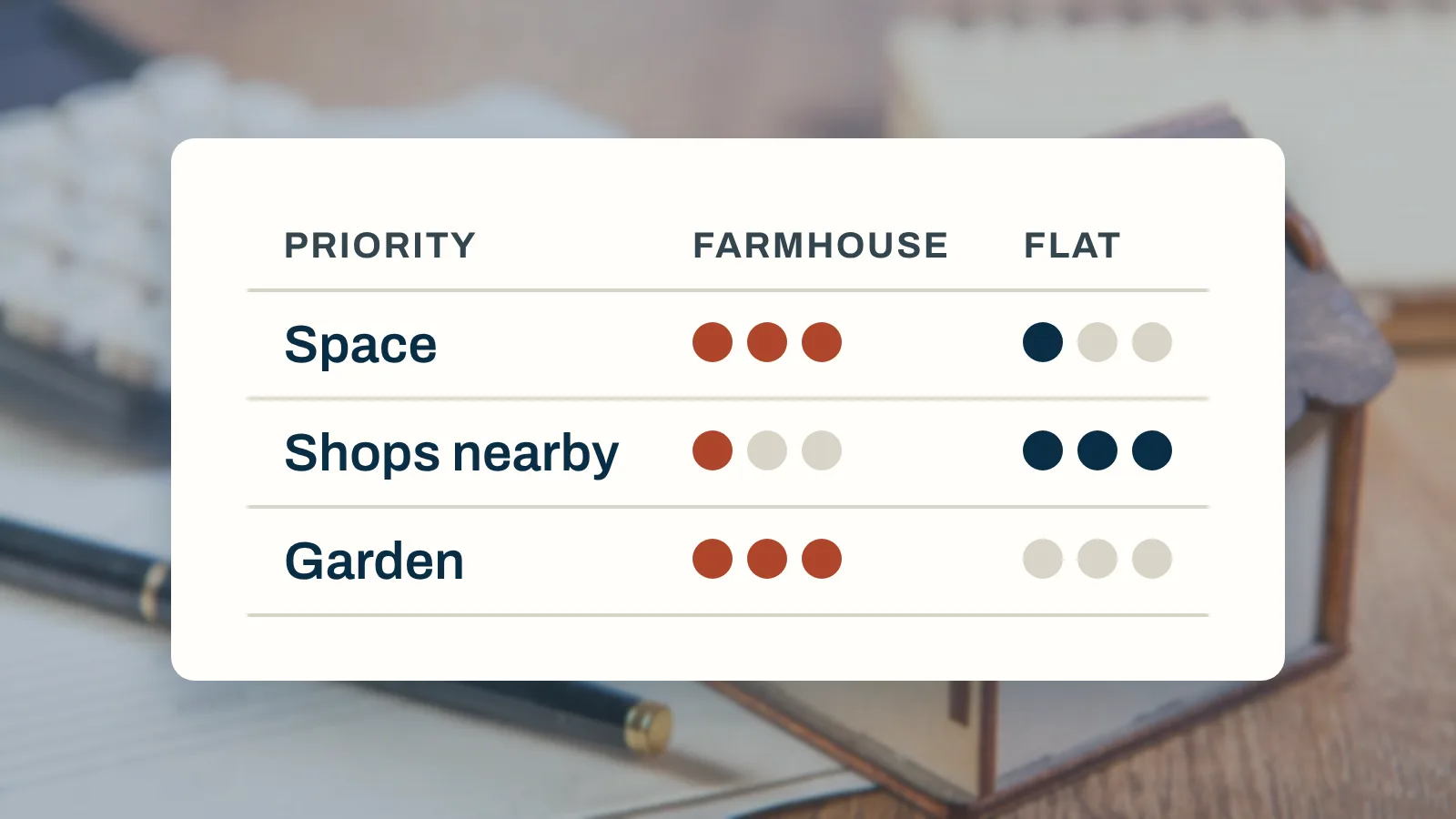
Compare houses against one written wish list, scoring every house the same way, rather than from memory.
Put the full cost beside each house: the price, the buying costs, the work it needs and what it costs to run.
Mark anything you do not know as unknown, never as zero.
Write one sentence on the biggest compromise each house asks of you; that is usually where the real decision sits.
Do not rewrite your wish list to fit a favourite house after a viewing.
To compare houses you have viewed, score each one against the same written wish list, then put the full cost beside it: the price, the buying costs, the work it needs and the running costs. Mark anything you do not know as unknown, never as zero. Then write one sentence on the biggest compromise each house asks of you.
That sentence is usually where the real decision sits.
Comparing on price and number of bedrooms alone hides the reasons the choice feels hard. One house has the garden, another is ten minutes closer to the people you see every week, a third needs far less work. A consistent method lets you see those trade-offs plainly.
Why comparing houses from memory goes wrong
After a run of viewings, memory is a poor judge. The last house you saw feels clearer than the first. A sunny afternoon flatters one property, a wet Tuesday spoils another. And a single feature you love, a view or a fireplace, can quietly outweigh three things you need.
A written comparison fixes three common problems:
Moving goalposts. You judge each house against the one before rather than against what you need.
Hidden costs. A cheaper house that needs a new roof can cost more than a dearer one that does not.
Gaps treated as good news. An unanswered question feels like no problem until it is one.
Step 1: write your wish list before you compare
Everything else depends on a short, written list of what you need. Split it in two.
Must-haves: the things that make everyday life work. If a house fails one, it is out. Keep this list short, usually five to eight items.
Nice-to-haves: the things that would make life better but that you could live without or add later.
Our guide to building a house wish list covers how to separate the two, and how to agree them if you are buying with someone else.
Tip
Write must-haves as tests, not wishes. "Two bedrooms of at least double size" is easier to check than "enough space". "Under 30 minutes to work at 8am" is easier to check than "good commute".
Step 2: score every house the same way
Go through your viewing notes for each house and score it against the list.
Must-haves: pass, fail or unknown. A fail drops the house from the shortlist.
Nice-to-haves: a simple score, such as 0 (no), 1 (partly) or 2 (yes).
Optional weighting: if some nice-to-haves matter more, multiply by 1, 2 or 3. Keep it simple; a score that takes an hour to calculate hides more than it shows.
The asking price is only the start. For each house, add:
Cost line
What to include
Price
Asking price, or your likely offer
Buying costs
Tax on the purchase, legal fees, survey, lender fees if borrowing, removals
Work needed
Repairs and changes to make it work for you, even as rough estimates
Running costs
Energy, water, local property tax, service charges, insurance
Living costs during work
Rent or a second home while work happens, if you cannot live there
Buying costs alone can be substantial. In its May 2026 guide, Which? put average conveyancing at £1,421 and a house survey at £462 for first-time buyers, and £2,182 and £510 for home movers. Our full guide to the costs of buying a house lists every line.
In the UK
You can check a property's council tax band in England or Wales with GOV.UK's Council Tax band checker, find its energy rating with Find an energy certificate, and check flood risk in England with the long term flood risk service. Use the same checks for every house on your shortlist so the comparison stays fair.
Watch out
A house that needs work is not cheaper until you know what the work costs. If you are weighing a project, our guide to buying a fixer-upper shows how to price it before you offer.
Step 4: put the houses side by side
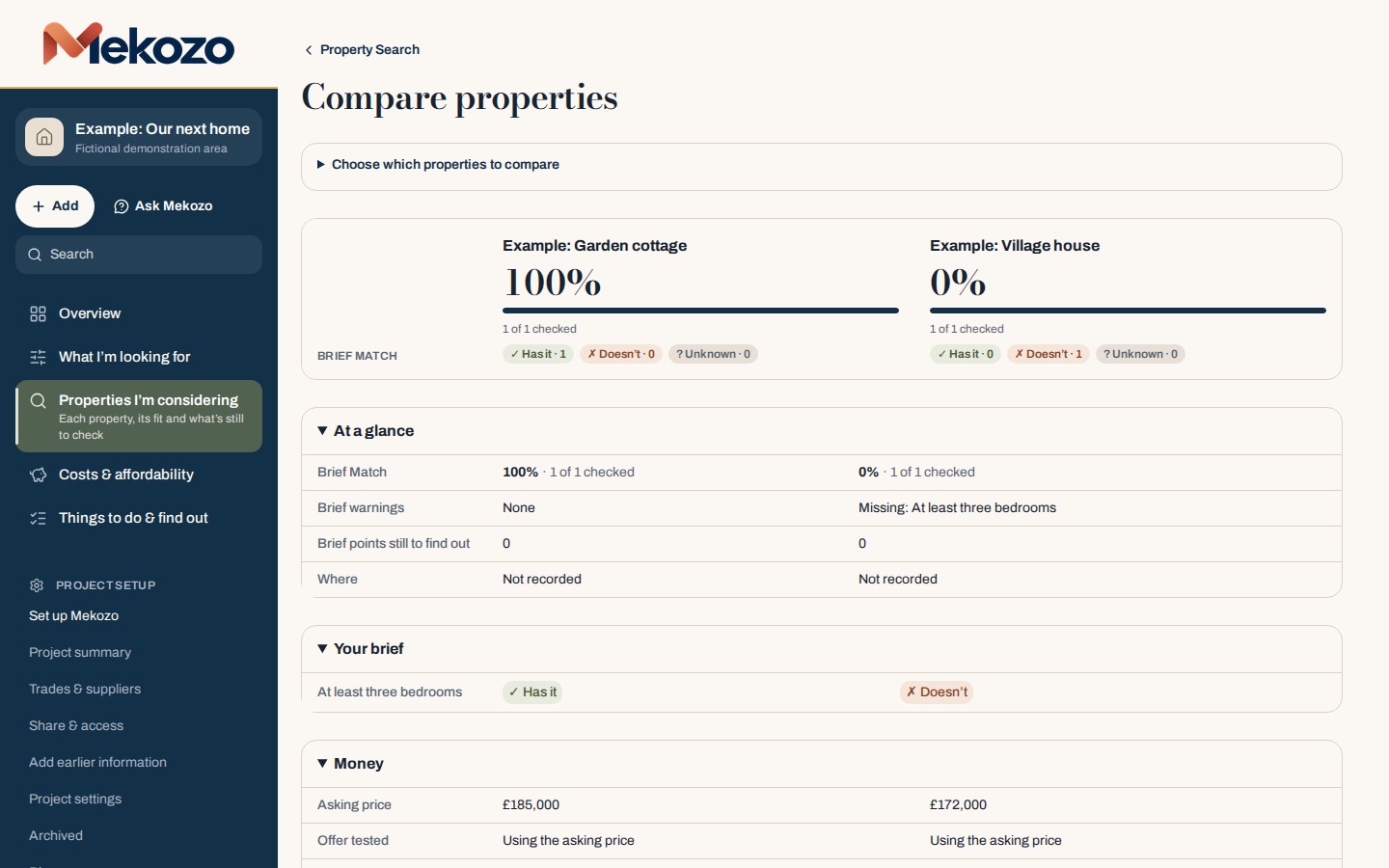
Mekozo compares the homes you are considering side by side against your Property Brief, showing which points each one meets, which it misses, and its price.
Now line them up. A simple comparison looks like this:
House A
House B
House C
Must-haves met
6 of 6
5 of 6 (1 unknown)
6 of 6
Nice-to-have score
7
11
9
Price
£285,000
£270,000
£299,000
Buying costs
Known
Known
Known
Work needed
Small
New kitchen, rewire
Decorating
Yearly running costs
Lower
Higher (older boiler)
Middle
Open questions
1
4
2
Biggest compromise
No garden
Unknown wiring cost
15 minutes further from family
Illustrative figures only.
Look at three things together, not one at a time:
The must-have line. Any "unknown" needs answering before an offer.
The full cost. Price plus everything else, not price alone.
The biggest compromise. This is the line people skip and later regret.
Step 5: test the compromise, not just the score
Scores help, but they do not decide for you. The useful question is: which compromise can you live with for the next five or ten years?
Say it out loud. "We would have no garden." "We would spend our first year on a rewire." "We would be further from your parents." Hearing it plainly helps.
Test it in real life. Drive the commute at rush hour. Walk to the shops. Visit after dark.
Check it with everyone buying. Couples often weigh the same compromise very differently, and it is better to find out now.
Step 6: watch for changing your list to fit a favourite
After a viewing, it is normal to learn something about what you want. A revised list can be a better list. But notice when you are changing a must-have only to justify a house you have fallen for.
A useful check: would you have changed the list if you had not seen this particular house? If not, keep the original rule, or change it on purpose and apply it to every house, not just the favourite.
Comparing houses when you are buying with someone else
Two people can view the same house and come away with different scores. That is useful information, not a problem, as long as you find it before the offer rather than after.
Agree the must-haves together first. If one of you cannot live without a garden and the other without a short commute, both go on the list.
Score separately, then compare. Each of you scores every house on your own. Where your scores differ by a lot, talk about why.
Share one set of notes and costs. Disagreements are much easier to settle when you are looking at the same facts, not two memories.
Name the deal-breakers out loud. A compromise one of you accepts reluctantly tends to come back later.
Tip
If you are buying with family, such as helping a parent move or buying a home together with siblings, write down who is deciding what. A shared list avoids the decision drifting to whoever went to the most viewings.
Clear the unknowns before you offer
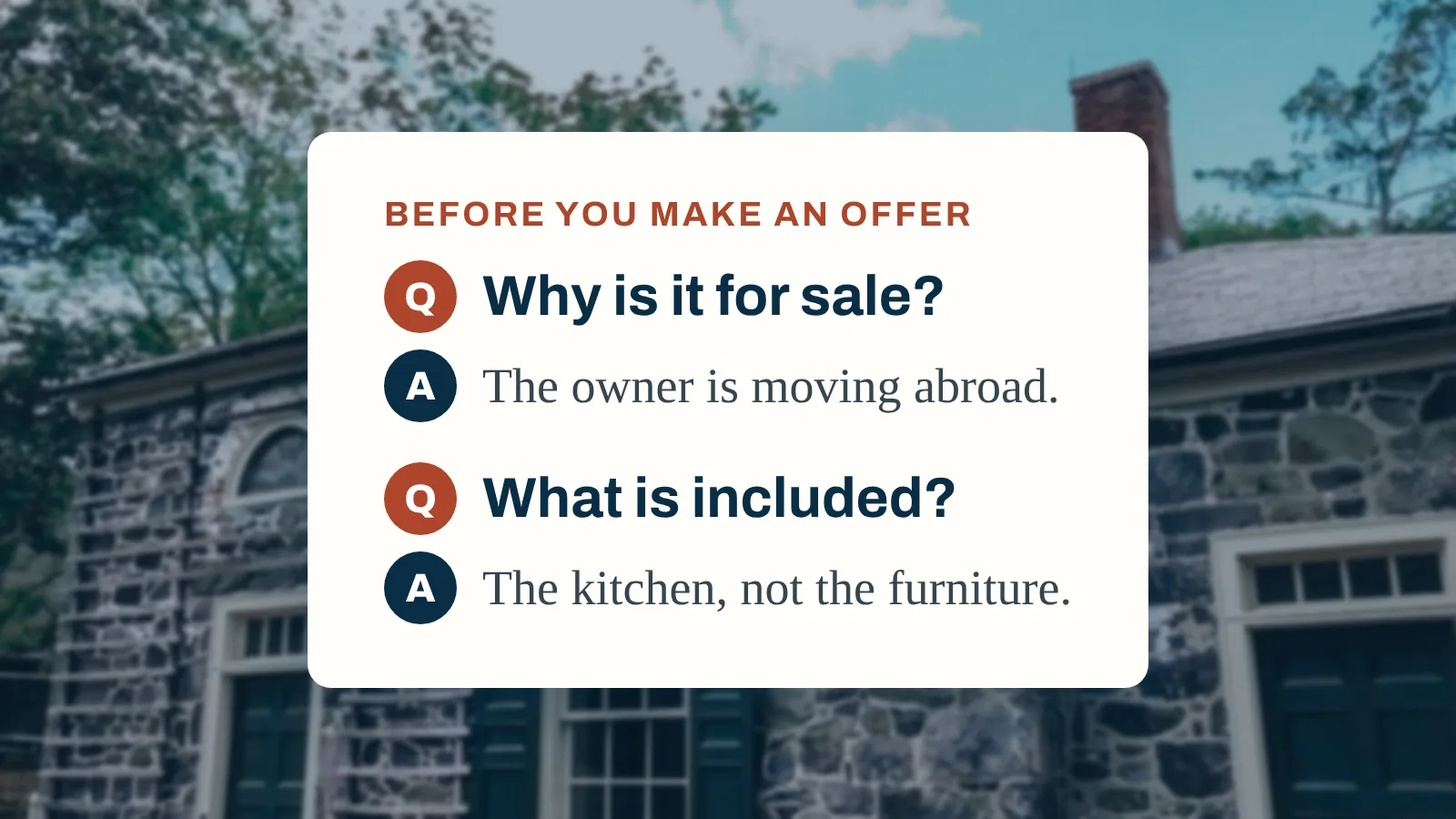
An "unknown" on your shortlist is a question with a deadline. Before you offer on a house, try to turn each one into a fact:
Ask the agent in writing for anything the seller should know, such as the age of the boiler or past work.
Book a second viewing to check what you could not judge the first time.
Get rough prices for any work you would need, so the full cost line is filled in.
Note what only a survey can answer, and plan to book one once your offer is accepted.
If a must-have is still unknown when you are ready to offer, decide whether you are comfortable offering subject to finding out, or whether to wait.
Spreadsheet or app?
A house comparison spreadsheet works well if you keep it up to date and use the same columns for every property. It gets harder when you are buying with someone else, when costs change after a survey, or when the notes, photos and questions for each house live somewhere else. Whatever you use, the method is the same: one wish list, one full cost, one compromise per house. Our guide to choosing a house hunting app or spreadsheet compares the two honestly.
On the Operation Sicily villa
From the villa in Sicily. Before buying his villa, Jonathan Smith, Mekozo's founder, who films his villa renovation on Operation Sicily, wrote his criteria down: a detached house with a garden, at least two bedrooms, in a quiet spot near the sea, for under €100,000, that had been on the market a while and needed a complete renovation, with the potential to add value (Episode 8). Over three months and 50 viewings, those criteria were the constant. He walked away from two deals when the documents and plans revealed problems the rooms did not. The villa he chose, in the Trapani province, met the brief, came in under budget and under market value, and had a walled garden for privacy. A fixed list is what made 50 viewings comparable.
This guide explains a method for comparing homes. It is not survey, legal or financial advice; use a qualified surveyor and a solicitor or conveyancer before you commit to a purchase.
Questions people ask
How do you compare two houses?
Score both against the same written wish list, split into must-haves and nice-to-haves, and add the full cost of each: price, buying costs, work needed and running costs. Then write one sentence on the biggest compromise each house asks of you. The house with the better score and a compromise you can live with is usually the stronger choice.
What should I include in a house comparison spreadsheet?
Include one row per house with the asking price, buying costs, estimated work, yearly running costs, a column for each must-have and nice-to-have, and a column for open questions. Keep unknowns marked as unknown rather than zero, so a gap never makes a house look cheaper than it is.
Should I weight my priorities when comparing houses?
Weighting helps when you have several nice-to-haves that matter by different amounts. Keep must-haves as pass or fail, and give nice-to-haves a simple weight such as 1 to 3. Avoid weighting so finely that the score hides the real trade-off.
What if I love a house that scores lower?
Write down exactly what you love about it and check whether it is on your wish list. If it is not, decide whether your list was missing something or whether the feeling is covering a compromise. Changing a must-have to fit a favourite is a decision worth making deliberately, not by accident.
How many houses should I compare at once?
A shortlist of two to four is usually enough to compare in detail. Drop any house that fails a must-have, then compare the rest side by side on score, full cost and open questions.
Jonathan Smith is the founder of Mekozo and Operation Sicily. Jonathan bought an abandoned villa in Sicily and is rebuilding it on camera, every week. Mekozo is the app Jonathan built to keep that renovation's money in one picture.
A plain guide to the steps and cost headings of buying a house in Spain, with the official Spanish sources to check each one, so you can plan the whole purchase before you commit.
Every step of a house hunt in order, from setting the whole-project budget and writing a wish list to viewings, comparisons and the checks to make before you offer, as one checklist you can work through.
The questions that matter across the whole purchase, from the first viewing to the binding contract, grouped by who can answer them, with a checklist you can reuse for every house.