Renovation schedule: plan the order of works, step by step
A renovation schedule is more than a list of dates. How to build one from the jobs, their dependencies, lead times and decision dates, and how to keep it on track when something slips.
A renovation schedule lists every job in order, with how long it takes, what it depends on, who does it and when the materials and decisions are needed.
Build it backwards from dependencies: services before plaster, plaster before floors and kitchens, and anything with a long lead time ordered early.
Add decision dates for you, not just work dates for the trades; late choices are one of the commonest causes of delay.
Hold buffers for drying times, inspections, deliveries and the weather, and keep notice periods for neighbours and approvals in the plan.
Review the schedule every week against what has actually happened, and agree any change to the dates in writing.
How do you plan a renovation schedule?
Plan a renovation schedule in six steps: list every job room by room, work out what each job depends on, put them in order, give each a duration and an owner, add order dates for long lead items and decision dates for you, then hold buffers for drying, inspections and deliveries. Review it every week against what has actually happened.
A schedule is not a promise that nothing will slip. It is a way of seeing, early, what a slip will knock on to. When the plasterer is a week late, the schedule tells you whether the kitchen fitters need moving, and whether the tiles should be delivered later. This guide shows how to build one and keep it useful. For the full order of works on a whole house, see our guide to a full house renovation.
What goes into a renovation schedule
Each line in a schedule answers six questions.
Column
Question it answers
Example
Job
What is being done, and where?
Bathroom: first fix plumbing
Depends on
What must be finished first?
Floor up; layout agreed
Who
Which trade or person?
Plumber
Duration
How long, in working days?
3 days
Materials and lead time
What must be on site, and when must it be ordered?
Shower valve: order 2 weeks ahead
Decision needed
What do you have to decide, and by when?
Shower position: by 1 March
Add start and finish dates once the order is set, and a status column for when work begins.
Step 1: list every job, room by room
Start from your scope of works. Go room by room and write every job, including the small ones that are easy to forget: removing radiators before plastering, boxing in pipes, fitting door linings, sealing round the bath. Then add the whole-house jobs, such as the rewire, heating and roof. Our guide to writing a scope of works is a good starting list.
Tip
Split big jobs into the visits the trade will actually make. An electrician usually comes at least twice: first fix while walls are open, second fix after plastering. Each visit is its own line.
Step 2: work out what depends on what
This is the heart of the schedule. Most delays come from a job that cannot start because something before it is not finished.
The general pattern for most renovations:
Structure and weather: structural repairs, roof, and windows or temporary boarding.
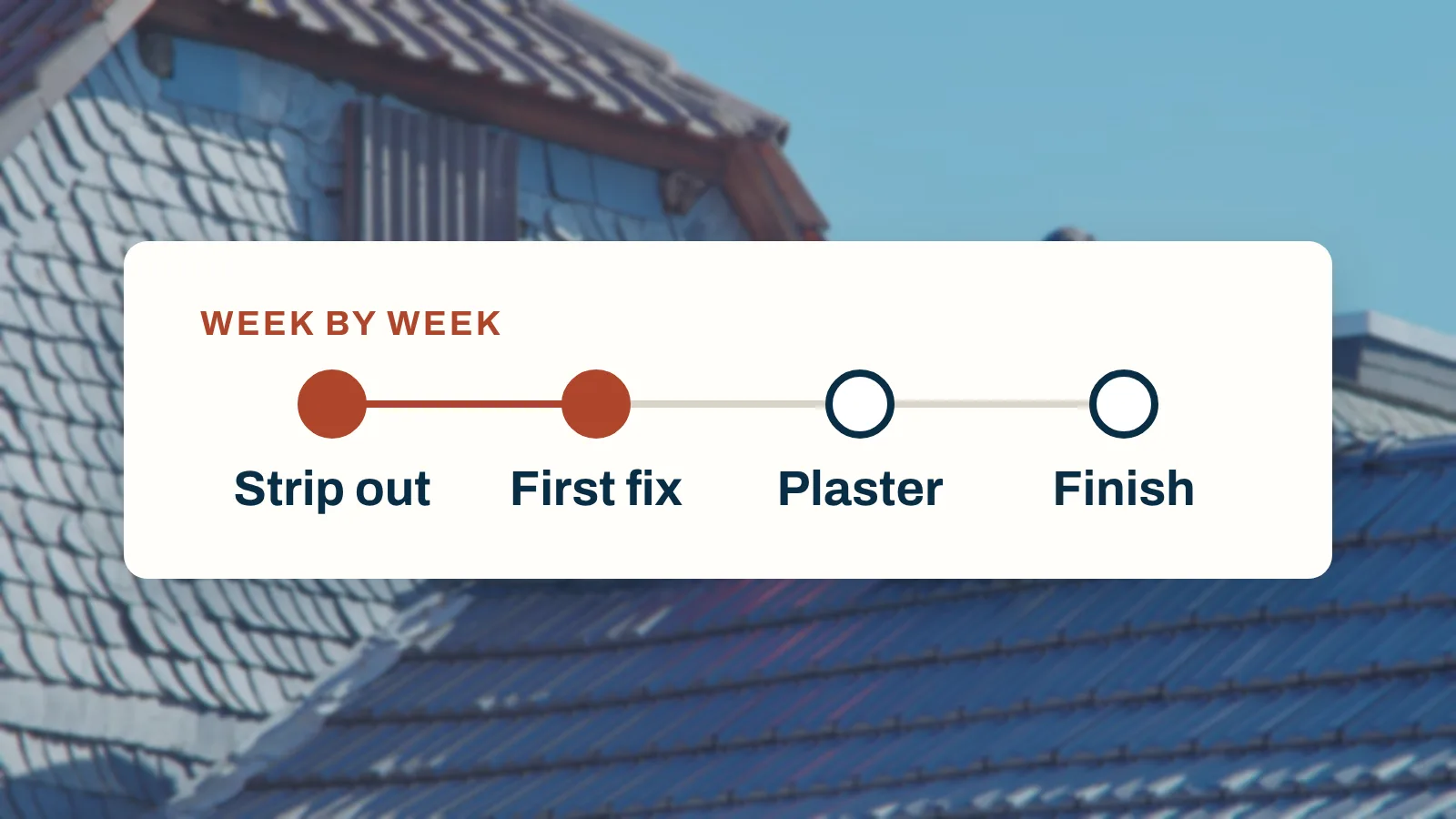
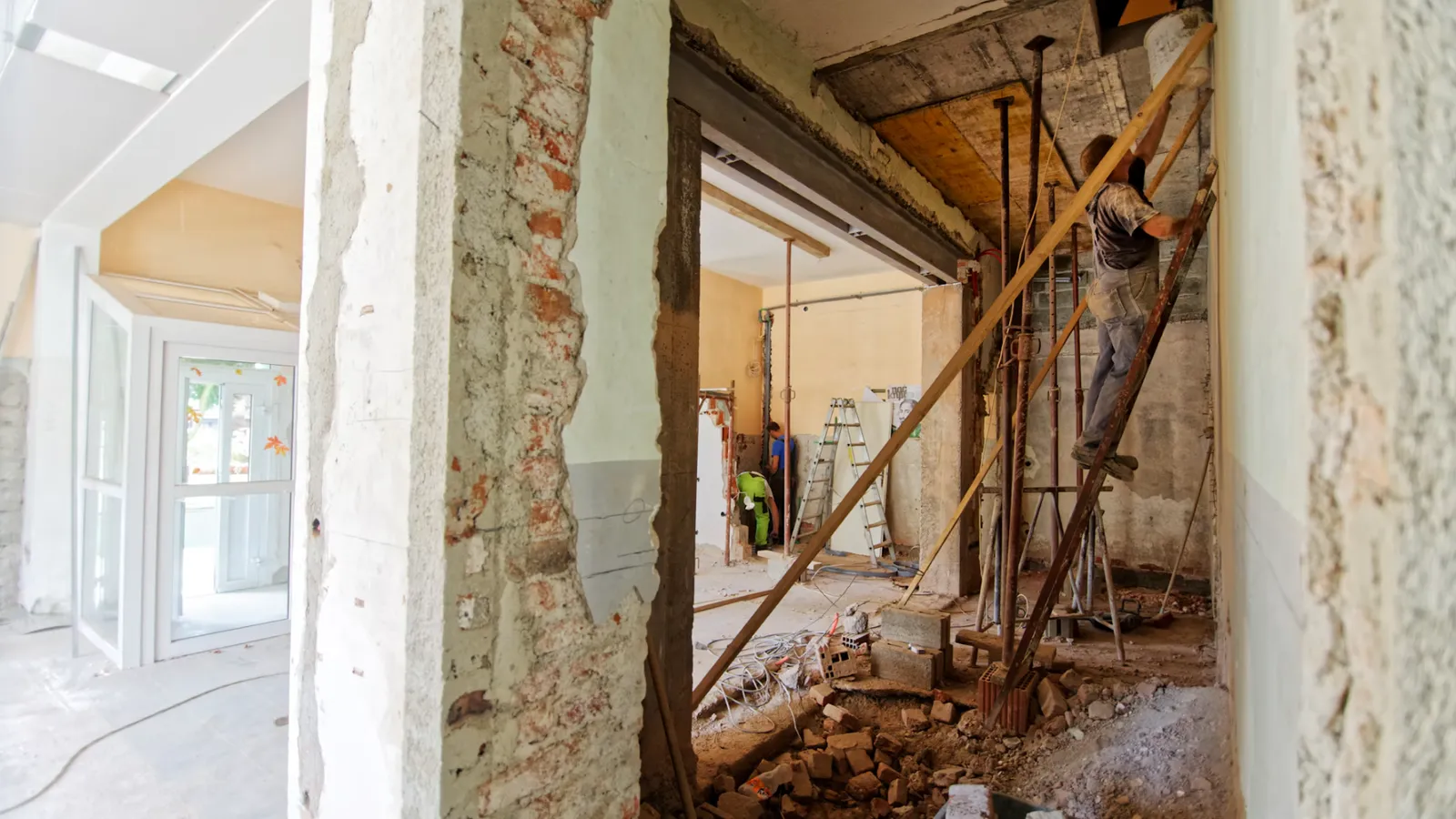
Strip out and first fix: old fittings removed; new cables, pipes, heating and drains run while walls and floors are open.
Inspections: any building control or other checks needed before the work is covered.
Plaster and screed: walls and floors closed, then left to dry.
Second fix: sockets, switches, radiators, sanitaryware connected.
Kitchens, bathrooms and flooring: fitted once the rooms are dry and finished.
Decoration: last, once the dust has stopped.
Some jobs can overlap in different rooms; others must wait for drying, testing or inspection.
Watch out
The most expensive schedule mistake is closing a wall too early. Once plaster or tiles go on, any cable, pipe or bracket you forgot means opening it up again.
Step 3: add durations, owners and buffers
Ask each trade how long their part will take and write it in working days. Then add the time between jobs that nobody is paid for, but which the schedule still needs:
Drying times for plaster, screed and some adhesives.
Inspections, which have to be booked and may not happen the day you want.
Deliveries, which arrive on a day, not an hour.
Weather, for any outside work.
Holidays and trade availability, including your own.
In the UK
The Health and Safety Executive says homeowners can help keep a job safe by allowing sufficient time and money in the agreed contract for the work to be carried out safely. A schedule with no slack pushes trades to rush.
Step 4: add lead times and notice periods
Some things have to be started long before the work that needs them.
Item
Why it needs planning early
Made to measure windows and doors
Measured, made and delivered before fitting
Kitchens
Designed, ordered and made, often months ahead
Bathroom fittings, tiles and flooring
Stock runs out; batches should match
Skips, scaffolding and parking permits
Booked ahead, sometimes with council approval
Approvals and inspections
Applications take time to process
Neighbours' notice
Some work needs formal notice before it starts
In the UK (England and Wales)
Under the Party Wall etc Act 1996, the government's explanatory booklet says work to a party wall needs two months' notice, and excavating near a neighbour's property or building on the line of junction needs one month's notice. If your job is covered, those weeks belong at the start of the schedule.
Step 5: add your decision dates
Builders often wait on homeowners more than homeowners realise. A tile not chosen, a socket position not confirmed or a kitchen layout still changing can stop a trade on site.
For every choice the work depends on, write a "decide by" date in the schedule, well before the job that needs it:
Layout of kitchen and bathroom: before first fix
Socket, switch and light positions: before electrical first fix
Radiator positions and sizes: before heating first fix
Tiles, flooring and sanitaryware: before their lead time starts
Paint colours: before decorators are booked
Door handles, worktops, taps: before second fix and fitting
Tip
Keep a separate list of open questions and decisions, with who needs to answer and by when. Questions left in a message thread are how a two-day decision turns into a two-week delay.
Step 6: track it every week
Mekozo's Costs & spending view shows the renovation's costs by room or by piece of work, with what is paid and still to pay, so each stage of the schedule has its money beside it.
A schedule only helps if it is kept up to date. Once a week, ideally on site with the builder:
Mark what is finished, checked by you, not just reported.
Mark what is underway, and whether it will finish on time.
Look two weeks ahead: deliveries due, trades booked, decisions needed.
Move dates honestly. If one job slips, move everything that depends on it, not just that one line.
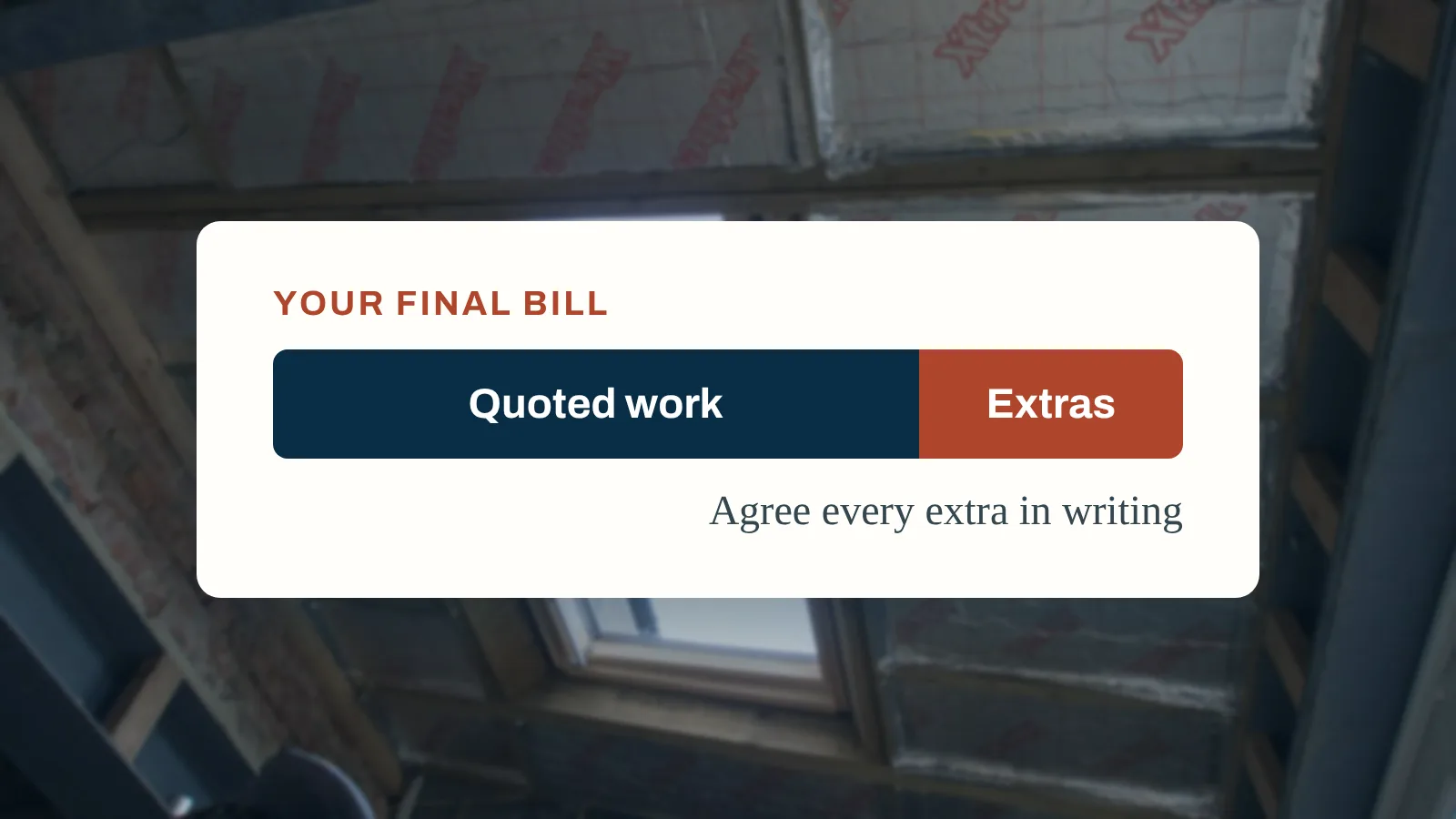
Agree changes to dates in writing, in the same message as any change to the work or price.
Linking the schedule to payments keeps both honest: a stage payment falls due when that stage is finished, not when the calendar says. Our guide to paying a contractor covers how to set those stages.
When the schedule slips
Something will slip. What matters is spotting it early and deciding what to do.
Find the cause: a hidden problem, a late decision, a delivery, a trade, the weather.
Find the knock-on: which later jobs and deliveries move with it.
Decide the response: wait, reorder the work, bring in extra help, or change the scope.
Record it: a slip caused by a change you asked for should be on the change record as a variation or extra (change order) agreed in writing; our guide to variations and extras shows what to record.
In the UK (England)
If a trader has not finished on time, Citizens Advice says you have to give them a second chance to finish, unless you made it clear that the work had to be finished by a certain date. It suggests making the new deadline clear and putting it in writing. Its guidance on contracts also suggests agreeing in advance why delays might happen and what the trader will do about them.
A simple renovation schedule, laid out
#
Job
Depends on
Who
Days
Order by
Decide by
Status
1
Strip out bathroom
Skip booked
Builder
2
Layout
Done
2
First fix plumbing
1, layout agreed
Plumber
3
Shower valve
Shower position
Underway
3
First fix electrics
1
Electrician
2
Light positions
Booked
4
Plaster
2, 3
Plasterer
2, then drying
Booked
5
Tiling
4 dry
Tiler
4
Tiles, 3 weeks ahead
Tiles chosen
Not started
6
Second fix and fit-out
5
Plumber, electrician
3
Sanitaryware
Taps
Not started
7
Decorate and snag
6
Decorator, you
3
Paint
Not started
Illustrative example only. Durations depend on your job; ask your trades.
On the Operation Sicily villa
From the villa in Sicily. The villa renovation that Mekozo's founder, Jonathan Smith, films for Operation Sicily shows how much a schedule is shaped by dependencies. Months two to four went on geometra meetings, permits and preparing the site; months four to eight on cutting and filling wall chases for the electrical ducting, all powered by a generator because there was no mains supply yet. Mains electricity came about ten to twelve months in, and plastering about twenty months in, because every first fix job had to be finished first (The real timeline of a Sicilian villa renovation). Lead times mattered too: the kitchen units were ordered and paid for months ahead, with a three month lead time (Episode 92). And plans moved: when the window fitters were delayed because their transport broke down, he stopped tiling and cleaned up ready for them; the bathroom window was left until the wall tiles were finished, with the fitters coming back in a few weeks (Episode 88). His advice is to plan three or four stages ahead, because each decision commits you further into the future than it seems.
This guide explains a planning method. Durations and rules vary by job and country; it is not legal or professional advice.
Questions people ask
How do you make a renovation schedule?
List every job room by room, decide what each job depends on, put them in order, and give each one a duration and an owner. Then add order dates for materials with long lead times, dates by which you must make decisions, and buffers for drying, inspections and deliveries. Review it weekly once work starts.
What should a renovation schedule include?
Each line should show the job and where it is, what must be finished first, who does it, how long it takes in working days, the materials and when they must be ordered, and any decision you need to make and by when. Add start and finish dates once the order is set, and a status column once work begins.
How long does a house renovation take?
It depends on the size of the job, the condition of the house, approvals and how many trades are involved. A single room can take weeks; a whole house can take many months. Build your own estimate from the schedule, with buffers, rather than relying on a typical figure, and ask your builder for their programme.
Why do renovations run late?
The common causes are hidden problems found once work starts, late decisions, materials with long lead times ordered too late, trades not available when the previous job finishes, inspections, drying times and bad weather. A schedule that shows dependencies and lead times makes most of these visible early.
What can I do if my builder is running late?
Talk to them first and agree a revised date in writing. In England, Citizens Advice says you usually have to give the trader a second chance to finish, unless you made it clear the work had to be finished by a certain date; it suggests putting the new deadline in writing.
Jonathan Smith is the founder of Mekozo and Operation Sicily. Jonathan bought an abandoned villa in Sicily and is rebuilding it on camera, every week. Mekozo is the app Jonathan built to keep that renovation's money in one picture.
Changes and extras are where renovation budgets drift. What a variation is, the four kinds of change, a five step way to agree each one before the work, and a change log you can copy.
Renovating a house you cannot visit every day takes a different kind of planning. The local team, written briefs, photo routines, payments and travel costs, with lessons from a villa renovated between the UK and Sicily.
A full house renovation is easier to control as a set of room plans tied together by the whole-house jobs. How to write each room's plan, put the works in the right order and budget it all.